By Zach Kram, 2026-06-11 19:55:00
2026年NBA总决赛在前三场比赛中已经极具观赏性。但它们还称不上载入史册。至少当时还不是。
但这一切在第四场比赛中改变了。
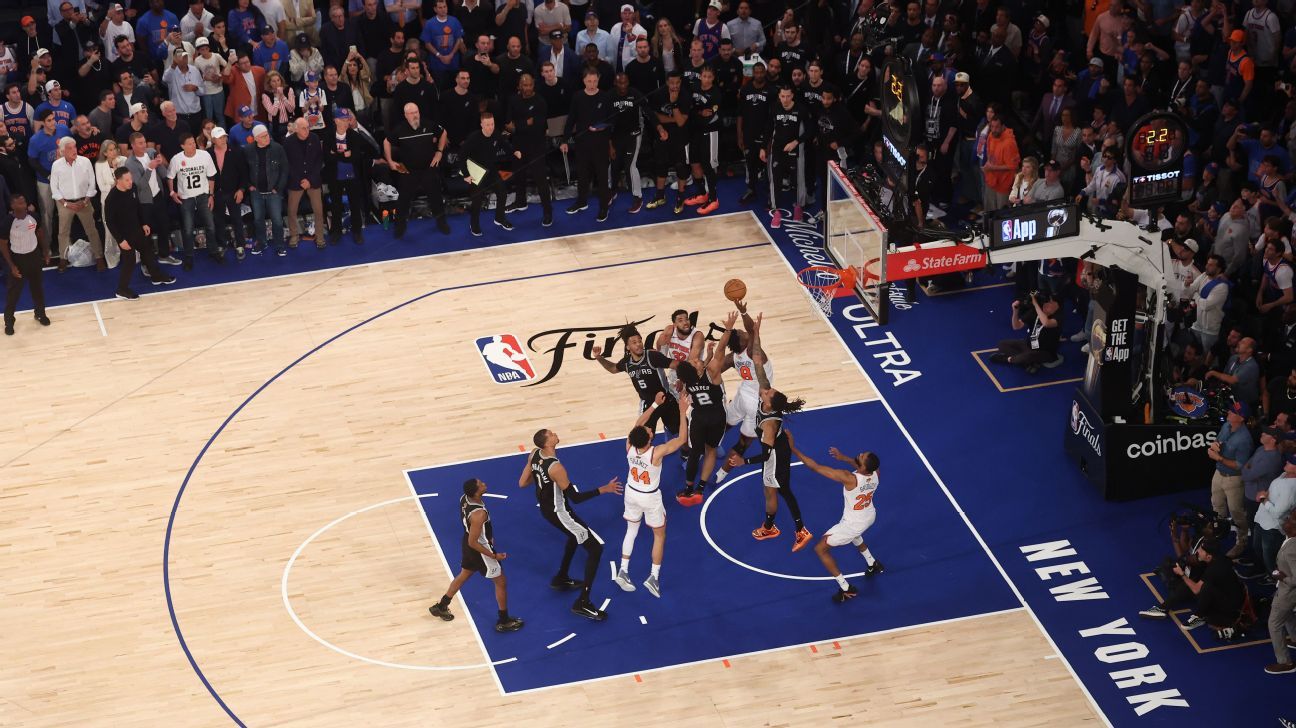
周三,纽约尼克斯在一度落后圣安东尼奥马刺29分的情况下,完成了总决赛历史上最大分差的逆转,最终以107-106险胜。麦迪逊广场花园从未承办过如此震撼的比赛。NBA球迷从未见证过如此疯狂的奇迹。在这项运动的历史上,也从未发生过类似的事情。
在这场概率微乎其微的史诗级胜利之后,尼克斯带着坚定的信念和势不可挡的气势,距离他们53年来的首个总冠军仅一步之遥。他们将有机会于周六(美东时间晚8:30,ABC/ESPN App直播)在圣安东尼奥客场夺冠。
但在此之前,让我们全方位复盘这场精彩绝伦的第四战,探寻尼克斯是如何完成惊天逆转,以及马刺是如何走向崩盘的。
快速链接:
各方反应: 第三战 | 第二战 | 第一战
看点解析 | 赛程 | 对阵图 | 季后赛专题
尼克斯逆转之路深度剖析
以下是第四战上半场发生的一些不可思议的奇特现象:
- 开场仅62秒,卡尔-安东尼·唐斯 (Karl-Anthony Towns) 就领到了两次犯规。
- 阿列尔·胡克波尔蒂 (Ariel Hukporti) 和杰里米·索汉 (Jeremy Sochan) 完成了他们的总决赛首秀。
- 马刺投进的三分球个数,甚至比尼克斯三分球的出手次数还要多。
- 维克托·文班亚马 (Victor Wembanyama) 在上场的21分钟里正负值达到了惊人的+28。
其结果是马刺打出了历史级的开局:根据ESPN Research的数据,他们首节结束时领先19分,创下了总决赛历史上客场球队首节最大领先纪录;半场领先27分同样刷新了该项历史纪录。
但不知疲倦的尼克斯并未因此慌乱。在本届总决赛的前三场比赛中,他们就已经多次克服两位数的落后;在东部决赛首战对阵克利夫兰骑士时,他们曾抹平第四节22分的劣势;而在去年的季后赛中,他们也曾多次在落后波士顿凯尔特人20分以上的情况下完成逆转。
周三第三节初段,在马刺将领先优势扩大到29分之后,尼克斯多点开花,四名不同的球员联手打出一波13-0的高潮缩小分差。随后马刺重新找到得分感觉,但杰伦·布伦森 (Jalen Brunson) 挺身而出,用一次次坚决的回敬球咬住比分。纽约带着15分的落后进入第四节——这依然是个不小的分差,但相比之前几乎被削减了一半,已经变得不再遥不可及。
“让我们在进入第四节时把分差缩小到15到17分左右,只要做到这一点,我们就有机会,”尼克斯主教练迈克·布朗 (Mike Brown) 在半场休息时告诉他的队员们。任务圆满完成。
第四节初段,尼克斯的追分势头一度受阻。在比赛还剩9分33秒时,文班亚马补篮得手,帮助马刺重新建立起20分的领先优势。根据ESPN Analytics的数据,此时圣安东尼奥的胜率高达99.6%,这意味着尼克斯完成逆转的概率仅为250分之一。
但250分之一的希望总好过毫无希望,而这正是纽约所需要的全部契机。在随后的比赛中,多位英雄挺身而出,尼克斯打出了一波32-11的狂潮,硬生生将那250分之一的微茫希望变成了现实。
饱受犯规困扰的唐斯虽然在进攻端参与度不高,但他把握住了仅有的几次机会,包括在第四节中段不到一分钟内连拿5分,帮助尼克斯将分差缩小到个位数。随后,替补后卫何塞·阿尔瓦拉多 (Jose Alvarado)——这也是他整个季后赛期间首次与布伦森同台搭档——在马刺试图重新将分差扩大到两位数的关键时刻,连续砍下5分,稳住了局势。
布伦森在关键时刻同样贡献斐然,他全场25投12中砍下36分,打出了他在总决赛中表现最全面的一场比赛。在第二节马刺下起三分雨时,他单节轰下15分,帮助纽约勉强咬住比分;而在决胜阶段,他更是投中了两个价值连城的关键球:首先是在进攻时间即将耗尽时,迎着文班亚马的防守飙中一记三分……
— KramClips (@ KramClips) June 11, 2026
……紧接着,在进攻时间再次见底的情况下,他顶着斯蒂芬·卡斯尔 (Stephon Castle) 的强力干扰抛投命中,帮助尼克斯实现了本场比赛的首次领先。
— KramClips (@ KramClips) June 11, 2026
但在尼克斯众多的英雄中,最耀眼的莫过于OG·阿奴诺比 (OG·Anunoby),他全场15投10中(三分球9投7中),砍下了季后赛生涯新高的33分。目前他在季后赛中场均可以贡献20.7分,投篮命中率高达58%(三分命中率51%),状态热得发烫。
然而,真正让阿奴诺比从一个深受喜爱的角色球员蜕变为纽约传奇的,并非他百步穿杨的跳投,而是两次拼尽全力的防守与拼抢。
在布伦森抛投命中后,马刺凭借卡斯尔的两记罚球重新夺回领先优势。随后布伦森迎着文班亚马的防守投篮偏出,达龙·福克斯 (De’Aaron Fox) 在比赛还剩12秒时于马刺后场抢下篮板,马刺眼看就要扩大领先。福克斯是NBA速度最快的球员之一,他当时认为自己有足够的时间用擅长的左手完成上篮,将领先优势扩大到3分。
但阿奴诺比全速回防,在没有犯规的情况下干净利落地封盖了福克斯,为纽约赢得了最后一击的机会。
— KramClips (@ KramClips) June 11, 2026
在纽约的最后一次进攻中,文班亚马换防到外线去干扰布伦森的超远三分,而没有留在内线。此时负责发边线球的阿奴诺比眼前出现了一条直通篮下的空切通道。“当球投出去的时候,我身边空无一人,”他在赛后说道,“没有人卡位防我。”
阿奴诺比一路畅通无阻地冲入禁区,伸长右臂,在空中将球轻轻一补,皮球划出一道完美的弧线空心入网。这是尼克斯队史上最重要的一记进球。
— KramClips (@ KramClips) June 11, 2026
这是否有些言过其实、流于一时激动的吹捧?也许吧。尼克斯拥有悠久而骄傲的历史,包括两座总冠军奖杯以及无数令人难忘的经典瞬间——比如阿兰·休斯顿 (Allan Houston) 和帕特里克·尤因 (Patrick Ewing) 的生死战系列赛绝杀,以及拉里·约翰逊 (Larry Johnson) 的“打4分”等等。
但考虑到这一刻的时间节点、比赛的分量以及当时的绝境,在比赛仅剩1.2秒时完成绝杀,并缔造总决赛历史上最伟大的单场逆转,阿奴诺比的这次补篮几乎无可匹敌。正如尼克斯主帅布朗在赛后动情地赞叹道:“这绝对是纽约篮球历史上最具标志性的一投。”
马刺崩盘原因深度剖析
季后赛篮球是一场零和博弈。每一次得分都意味着对手的失分,每一场胜利都伴随着对手的失利,而每一次载入史册的惊天逆转,背后都是另一支球队的历史级崩盘。
对于周三降临在马刺身上的命运,没有比“崩盘”更贴切的词了。在本世纪,圣安东尼奥的球迷也曾经历过其他痛苦的季后赛失利,但那些都是在电光石火间完成的致命一击,凝聚在某一个特定的回合中:比如2004年季后赛中德里克·费舍尔 (Derek Fisher) 的0.4秒反超绝杀,2006年马努·吉诺比利 (Manu Ginobili) 对德克·诺维茨基 (Dirk Nowitzki) 的致命犯规,以及2013年雷·阿伦 (Ray Allen) 投中的那记底角三分。
相反,在第四战中,圣安东尼奥的溃败是在极其煎熬的一个小时里慢慢发生的,29分的领先优势一点点被蚕食、萎缩,直至最终化为乌有。马刺队一直推崇著名的“石匠哲学”——石匠知道,他前100次的锤击或许看不出任何裂纹,但正是这些积累才让第101次的重击最终将巨石劈为两半。然而在周三,马刺自己却成了那块被敲击的巨石,在尼克斯无情铁锤的一次次重击下毫无招架之功,直到阿奴诺比的补篮送出了致命的第101击。
不过,对于造访麦迪逊广场花园的客队来说,第四战的开局并非如此。正如他们在本届季后赛中经常做的那样,马刺在开场阶段展现出了极强的侵略性,迅速建立起巨大的领先优势,并创下了总决赛半场最多三分球命中数(14个)以及客场球队半场最高得分(76分)的两项历史纪录。
然而,上半场狂砍76分的马刺,在下半场却仅仅拿到了30分——根据Elias Sports Bureau的数据,这创下了24秒进攻时限时代以来,季后赛单场比赛下半场得分下滑幅度的最大纪录。
更细化的数据同样惨不忍睹。在下半场,圣安东尼奥的两分球命中率仅为22.7%(22投5中),三分球命中率仅为17.6%(17投3中),整体投篮命中率低至20.5%。他们的失误次数(9次)甚至比运动战进球数(8个)还要多。后卫线上的福克斯、卡斯尔和迪伦·哈珀 (Dylan Harper) 在下半场的个人失误数都超过了各自的命中数(尽管卡斯尔在罚球线上交出了8罚8中的表现)。
“我们偏离了最初帮助我们建立领先优势的篮球风格,”马刺主教练米奇·约翰逊 (Mitch Johnson) 表示,“你可以看到,我们开场时展现出的那种侵略性和坚决,在下半场有些消散了。”
正如约翰逊所言,马刺在下半场不仅是投不进,更是投了太多糟糕的球。根据GeniusIQ的数据,他们下半场的投篮质量创下了本赛季所有比赛下半场的最低纪录——甚至比之前在总决赛第二战下半场创下的新低还要糟糕。
第四战马刺进攻端冰火两重天的半场表现
| 统计数据 | 上半场 | 下半场 |
|---|---|---|
| 两分球命中数/出手数 | 14/21 (67%) | 5/22 (23%) |
| 三分球命中数/出手数 | 14/26 (54%) | 3/17 (18%) |
| 投篮质量 | 51.6% | 45.7% |
| 投篮把握度 | +22.9% | -21.4% |
| 失误次数 | 2 | 9 |
尽管投篮质量不佳,但马刺在下半场投丢这么多球也确实有些运气不佳。不过,他们上半场超常的投篮手感同样伴随着极大的运气成分,因此整场比赛下来,运气因素也算相互抵消了。
文班亚马在决胜阶段同样表现失常。在上半场11投6中之后,他在下半场仅有14投3中。他还投丢了三个罚球——包括在比赛还剩1分47秒、马刺仅领先1分时的两次关键罚球——要知道,他在常规赛的罚球命中率高达83%,季后赛也有86%。
他可能确实太累了,毕竟第三战之后只有一天的休息时间,而且他在第四战中几乎没有得到喘息的机会。他本场出战了44分钟,创下了他职业生涯单场第二高出场时间纪录,仅次于他在西部决赛第一场(那场比赛打到了双加时)中出场的49分钟。在整个下半场,他仅仅休息了58秒。
在周三的比赛中,没有给卢克·科内特 (Luke Kornet) 更多的出场时间来让文班亚马恢复体力——尤其是在马刺还保持大比分领先的时候——是主教练约翰逊的一大决策失误。另一个失误则是他在纽约疯狂追分时显得不愿叫暂停:在第四节,约翰逊在马刺以95-80领先时叫了一次暂停,四分钟后在比分变成99-95时又叫了一次,但在尼克斯将分差蚕食了11分的这段时间里,他没有采取任何调整。
然而,马刺最让人费解的决定并非来自教练席,而是发生在球场上。当时在24秒进攻时限已经关闭的情况下,福克斯选择强行顶着阿奴诺比上篮,而不是将球运到外线消耗时间并迫使尼克斯犯规。
福克斯出手这记不理智投篮时,比赛时间还剩12.0秒——这个时间精确到小数点后,与第二战中文班亚马扔出长传球砸在卡斯尔背上导致马刺输掉比赛的剩余时间完全一致。
这两次失误成为了本届总决赛的决定性瞬间,直接导致了尼克斯的两场1分险胜。在比赛最后阶段慌乱的局势判断,是尼克斯目前大比分3-1领先马刺、而不是马刺领先尼克斯的最直接原因。
展望第五战:细节与边缘因素观察
• 尽管外界的注意力大多集中在唐斯的犯规麻烦上,但卡斯尔在周三的犯规问题同样致命。卡斯尔在第三节初段领到了个人第四次犯规,他的被迫下场直接点燃了纽约人的第一波反扑高潮。在第四节,他又因为在防守布伦森抛投时领到第五次犯规而不得不下场休息。
这已经不是卡斯尔在本届总决赛中第一次陷入犯规泥潭了。尽管他在进攻端的表现时好时坏,但他依然是马刺防守端和组织端至关重要的一环。在接下来的比赛中,他必须在防守动作上表现得更加克制和聪明。
• 马刺阵中为数不多的亮点之一是哈珀,他全场12投8中高效砍下21分,多次冲击内线撕裂纽约的外线防守。尽管和队友们一样,他在决胜阶段未能有所建树,但这位菜鸟后卫的效率、精彩镜头以及整体影响力(他交出了全队最高的+12正负值)都证明了他在队中日益提升的重要性。
• 尼克斯在米切尔·罗宾逊 (Mitchell Robinson) 在场时已经连续第三场净负两位数。罗宾逊在第二战出场14分钟正负值为-10,第三战出场7分钟为-13,而在第四战出场13分钟为-14。在第四战中,由于唐斯过早陷入犯规麻烦,罗宾逊被迫打乱了常规的轮换节奏,并迅速出现疲态。此外,罗宾逊在罚球线上4投0中,马刺成功利用了“砍罗宾逊战术”限制了尼克斯。
无论唐斯能否打满他常规的时间,罗宾逊影响力的下滑对尼克斯来说依然是一个棘手的问题。
• 季后赛的残酷熔炉似乎还吞噬了另一名尼克斯球员:麦尔斯·麦克布莱德 (Miles McBride) 在周三的比赛中4投0中,目前他在总决赛中的投篮命中率仅为20%(20投4中)。在前三轮季后赛中,他每场比赛的出场时间都达到了两位数,但在过去的这两场对决中,他的出场时间都被限制在了个位数。
显而易见,在主帅布朗的后卫轮换顺位中,阿尔瓦拉多已经排在了麦克布莱德之前。
• 最后,一个潜在的裁判判罚隐患将笼罩在接下来的总决赛中:在第四战中,文班亚马因一次无意的肘击打到唐斯面部而领到了一次恶意犯规,这使得他距离自动停赛仅差一次恶意犯规,情况类似于2016年总决赛中的德雷蒙德·格林 (Draymond Green)。
此时此刻,文班亚马不需要在比赛中被驱逐就会面临停赛;任何一次对对手头部的额外肘击都会触发禁赛条款。他现在处于一个非常微妙的境地——尤其是如果尼克斯在接下来的比赛中主动去寻求这种身体接触的话。马刺不希望他因为害怕身体接触而改变自己的打法,但在球队已经退无可退、再输一场就将被淘汰的关头,他们也绝对无法承受失去他的代价。
• 与此相关的是,NBA官方显然也不希望文班亚马的缺阵争议毁掉这轮精彩绝伦的系列赛。在第三战收获了惊人的收视率数据之后,联盟目前正处于兴奋状态,而随着第四战在最后时刻陷入白热化,收视率预计将再创新高。
由生成式 AI 翻译,译文内容可能不准确或不完整,以原文为准。
点击查看原文:NBA Finals Game 4: Anatomy of Knicks' comeback, Spurs' collapse
NBA Finals Game 4: Anatomy of Knicks’ comeback, Spurs’ collapse
The 2026 NBA Finals were highly entertaining through three games. But they weren’t historic. Not yet.
That changed in Game 4.
The New York Knicks fell behind the San Antonio Spurs by 29 points Wednesday before completing the largest comeback in Finals history and emerging with a 107-106 victory. Madison Square Garden had never hosted anything quite like this before. NBA fans had never seen anything quite like this before. There had never, in the sport’s history, been anything quite like this before.
The Knicks are now just one win away from their first title in 53 years, buoyed by belief and indescribable momentum after an extraordinarily improbable win. They’ll have the chance to clinch the championship in San Antonio on Saturday (8:30 p.m. ET, ABC/ESPN App).
But first, let’s break down Game 4 in all its glory, exploring how the Knicks came back and, alternatively, how the Spurs collapsed.
Quick links:
Reaction: Game 3 | Game 2 | Game 1
Takeaways | Schedule | Bracket | Playoffs
Anatomy of a Knicks comeback
Here are some strange things that happened in the first half of Game 4:
- Karl-Anthony Towns picked up two fouls just 62 seconds in.
- Ariel Hukporti and Jeremy Sochan made their Finals debuts.
- The Spurs made more 3-pointers than the Knicks attempted.
- Victor Wembanyama was plus-28 in 21 minutes.
The result was a historic start for the Spurs: Their 19-point lead after the first quarter was the largest for any road team in Finals history, per ESPN Research, and so was their 27-point lead at halftime.
But the indefatigable Knicks, who had already overcome double-digit deficits in the first three games of these Finals, who’d overcome a 22-point fourth-quarter deficit against the Cleveland Cavaliers in Game 1 of the conference finals and who’d overcome multiple 20-point deficits against the Boston Celtics in last year’s playoffs, weren’t fazed.
After the Spurs stretched their lead to 29 early in the third quarter Wednesday, four different Knicks scored during a 13-0 run to close the gap. Then the Spurs started scoring again, but Jalen Brunson matched every basket with one of his own. New York entered the fourth quarter down by 15 points – still a large deficit, but a more manageable one that had been cut almost in half.
“Let’s cut it to around 15 to 17 going into the fourth, and if we do, we’ll give ourselves a chance,” Knicks coach Mike Brown told his team at halftime. Mission accomplished.
The comeback was temporarily halted early in the fourth quarter, and with 9:33 remaining, a Wembanyama putback reestablished the Spurs’ lead at 20 points. At that juncture, San Antonio’s win probability was 99.6%, per ESPN Analytics, meaning the Knicks had a 1-in-250 chance at a comeback.
But 1 in 250 is better odds than 0 in 250, and that was all the opportunity New York needed. Various heroes emerged over the rest of the game, as the Knicks outscored the Spurs 32-11 and fulfilled that 1-in-250 sliver of a chance.
Towns, dogged by foul trouble, barely participated in the offense, but he made his few attempts count, including scoring five points in less than a minute as the Knicks cut the lead to single digits midway through the fourth. Then reserve guard Jose Alvarado – playing with Brunson for the first time all postseason – scored five clutch points in a row, when San Antonio was threatening to boost its lead back to double figures.
Brunson contributed in the clutch as well en route to finishing with 36 points on 12-for-25 shooting, his best all-around game of the Finals. His 15 second-quarter points amid the Spurs’ 3-point barrage helped New York stay within remote striking distance, and he made a pair of massive shots down the stretch: a 3-pointer over Wembanyama with the shot clock winding down …
— KramClips (@ KramClips) June 11, 2026
… followed by a contested floater over Stephon Castle, again with the shot clock near zero, to give the Knicks their first lead of the game.
— KramClips (@ KramClips) June 11, 2026
But the most superlative Knicks hero of them all was OG Anunoby, who finished with a playoff-career-high 33 points on 10-for-15 shooting (7-for-9 on 3s). He’s now averaging 20.7 PPG on 58% shooting (51% on 3s) in the playoffs and riding an extended hot streak.
Yet it was two hustle plays, not his knockdown jumpers, that transformed Anunoby from a beloved role player into a New York legend.
Following Brunson’s floater, the Spurs regained the lead with two Castle free throws, and they were poised to extend it when Brunson missed a shot over Wembanyama, and De’Aaron Fox chased down the rebound near the Spurs’ basket with 12 seconds left. Fox is one of the NBA’s fastest players, and he thought he had time to lay the ball in with his dominant left hand to push the lead to three.
But Anunoby sprinted back and blocked Fox without fouling, giving New York another chance to win.
— KramClips (@ KramClips) June 11, 2026
And on New York’s final possession, after Wembanyama switched onto Brunson and contested his deep 3-point try rather than remain in the paint, Anunoby – the inbounder on the play – had a clear lane to the rim. “When the shot went up, I was free,” he said after the game. “There was no one boxing me out.”
Anunoby arrived in the paint unimpeded, reached back his long right arm and tipped the ball on a perfect trajectory through the net. It was the most important basket in Knicks franchise history.
— KramClips (@ KramClips) June 11, 2026
Is that prisoner-of-the-moment hyperbole? Maybe. The Knicks have a long and proud tradition, including two titles and various memorable plays – do-or-die series winners from Allan Houston and Patrick Ewing, Larry Johnson’s 4-point play and so on – throughout their history.
But the intersection of moment and stakes and context, yielding a winner with 1.2 seconds left to complete the greatest single-game comeback in Finals history, makes Anunoby’s tip hard to beat. Just ask Brown, the Knicks coach, who effused, “That has to be the most iconic shot in the history of New York basketball.”
Anatomy of a Spurs collapse
Playoff basketball is a zero-sum game. Every point scored is someone else’s point allowed, every win is someone else’s loss, every historic comeback is someone else’s historic collapse.
There’s no other word for what befell the Spurs on Wednesday: collapse. San Antonio fans have experienced other painful playoff losses this century, but they were gut punches in a single moment, crystallized in a single play: Derek Fisher beating the clock in the 2004 playoffs, Manu Ginobili fouling Dirk Nowitzki in 2006 and Ray Allen splashing a corner 3 in 2013.
In Game 4, conversely, San Antonio’s downfall unfolded over the course of an excruciating hour, as a 29-point lead dwindled and withered and ultimately disappeared. The Spurs famously espouse the philosophy of the stonecutter who knows that his first 100 strikes with a hammer are just as important as the 101st blow that finally splits the rock in two. On Wednesday, the Spurs were the metaphorical rock, unable to ward off strike after strike after strike from the Knicks’ relentless hammer until Anunoby’s tip dealt the final blow.
Game 4 didn’t start that way for the MSG visitors, though. As they have so often this postseason, the Spurs acted as the aggressors early on, building a big lead as they set Finals records for the most 3-pointers in a half (14) and the most points for a road team in the first half of a game (76).
But 76 first-half points gave way to just 30 after halftime – tied for the largest decrease in any playoff game in the shot clock era, per the Elias Sports Bureau.
The more granular numbers aren’t any prettier. In the second half, San Antonio made just 22.7% of its 2-pointers (5-for-22) and 17.6% of its 3s (3-for-17), for a 20.5% mark from the field. It had more turnovers (nine) than made field goals (eight), and guards Fox, Castle and Dylan Harper all individually had more turnovers than made shots in the second half (though Castle did go 8-for-8 on free throws).
“We got away from playing the brand of basketball that got us the lead,” Spurs coach Mitch Johnson said. “You saw at times the aggressiveness and just conviction that we played with early on dissipate a little bit.”
To Johnson’s point, the Spurs weren’t just missing shots – they were taking bad ones after halftime. Their shot quality was their worst in the second half of any game all season, per GeniusIQ – beating out the previous low that came in the second half of Game 2 of the Finals.
A tale of two halves for the Spurs offense in Game 4
| Statistic | First Half | Second Half |
|---|---|---|
| 2P/2PA | 14/21 (67%) | 5/22 (23%) |
| 3P/3PA | 14/26 (54%) | 3/17 (18%) |
| Shot Quality | 51.6% | 45.7% |
| Shotmaking | +22.9% | -21.4% |
| Turnovers | 2 | 9 |
Even with that poor shot quality, the Spurs were unlucky to miss so many shots in the second half. But they had been about equally lucky to shoot so well in the first half, so it all evened out over the course of the game.
Wembanyama also faltered down the stretch. After a 6-for-11 performance in the first half, he went 3-for-14 after halftime. He missed three free throws – including a pair in the clutch, with the Spurs up by a point with 1:47 left – even though he made 83% of his free throws in the regular season and 86% in the postseason.
He might have been fatigued, with just one day off following Game 3 and little rest in Game 4. He played 44 minutes, the second most of any game in his career, behind only his 49 minutes in Game 1 of the conference finals (which went to double overtime). He sat for only 58 seconds in the second half.
Not giving Luke Kornet a few more minutes so Wembanyama could recharge – especially when the Spurs were still up big – was one of the big hinge points for Johnson on Wednesday. Another was his reluctance to call more frequent timeouts as New York pounded away at the lead: In the fourth quarter, Johnson called one timeout when the Spurs led 95-80 and another when it was 99-95 four minutes later, but nothing in between as the Knicks crept 11 points closer.
Yet the Spurs’ most questionable decision came on the court, not from the bench, when Fox decided to challenge Anunoby with a layup with the shot clock off rather than dribble the ball back out and force a Knicks foul.
Fox released his ill-conceived shot with 12.0 seconds left on the game clock – the exact same amount of time that remained, down to the decimal, when Wembanyama threw the outlet pass that bounced off Castle’s back and cost the Spurs Game 2.
Those are the two defining plays of the Finals, contributing to a pair of one-point Knicks wins. The harried late-game reads are the most simple reason the Knicks lead the Spurs three games to one, rather than vice versa.
Notes and loose ends looking ahead to Game 5
• For as much attention that was paid to Towns’ foul trouble, Castle’s was equally important Wednesday. Castle picked up his fourth foul early in the third quarter, and his ensuing absence sparked New York’s first run of the game. He also missed time in the fourth quarter after picking up his fifth foul while contesting a Brunson runner.
This wasn’t Castle’s first dalliance with foul trouble in these Finals. And even as his offense has come and gone, he remains a critical defender and creator for the Spurs. He must be more disciplined with his physicality going forward.
• One of the Spurs’ lone bright spots was Harper, who scored 21 points on 8-for-12 shooting and repeatedly got downhill against New York’s perimeter defenders. Like the rest of his teammates, he didn’t produce down the stretch, but the rookie guard’s efficiency, highlight plays and overall impact – he had a team-best plus-12 differential – demonstrated his growing importance to the team.
• For the third consecutive game, the Knicks were outscored by double digits with Mitchell Robinson on the floor. Robinson was minus-10 in 14 minutes in Game 2, minus-13 in seven minutes in Game 3 and minus-14 in 13 minutes in Game 4, when he was forced into an atypical substitution pattern due to Towns’ early fouls and quickly grew fatigued. Robinson also went 0-for-4 on free throws, as the Spurs successfully exploited the Hack-a-Mitch gambit.
Robinson’s diminished impact is still a problem for the Knicks, whether Towns can play his usual allotment of minutes or not.
• The playoff crucible might have claimed another Knicks victim, as well: Miles McBride missed all four of his shot attempts Wednesday and is now at 20% from the field (4-for-20) in the Finals. He had reached double-digit minutes in every playoff game through the first three rounds, but he has been stuck in single digits the past two contests.
At this point, it’s clear Alvarado has passed McBride in Brown’s guard hierarchy.
• Finally, a potential officiating concern will loom over the rest of the Finals, for as long as they persist: After Wembanyama picked up another flagrant foul in Game 4, due to an inadvertent elbow to Towns’ face, he’s one more flagrant away from an automatic suspension, a la Draymond Green in the 2016 Finals.
At this point, Wembanyama doesn’t need to be ejected from a game to receive a suspension; any additional elbow to an opponent’s head would warrant one. He’s in a tricky situation – especially if the Knicks seek out that sort of contact in the remaining game(s). The Spurs won’t want him to change his playing style out of fear of making contact, but they also can’t afford him to miss any more time, either, now that they’re one loss away from elimination.
• And on a related note, the NBA surely doesn’t want the controversy of a Wembanyama absence to mar this captivating series. The league is flying high after receiving incredible viewership numbers in Game 3, and presumably more of the same as Game 4 tightened late.
By Zach Kram, via ESPN