By Zach Kram, 2026-06-09 19:45:00
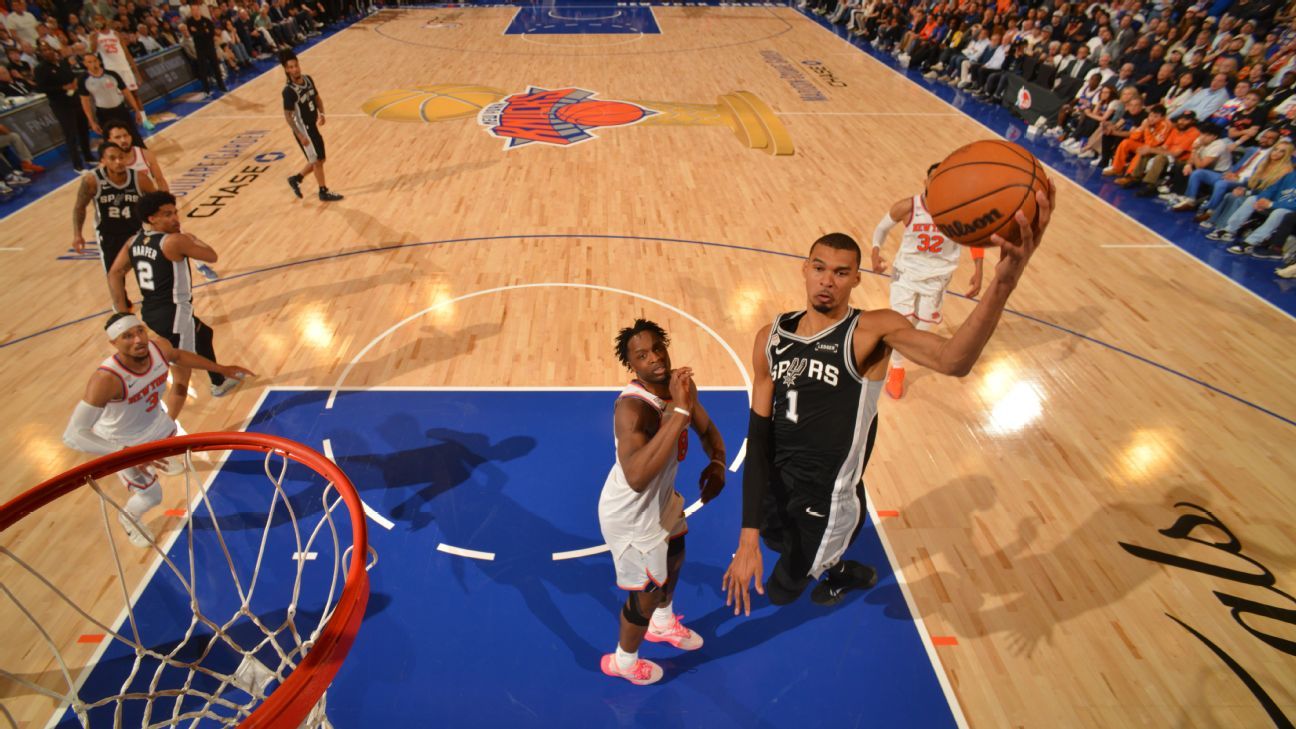
现在,这成了一轮真正的系列赛。
在纽约尼克斯队客场偷下2026年NBA总决赛的第1场和第2场后,圣安东尼奥马刺队在周一的第三场比赛中还以颜色,以115-111的比分客场取胜,让群情激昂的麦迪逊广场花园球馆瞬间鸦雀无声。
凭借2-1的系列赛领先优势以及剩下的两个主场优势——包括周三的第四场比赛(美东时间晚上8:30,ABC/ESPN App直播)——尼克斯依然更被看好夺得他们53年来的首个总冠军。但在NBA季后赛历史上,从未有球队能在0-3落后的情况下实现逆转,因此第三场对马刺来说是一场不容有失的生死战。
他们做到了。马刺终结了尼克斯的13连胜,也让这轮高水平的总决赛保留了应有的悬念。
让我们从多个角度来深度剖析马刺这场至关重要的G3胜利,从最关键的战术配合与趋势,到它为第四场比赛带来的最大阵容疑问。
快速链接:
各方反应: 第二场 | 第一场 | 要点总结
赛程表 | 对阵图 | 季后赛专题报道
第三场比赛最关键的战术配合
在总决赛前两场失利中,圣安东尼奥面临的最大问题是无法撕开纽约的防线。马刺在常规赛中的进攻效率排名联盟第三(顺便提一句,与尼克斯并列),但在总决赛前两场中,他们每百回合仅能得到100.5分。
作为对比,本赛季进攻最差的球队布鲁克林篮网队每百回合平均也能得到108.2分——这比马刺在面对尼克斯时的表现要好上近8分。
不过,马刺在第二场比赛的最后阶段找到了更好的节奏,抹平了尼克斯14分的领先优势,并将这种势头延续到了第三场的开局,在比赛初期通过一波内线强攻奠定了基调。
在本场比赛的第一次得分中,马刺使用了他们杀伤力极大的“45度掩护”战术,让维克托·文班亚马 (Victor Wembanyama) 在篮筐上方获得空档。斯蒂芬·卡斯尔 (Stephon Castle) 运球过半场,在接受文班亚马和朱利安·尚帕尼 (Julian Champagnie) 的双重掩护后选择突破。随着尼克斯防线轮转,卡斯尔将球分给外线的达龙·福克斯 (De’Aaron Fox),后者持球突破并送出一记高抛空中接力,文班亚马高高跃起,在立足未稳的卡尔-安东尼·唐斯 (Karl-Anthony Towns) 头顶轻松完成暴扣。
— Zach Kram (@ zachkram) June 9, 2026
下一次得分同样是针对内线的文班亚马。这一次,尚帕尼和文班亚马在弧顶为卡斯尔设置了梯次掩护,这迫使唐斯远离油漆区,而体型较小的OG·阿奴诺比 (OG Anunoby) 只能在内线与文班亚马肉搏。但文班亚马卡到了一个根本无法防守的位置,直接迎着防守队员单手劈扣。
— Zach Kram (@ zachkram) June 9, 2026
马刺的攻势还没完。仅仅两分钟后,他们再次祭出了“45度”战术。这一次,纽约在半场附近对卡斯尔进行包夹,他起跳并佯装要传给侧翼的福克斯——在阿奴诺比被假动作晃飞并扑向外线后——卡斯尔将球塞给篮下无人防守的文班亚马,后者轻松得分。
— Zach Kram (@ zachkram) June 9, 2026
在比赛进行到5分钟时的第一次官方暂停时,文班亚马已经4投4中砍下9分,卡斯尔也3投3中贡献7分。当时两人还合力送出了3次助攻:其中两次是卡斯尔助攻文班亚马,一次是文班亚马回敬卡斯尔。
随着比赛的进行,马刺火热的势头有所放缓。但他们的进攻从未像前两场比赛的某些时段那样陷入严重停滞。在前两场对决中,他们曾单节仅得18分、19分和21分,但在第三场比赛中,马刺单节最低得分也未低于23分。
这在很大程度上是因为他们持续对纽约的篮筐施加压力。当尼克斯在场上没有唐斯或米切尔·罗宾逊 (Mitchell Robinson) 而改打小阵容时,一个简单的挡拆配合就能让文班亚马轻松切入篮下,在米卡尔·布里奇斯 (Mikal Bridges) 头顶完成扣篮。
— Zach Kram (@ zachkram) June 9, 2026
在第四节开局阶段,他又通过反跑空切甩开唐斯,完成了另一次空中接力。
— Zach Kram (@ zachkram) June 9, 2026
在总决赛的前两场比赛中,文班亚马仅完成了一次空中接力。而在第三场比赛中,他仅凭空接就拿下了4次得分(包括一次点篮得手),这追平了他职业生涯单场季后赛的最高纪录。
文班亚马在第三场比赛中还设置了35次掩护,这是他本赛季单场第三高的纪录,仅次于分区决赛的第1场和第7场。总的来说,随着比赛强度的提升,马刺更加频繁地让文班亚马担任掩护者:根据GeniusIQ的数据,他在季后赛中每百回合掩护36.5次,而在常规赛中这一数据仅为23.4次。
周一晚上,文班亚马展现了极高的效率,18投砍下32分,而卡斯尔也以14投贡献了23分。这对双子星在前两场比赛中投篮命中率仅为40%,而本场比赛合力投出了59%的命中率。他们合砍的55分也创下了两人在季后赛常规时间(非加时赛)的得分新高。
马刺在第三场比赛中还展现了其他的进攻优势。他们在第三节和第四节都早早让对手犯满,从而获得了更多的罚球机会。角色球员尚帕尼和德文·瓦塞尔 (Devin Vassell) 联手在外线投出了10投6中的三分表现。此外,马刺对球权的保护也做得更好,仅出现了8次失误,创下了今年季后赛的新低。
但文班亚马更强的侵略性,以及马刺更具针对性地将他置于篮筐附近的优势位置,才是球队打出总决赛最佳进攻表现的核心催化剂。
根据GeniusIQ的数据,文班亚马在第一场比赛中的平均出手距离为17.3英尺,第二场为15.2英尺。而到了第三场,他的平均出手距离骤降至10.6英尺。
因此,马刺在第三场比赛中的进攻效率飙升至123.7也就不足为奇了——这是他们今年季后赛中进攻效率第二高的比赛(仅次于在对阵明尼苏达的第六场比赛中30分大胜的战役),同时也是尼克斯在今年季后赛中防守效率最差的一场。
值得特写的一回合防守
虽然圣安东尼奥凭借进攻赢下了第三场比赛,但这并不意味着周一的比赛中没有防守亮点。其中一个防守回合极其精彩,完全值得在本文中单独拿出来进行剖析。
尼克斯在总决赛中出色的传导球赢得了应有的赞誉。他们喜欢突分、再突分、不断重复突分,直到马刺的防线出现漏洞,从而为纽约创造出空位投篮机会。最好的例子就是第二场比赛中以米卡尔·布里奇斯投中三分而告终的那次配合,我在那场比赛后的复盘文章中也重点提到了这一点。
— KramClips (@ KramClips) June 6, 2026
但在第三场比赛的关键时刻,当圣安东尼奥在最后五分钟手握8分领先优势时,马刺彻底掐断了尼克斯重演这一幕的企图。看看这次精彩的防守:马刺连续切断了对方四次潜在的出手选择,最后由文班亚马将兰德里·沙梅特 (Landry Shamet) 的上篮狠狠钉在篮板上。
— Zach Kram (@ zachkram) June 9, 2026
在整个防守回合中,马刺的五名防守球员轮转默契,随着球在外线的转移而同步移动。在此期间,文班亚马在不同时间点防守了三名不同的尼克斯球员、镇守了篮筐,并补防了两个底角。
尼克斯绝对没有计划用沙梅特挑战文班亚马来结束这次进攻。但马刺的拼抢和默契配合让他们别无选择。
第三场比赛带来的三大启示
1. 圣安东尼奥在周一的比赛中使用了三后卫阵容收尾,由迪伦·哈珀 (Dylan Harper) 取代尚帕尼进入决胜阵容。考虑到哈珀在前两场总决赛中可以说是马刺表现最好的球员,这并不让人意外。然而,考虑到马刺主教练米奇·约翰逊 (Mitch Johnson) 在周一之前,在整个季后赛中仅让这套五人阵容合力打了12分钟,这依然算是一个奇招。
当福克斯、卡斯尔、哈珀和瓦塞尔环绕在文班亚马身边时,马刺的阵容无疑偏小。但他们也因此变得更快、持球更具活力,这些特质在第三场比赛中起到了极好的效果。在接下来的总决赛中,我们可以期待看到更多三后卫阵容的使用——坦率地说,在未来的几年里也是如此,因为随着卡斯尔和哈珀的成长,以及福克斯凭借顶薪续约稳居圣安东尼奥,这套阵容将大有可为。
2. 阿奴诺比是尼克斯周一效率最高的得分手,他13投9中砍下28分。这距离他季后赛生涯单场最高得分仅差1分(他曾三次拿到过29分,包括在首轮对阵亚特兰大时拿过两次)。
与杰伦·布伦森 (Jalen Brunson) 不同,阿奴诺比的得分往往来自于进攻体系的顺畅运转,而不是依靠大量的出手权或单打独斗。他在季后赛中的使用率仅为低于平均水平的18.1%。
但周一的爆发表明,尼克斯或许应该更有针对性地为阿奴诺比创造更多的出手空间。他的体型和力量让他面对马刺的任何侧翼防守人时都占据优势;甚至在这轮系列赛中,他已经多次过掉文班亚马完成扣篮。特别是在马刺如果继续使用三后卫阵容的情况下,阿奴诺比完全可以在外线和篮下持续制造杀伤。
3. 尼克斯大可不必对他们的轮换感到恐慌,毕竟在13连胜之后遭遇一场惜败并不足以为奇。然而,第三场比赛中的一个数据点确实值得警惕:在米切尔·罗宾逊登场的短短7分钟里,圣安东尼奥净胜了纽约13分。
从尼克斯的角度来看,这其中存在两个问题。首先,当然是净负13分的部分。通常情况下,担心替补中锋在场上时如何“生存”的是马刺,但在这场比赛中,尼克斯在主力中锋下场休息时输掉了无法接受的分数。
同样令人担忧的是“7分钟”这个时长,这是罗宾逊在今年季后赛中单场出场时间最少的一次(不包括他因病缺席的一场比赛)。部分由于犯规问题,再加上尼克斯主教练迈克·布朗 (Mike Brown) 想要避免对手使用“砍米切尔”战术,纽约在周一的比赛中曾有几分钟让阿奴诺比客串中锋主打小阵容。
纽约通常不这样打球;唐斯和罗宾逊在第一场比赛中合力打了47分钟,在第二场中合力打了48分钟。而阿奴诺比出任中锋的效果好坏参半,当时空间被拉得很开,两队都在场上疯狂折返跑上篮。但这绝对是第四场比赛中值得关注的一个细节,看看布朗是会回归他惯用的中锋轮换,还是会继续坚持这种偶尔的变阵。
展望第四场:花絮与细节
• 季后赛篮球的魅力之一,就是角色球员在出人意料的情况下挺身而出。尼克斯后卫乔丹·克拉克森 (Jordan Clarkson) 在第三场比赛中就扮演了这样的角色。在周一之前,他本赛季在季后赛中从未得分上双,甚至在周五的第二场比赛中根本没有获得出场机会。
但为了寻找替补席上的活力,迈克·布朗在第三场比赛中派上了克拉克森——以及豪塞·阿尔瓦拉多 (Jose Alvarado),后者在文班亚马头顶多次投篮命中,同样提供了替补火力——并收到了奇效。在度过34岁生日的第二天,克拉克森在13分钟的出场时间里7投4中,贡献了10分,其中包括两次在进攻时间行将结束时的强投三分,正负值达到了+8。
也许在接下来的总决赛中,克拉克森再也无法拿到10分,甚至得不到13分钟的出场时间。但在这一晚,他是纽约极为关键的奇兵。
• 马刺替补凯尔登·约翰逊 (Keldon Johnson) 在周一经历了一场跌宕起伏的比赛,尽管他的数据统计(在17分钟内得到7分、2个篮板和1次抢断)看起来平平无奇。这位年度最佳第六人在比赛中罚丢了三个罚球,犯了几次愚蠢的犯规——包括一次无谓的进攻犯规,在尼克斯挑战成功后抹杀了文班亚马的一次三分得分——而且在进攻端整体显得有些失控。
然而,凯尔登·约翰逊最终却拿到了全场最高的正负值(+14),对于阵容深度迅速流失的马刺队来说,他能够顶上这17分钟至关重要。凯尔登·约翰逊本可能会葬送第三场比赛,但他同样为马刺的最终获胜立下了汗马功劳。
• 谈到圣安东尼奥逐渐吃紧的阵容深度:在纽约进行的第三场和第四场比赛之间只有一天的休息时间,这也是本轮系列赛中最后一次出现背靠背式的赛程(仅休息一天)。相反,在第四场和第五场、第五场和第六场(如有必要)以及第六场和第七场(如有必要)之间,都将有两天的休息时间。
这可能会对周三的第四场比赛产生影响,因为在目前这个阶段,尤其是在主场,迈克·布朗显然比米奇·约翰逊拥有更多值得信赖的轮换球员。(在经历了汤姆·锡伯杜 (Tom Thibodeau) 执教的岁月后,这对尼克斯来说是一个罕见而幸福的烦恼。)
米奇·约翰逊在第三场比赛中将哈里森·巴恩斯 (Harrison Barnes) 移出了轮换阵容,而卡特·布莱恩特 (Carter Bryant) 也仅打了4分钟。但在文班亚马、卡斯尔、福克斯和瓦塞尔周一都至少打了37分钟之后,这些马刺主力能否在仅休息一天的情况下迅速调整,在第四场比赛中保持同样的强度和耐力,仍有待观察。
由生成式 AI 翻译,译文内容可能不准确或不完整,以原文为准。
点击查看原文:2026 NBA Finals: Important plays, lessons from Knicks-Spurs Game 3
2026 NBA Finals: Important plays, lessons from Knicks-Spurs Game 3
Well, we have a series.
After the New York Knicks stole Games 1 and 2 of the 2026 NBA Finals on the road, the San Antonio Spurs returned the favor in Game 3 on Monday, silencing an energized Madison Square Garden crowd with a 115-111 win.
The Knicks are still favorites to win their first championship in 53 years, with a 2-1 series lead and two remaining home games, including Game 4 on Wednesday (8:30 p.m. ET, ABC/ESPN App). But no team has ever overcome a 3-0 deficit in an NBA playoff series, so Game 3 was a must-win for the Spurs.
They obliged, snapping the Knicks’ 13-game win streak and maintaining the suspense that a Finals of this caliber deserves.
Let’s break down San Antonio’s crucial Game 3 win from all angles, from its most important plays and trends to the biggest lineup questions it sparked for Game 4.
Quick links:
Reaction: Game 2 | Game 1 | Takeaways
Schedule | Bracket | Playoff coverage
The most important plays of Game 3
San Antonio’s greatest problem through two Finals losses was an inability to break down New York’s defense. The Spurs ranked third in the regular season in offensive rating – tied with the Knicks, incidentally – but they had scored just 100.5 points per 100 possessions in the Finals.
For context, the worst offensive team this season, the Brooklyn Nets, averaged 108.2 points per 100 possessions – nearly eight ticks better than the Spurs against the Knicks.
But the Spurs found a better rhythm down the stretch in Game 2, as they erased a 14-point Knicks lead, and they carried that pace right up to the start of Game 3, when they set the tone early with a flurry of buckets down low.
For the very first basket of the game, the Spurs used their killer “45 screen” set to get Victor Wembanyama open above the rim. Stephon Castle brought up the ball and drove after receiving screens from both Wembanyama and Julian Champagnie. With the Knicks defense rotating, Castle kicked out to De’Aaron Fox, who drove and lofted an alley-oop pass, and Wembanyama leaped for an easy slam over a flat-footed Karl-Anthony Towns.
— Zach Kram (@ zachkram) June 9, 2026
The next bucket also targeted Wembanyama down low. This time, Champagnie and Wembanyama set staggered screens for Castle at the top of the arc, which forced Towns away from the paint and the smaller OG Anunoby to wrestle with Wembanyama down low. But Wembanyama burrowed into an unguardable position and dunked right through the defender.
— Zach Kram (@ zachkram) June 9, 2026
The Spurs weren’t done. Just a couple of minutes later, they used their “45” set once again. This time, New York trapped Castle at midcourt, so he rose, feigned as if he would pass to Fox on the wing and – after Anunoby bit on the fake and sprinted out to the perimeter – dished to Wembanyama, who was wide open underneath.
— Zach Kram (@ zachkram) June 9, 2026
At the first TV timeout of the night, five minutes into the game, Wembanyama had already scored nine points on 4-for-4 shooting, and Castle had already scored seven points on 3-for-3 shooting. The duo had three assists at that point, as well: two from Castle to Wembanyama, and one the other way around.
The Spurs’ torrid pace slowed as the night continued. But the offense never stagnated as severely as it had for stretches in the first two games. They had quarters with 18, 19 and 21 points in those contests, but the Spurs never dipped below 23 in a quarter in Game 3.
In large part, that’s because they kept pressure on New York’s basket. When the Knicks went small without Towns or Mitchell Robinson on the floor, a basic pick-and-roll allowed Wembanyama to glide to the rim and dunk over Mikal Bridges.
— Zach Kram (@ zachkram) June 9, 2026
And he beat Towns backdoor for another alley-oop to open the fourth quarter.
— Zach Kram (@ zachkram) June 9, 2026
Through the first two games of the Finals, Wembanyama had converted just one alley-oop. Then in Game 3 alone, he scored off four lobs (including one tipped layup), which tied for his most in any playoff game.
Wembanyama also set 35 picks in Game 3, his third-highest total in any game this season, behind only Games 1 and 7 of the conference finals. In general, the Spurs have used Wembanyama much more as a screener as the stakes have risen: 36.5 screens per 100 possessions in the postseason versus 23.4 screens per 100 possessions in the regular season, per GeniusIQ.
Wembanyama finished with an efficient 32 points on 18 shots on Monday night, while Castle added 23 points on 14 shots. The duo shot a combined 59% after mustering a 40% mark through the first two games. And their 55 combined points were their postseason high in a non-overtime game.
The Spurs enjoyed other offensive strengths in Game 3, as well. They got into the bonus early in both the third and fourth quarters, securing more free throw opportunities. Role players Champagnie and Devin Vassell combined to shoot 6-of-10 on 3-pointers. And the Spurs took better care of the ball, committing a postseason-low eight turnovers.
But Wembanyama’s increased aggression, and the Spurs’ increased urgency in putting him in advantageous situations near the rim, were the main catalyst for the team’s best offensive performance in the Finals.
His average shot came from 17.3 feet away from the rim in Game 1, and from 15.2 feet away in Game 2, per GeniusIQ. His average shot distance in Game 3 dropped to 10.6 feet.
So it’s no wonder that the Spurs’ offensive rating leaped to 123.7 in Game 3 – their second-most-efficient game of the postseason (behind their 30-point blowout win in Game 6 against Minnesota), and by far the Knicks’ worst defensive rating of the playoffs.
A defensive possession to highlight
Just because San Antonio won Game 3 with its offense doesn’t mean there weren’t any defensive highlights Monday. And one possession was so extraordinary that it deserves a special carveout in this column.
The Knicks have received proper credit for their excellent ball movement in the Finals. They like to drive and kick, and drive and kick again, and drive and kick some more, all on repeat until the Spurs defense springs a leak and New York generates an open shot. The best example is this play that culminated in a Mikal Bridges 3-pointer in Game 2, which I highlighted in my piece after that game.
— KramClips (@ KramClips) June 6, 2026
But in a key moment in Game 3, with San Antonio holding an eight-point lead in the final five minutes, the Spurs shut down the Knicks’ attempt at a repeat. Behold this beauty, as the Spurs cut off four potential shots in a row, before Wembanyama spiked Landry Shamet’s layup off the backboard.
— Zach Kram (@ zachkram) June 9, 2026
All five Spurs defenders rotated in concert throughout this possession, moving in sync with the ball around the perimeter. And at various points throughout, Wembanyama defended three different Knicks, the rim and both corners.
The Knicks almost certainly didn’t plan to end their possession with Shamet challenging Wembanyama. But the Spurs’ effort and coordination gave them no choice.
Three key Game 3 lessons
1. San Antonio closed with a three-guard lineup Monday, with Dylan Harper taking Champagnie’s place among the starters. That wasn’t a shocker, given that Harper was arguably their best player through the first two games of the Finals. Given that Spurs coach Mitch Johnson had used this particular five-man group for only 12 minutes all postseason before Monday, however, it was still a surprise.
The Spurs are undoubtedly small when Fox, Castle, Harper and Vassell surround Wembanyama. But they’re also faster and more dynamic with the ball, and those attributes served them well in Game 3. Look for more of the three-guard group going forward in these Finals – and, frankly, for the next few years, as Castle and Harper grow and Fox remains ensconced in San Antonio with his max extension.
2. Anunoby was the Knicks’ most efficient scorer Monday, tallying 28 points on 9-for-13 shooting. It was one point off his playoff career high (set three times, including twice against Atlanta in the first round).
Unlike Jalen Brunson, Anunoby’s buckets tend to come within the flow of the offense, rather than via heavy volume or possession. His usage rate in the playoffs is a below-average 18.1%.
But Monday’s outburst suggests the Knicks might want to make more of a targeted effort to get Anunoby extra shots. His size and strength make him a difficult individual matchup for any of the Spurs’ wings; heck, he has even blown past Wembanyama for multiple dunks in this series. And especially if the Spurs go to their three-guard lineup again, Anunoby could continue scoring both on the perimeter and at the rim.
3. The Knicks should still feel generally comfortable with their rotations, as one close loss following 13 consecutive wins is no cause for alarm. Yet one data point should give reason for concern coming out of Game 3: San Antonio outscored New York by 13 points in seven minutes with Mitchell Robinson on the floor.
There are two issues here, from the Knicks’ perspective. The first, of course, is the minus-13 portion. Usually it’s the Spurs who worry about surviving with their backup center on the floor, but in this case, the Knicks lost by an untenable margin without their starter.
Almost as worrying is the “in seven minutes” part, as that’s the fewest minutes Robinson has played in a game this postseason (not counting one he missed due to illness). In part due to the foul situation, with Knicks coach Mike Brown wanting to avoid Hack-a-Mitch possibilities, New York went small with Anunoby at center for a few minutes on Monday.
New York doesn’t typically play that way; Towns and Robinson played a combined 47 minutes in Game 1 and 48 minutes in Game 2. And the results with Anunoby at center were mixed, as the court opened up and both teams raced up and down the floor for layups. But it’s a wrinkle worth watching in Game 4, to see if Brown returns to his usual center rotation or if he persists with the occasional change.
Notes and loose ends looking ahead to Game 4
• One of the joys of playoff basketball is when role players step up in unexpected circumstances. Knicks guard Jordan Clarkson fit that bill in Game 3. Before Monday, he hadn’t scored in double figures in any playoff game this season, and he didn’t play at all in Game 2 on Friday.
But in search of a spark off the bench, Brown inserted Clarkson – and Jose Alvarado, who provided his own bench production with multiple makes over Wembanyama – in Game 3, and he reaped the rewards. A day after his 34th birthday, Clarkson scored 10 points on 4-for-7 shooting, including two 3-pointers late in the shot clock, and he was plus-8 in 13 minutes.
It’s possible Clarkson doesn’t score 10 points or play 13 minutes at all in the entire rest of the Finals. But for one night, he was a tremendously important contributor for New York.
• Spurs backup Keldon Johnson had one of the more eventful games Monday, even if his box score stats (seven points, two rebounds and one steal in 17 minutes) look entirely normal. The Sixth Man of the Year also missed three free throws, committed a few foolish fouls – including an unnecessary offensive foul that wiped out a Wembanyama 3-pointer after a Knicks challenge – and generally looked out of control on offense.
And yet, Johnson finished with the best plus/minus in the game (plus-14), and his ability to play 17 minutes was critical for a Spurs team that is rapidly losing its depth. Johnson could have cost them Game 3, but he also played a big role in helping them win it.
• Speaking of that dwindling depth for San Antonio: There is only one day off between Games 3 and 4 in New York, for the last time in this series. Conversely, there will be two days off between Games 4 and 5, 5 and 6 (if necessary) and 6 and 7 (if necessary).
That could matter for Wednesday’s game, because at this point, especially at home, Brown clearly has more players he trusts than Johnson does. (That’s an unusual position for the Knicks, following the Tom Thibodeau years.)
Johnson removed Harrison Barnes from the rotation in Game 3, and Carter Bryant played only four minutes. But after Wembanyama, Castle, Fox and Vassell all played at least 37 minutes Monday, it remains to be seen whether those Spurs stalwarts can turn around with just one day of rest and play with the same intensity and endurance in Game 4.
By Zach Kram, via ESPN