By Zach Kram, 2026-06-06 19:55:00
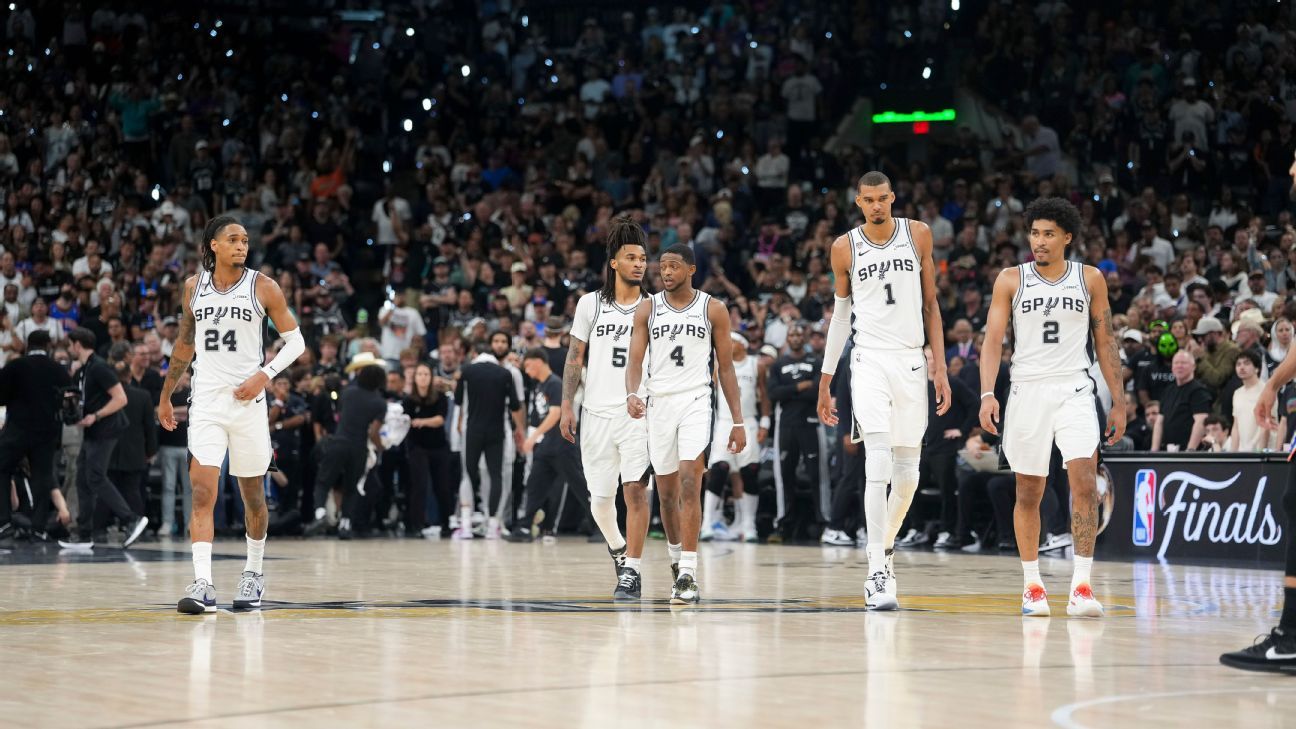
纽约尼克斯队本没有理由赢下2026年NBA总决赛的第二场比赛。他们此前已经通过在第一场客场取胜,从圣安东尼奥马刺队手中抢走了主场优势,因此即使在两天后表现有所松懈,也是完全可以理解的。
历史规律也预示着他们会输球,而且很可能是两位数的分差:进入本轮系列赛之前,在总决赛中赢下首战的客场球队,在接下来的第二场比赛中战绩仅为2胜16负,场均净输11.3分。况且,马刺队在西部半决赛对阵明尼苏达森林狼队时,就在主场输掉首战后迅速调整,在第二场以一场38分的狂胜予以回应。
但周五晚上在圣安东尼奥,剧情并未按此上演。相反,尼克斯队顶住了末节的崩盘危机,以105-104险胜,将连胜纪录扩大到13场,距离他们梦寐以求的总冠军仅差两场胜利。
面对这样的契机,当系列赛在周一移师纽约进行第三场对决(东部时间晚8:30,ABC/ESPN App直播)时,麦迪逊广场花园可能会创下室内噪音的分贝纪录。但在此之前,让我们从各个角度来剖析这场经典的第二战,从最关键的回合到关键的阵容决策,再到马刺队在力图挽救赛季时值得关注的球员。
快速链接:
第一场启示与精彩回合 | 核心要点
赛程 | 对阵图 | 季后赛报道
第二场最关键的回合
第二场惊心动魄的收尾,意味着我们必须从比赛的最后阶段说起。
第四节时间过半时,在阿努诺比 (OG Anunoby) 顶着维克托·文班亚马 (Victor Wembanyama) 完成一记扣篮后,尼克斯队领先了14分,系列赛2-0的领先优势似乎已是囊中之物。根据ESPN Analytics的数据,那一刻纽约的胜率高达98.2%。
但马刺队随即发起狂澜般反扑。在迪伦·哈珀 (Dylan Harper) 和达龙·福克斯 (De’Aaron Fox) 这对左手后场双枪的带领下,马刺队连得14分抹平分差,让最后几分钟陷入了令人窒息的白热化阶段。
就在这时,文班亚马成为了圣安东尼奥的焦点——无论是功是过。
积极的一面是,这位22岁的超级巨星频频在篮下得手。在圣安东尼奥那波14-0的攻势中,他利用一次漂亮的低位脚步,用左手挑篮打板命中。而在最后的决战时刻,他不仅完成了一次空中接力扣篮,还在转换进攻中快下打成一次2+1上篮,帮助马刺队夺得了下半场的首次领先。
但在远离篮筐的区域,文班亚马却打得十分挣扎。在关键时刻,他的跳投3投0中,先是投丢了一个失去身体平衡的后撤步三分,直接投出了三不沾……
— KramClips (@ KramClips) June 6, 2026
……随后又投丢了一个本可以在最后一分钟帮助圣安东尼奥反超比分的中距离跳投……
— KramClips (@ KramClips) June 6, 2026
……最后,在比赛的最后一投中错失了绝杀机会。
— KramClips (@ KramClips) June 6, 2026
在这两次投篮打铁之间,文班亚马还出现了一次致命失误,直接导致马刺队输掉了第二场。在杰伦·布伦森 (Jalen Brunson) 错失了反超比分的中距离跳投后,文班亚马在还剩13秒时抢下篮板。圣安东尼奥决定不叫最后一个暂停——考虑到当时纽约在场上使用的是一套攻强守弱的阵容,这是一个合理的决定。因为一旦叫暂停,尼克斯队主教练迈克·布朗 (Mike Brown) 就可以在最后一防中换上他最好的防守球员。
然而,文班亚马和斯蒂芬·卡斯尔 (Stephon Castle) 却出现了默契失误:当这位中锋试图将球传给他的后卫时,卡斯尔却转过头准备向前场快下。皮球仿佛在空中悬停了半个世纪,最后砸在卡斯尔的背上,直接弹到了布伦森手中。文班亚马在边线附近撞到了他,布伦森罚球命中,尼克斯队在客场再次偷走了一场胜利。
— KramClips (@ KramClips) June 6, 2026
当然,如果对这些失误进行过于苛刻的批评,可能会有些只见树木不见森林。毕竟,马刺队之所以能在最后一分钟保有赢下第二场的机会,文班亚马是关键原因:他用下半场更具侵略性的表现弥补了上半场的低迷,最终砍下全场最高的29分,外加9个篮板、4次盖帽和2次抢断。在他出场的40分钟里,马刺队净胜6分。
但在在这个季后赛中,这位22岁的中锋正在向“世界第一人”的宝座发起冲击,这意味着我们必须以更高的标准来要求他。姑且先不谈那次可以归咎于默契不足和经验欠缺的失误。文班亚马在最后时刻投丢的那两次中距离跳投虽然不是轻松的出手,但也绝非糟糕的机会,尤其是考虑到当时的比赛形势:第一次出手时,马刺队显然是在谋求一次“抢攻”(2-for-1)的机会;而第二次则是在时间所剩无几时,给了他一次直面篮筐的干净出手空间。
这两次出手都发生在距离篮筐20到21英尺之间,且都有防守球员贴身干扰。根据GeniusIQ的数据,在周五的比赛之前,文班亚马职业生涯中符合这些条件的投篮命中率仅为34%(32投11中)。同样,追踪数据显示,在第二场比赛最后的绝杀尝试中,针对他个人特点量化的投篮期望命中率也仅为36%。
这基本上是两次只有三分之一把握赢下总决赛的机会。而文班亚马两次都投丢了。
但这就是篮球运动的残酷之处,成败皆在毫厘之间;在最高舞台上,容错率极低,总冠军的归属往往取决于更小的细节。正如文班亚马在赛后接受采访时所说:“在这样的时刻,结果比过程更重要。……我必须把球投进。”
这种情绪同样适用于他的整支球队,因为文班亚马在比赛末段的投篮失准,只是马刺队在整个系列赛中进攻挣扎的一个缩影。
在第一场仅打出96.0的进攻效率后,马刺队在第二场拿到了105.1。虽然有所提升,但这在常规赛中依然只能排在联盟垫底。
在第一场比赛中,马刺队的问题主要在于投篮手感不佳。他们的出手质量其实不错,只是运气欠佳,投丢了太多空位机会。
然而在第二场比赛中,圣安东尼奥从一开始就很难制造出空位机会。根据GeniusIQ的数据,马刺队周五的预期有效命中率(expected eFG)仅为48%。这是他们本赛季所有比赛中出手质量最差的一场,也是自2019年以来,所有打进总决赛的球队中单场最差的出手质量。
在这轮系列赛的大部分时间里,马刺队显得疲惫而散漫——文班亚马在周五半场结束前就出现了两次糟糕的传球失误,这也预示了他最后时刻的那次致命失误——他们根本无法撕开尼克斯队密不透风的整体防守。
在第二场比赛中,除了开局阶段的猛攻和第四节那波14-0的冲击波外,马刺队在太多时候都只能选择强投,或者盲目地突入人堆。他们的半场进攻深陷泥潭,只有在转换进攻中形成多打少时才能稳定得分——但尼克斯队极少出现失误,而马刺队的防守体系也并不擅长制造失误。
如今,那次失误的阴影笼罩了一切。篮球历史上有很多著名的球场低级失误,文班亚马的这次传球失误虽然还无法与克里斯·韦伯 (Chris Webber) 在1993年NCAA总决赛中叫了没有的暂停,或者JR·史密斯 (JR Smith) 在2018年总决赛第一场记错比分相提并论。但如果马刺队最终输掉了这轮系列赛——在主场连丢两局后,他们显然处于绝对劣势——那么这次失误将在圣安东尼奥人的心中留下长久的遗憾。
“我的思绪依然很混乱,这就是问题的关键。我需要打得更沉稳,对比赛有更多的掌控力,”文班亚马在谈到比赛末段的失策时说道。对于那次失误,他补充道:“那个球是我扔掉的。我搞砸了。”
在经历了这个周末难得的额外一天休息后,他依然有自我救赎的机会。但在第二场比赛终场哨响的那一刻,他的第一次机会最终擦着篮筐滑落。
马刺队的三个关键轮换决策
1. 预计马刺队主教练米奇·约翰逊 (Mitch Johnson) 会在第三场中更加重用哈珀。这位新秀活力源泉在第二场中再次成为马刺队表现最好的球员之一,他替补出场砍下15分,并在比赛最后阶段多次挺身而出。他上场了32分钟,创下他今年季后赛单场出场时间第二高的纪录。(最高纪录是分区决赛第一场的47分钟,当时马刺队缺少了福克斯,比赛打进了双加时。)
让哈珀与他同样通过乐透选秀进入球队的年轻队友搭档,继续收到奇效。在常规赛中,文班亚马-哈珀-卡斯尔的三人组合打出了令人惊叹的+38.7的净效率(net rating),在全联盟1937个至少共同出场150分钟的三人组合中高居第二。(第一名是马刺队的文班亚马-哈珀-德文·瓦塞尔 (Devin Vassell) 组合)。而在季后赛中,这一三人组合的净效率也达到了+17.7。
约翰逊在使用这套阵容时已经展现出更强的紧迫感。本赛季,文班亚马、卡斯尔和哈珀在9场比赛中共同参与了至少20次进攻回合。其中有7场发生在季后赛,包括总决赛的前两场,而第8场则是去年12月对阵纽约的NBA季中锦标赛(NBA Cup)决赛。
2. 自分区决赛开始以来,在卢克·科内特 (Luke Kornet) 上场的92分钟里,马刺队累计净输52分,其中包括总决赛第一场上场10分钟输掉7分,以及第二场上场8分钟再次输掉7分。在此期间,马刺队仅赢下了科内特正负值为正的两场比赛(对阵俄克拉荷马雷霆队的第六场和第七场)。
科内特并不是一个糟糕的替补中锋,但与在MVP评选中高居第三的文班亚马相比,他的实力差距巨大,因此当文班亚马下场休息时,尼克斯队便能予取予求。
然而,这个问题并没有简单的解决办法。在第一场出战38分钟和第二场出战40分钟的过程中,文班亚马在大部分时间里都显得疲惫不堪,他的出场时间实际上已经达到了极限。而约翰逊手里也没有可以替代科内特的五小阵容——替补前锋哈里森·巴恩斯 (Harrison Barnes) 和卡特·布莱恩特 (Carter Bryant) 在第二场比赛中总共只打了8分钟且一分未得,而尼克斯队的米切尔·罗宾逊 (Mitchell Robinson) 更是会在进攻篮板上将马刺队的矮个阵容彻底摧毁。
到了纽约,约翰逊能做的最好安排就是将这些衔接段变成“全员皆兵”的决战时刻,让除文班亚马之外的所有马刺主力留在场上,并寄希望于球队能够咬住比分。科内特在上一轮对阵俄克拉荷马城的抢七大战中表现出色,回到纽约,他需要再次挺身而出。
3. 除了哈珀 and 科内特,约翰逊在这轮系列赛中还有其他可以信赖的替补球员吗?通常情况下,角色球员在主场的表现要好于客场,但尼克斯队的替补球员兰德里·沙梅特 (Landry Shamet)、麦尔斯·麦克布莱德 (Miles McBride)、豪塞·阿尔瓦拉多 (Jose Alvarado) 和罗宾逊都在圣安东尼奥的不同节点打出了关键表现,在第二场比赛中联手贡献了27分。相比之下,马刺队的替补合力仅得到19分:其中15分来自哈珀,其余所有人仅得4分。
这对圣安东尼奥来说是一个多方面的棘手问题,尤其是考虑到尼克斯队在总决赛中本就拥有更充沛的体能,而且如今他们还展现出了更深厚的阵容深度和轮换灵活性。而在马刺队的进攻挣扎中,年度最佳第六人凯尔登·约翰逊 (Keldon Johnson) 在场上的低效表现(总决赛两场累计出战24分钟,命中率仅为25%,得到6分)是一个被低估的因素。
展望第三场的花絮与细节
• 截至周六凌晨,在我撰写本文时,根据DraftKings Sportsbook的数据,杰伦·布伦森是夺得总决赛MVP的最大热门。他是尼克斯队的得分王,也是他们在关键时刻最依赖的创造者;他在第一场投中了制胜三分,在第二场罚中了制胜罚球。
但在第二场打出25投7中的表现后,布伦森在总决赛中的投篮命中率仅为34%。与此同时,卡尔-安东尼·唐斯 (Karl-Anthony Towns) 才是这轮系列赛中表现最全面的球员,在继第一场打出优异表现后,他在第二场12投8中,砍下了21分和13个篮板。
需要澄清的是,这并非投注建议。我有其他同事能在这方面为你提供更专业的指导。但唐斯确实在持续压制文班亚马,如果由我来投票,前两场比赛的总决赛MVP毫无疑问会投给他。
• 在这轮系列赛令人窒息的防守大战中,一些精彩的进攻配合依然令人眼前一亮。例如,马刺队在第二场的首次进攻,通过连续四次快速传导球,最终由瓦塞尔完成一记三分。
— KramClips (@ KramClips) June 6, 2026
而在另一端,尼克斯队在第二节也打出了一次极具观赏性的配合,他们耐心地连续进行了四次突破分球,直到彻底撕开马刺队的协防漏洞,由米卡尔·布里奇斯 (Mikal Bridges) 在24秒进攻时间即将结束时命中一记空位三分。
— KramClips (@ KramClips) June 6, 2026
两支球队的防守臂展和防守强度意味着,只有通过这种精妙的传导球,才有可能创造出空位出手机会。
• 三年前,在涉及凯文·杜兰特 (Kevin Durant) 的重磅交易中被送往篮网队后的半个赛季里,布里奇斯曾转型为NBA最顶尖的高产得分手之一。在太阳队时,他一直只是球队的次要进攻选择,但在布鲁克林,他的球权使用率(usage rate)从菲尼克斯时期的19.2%飙升至30.3%,场均得分也从17分跃升至26分。
因此,当尼克斯队送出五个首轮选秀权加一个选秀权互换权来交易得到这位从未入选过全明星的布里奇斯时,他们的部分考量就是希望他那更丰富的进攻武器库能让他成为布伦森身后的强力第二得分点。然而,这一计划并未真正实现:在效力尼克斯队的两个赛季中,布里奇斯的得分和球权使用率双双下滑,就在六周前,由于在对阵亚特兰大的首轮系列赛中形同梦游,他甚至面临着被贬为替补的强烈呼声。
但布里奇斯在过去的三个季后赛轮次中,重新找回了他的进攻魔力,他在第二场比赛紧张时刻展现出的自主创造投篮机会的能力,给球队注入了巨大的强心剂。
第三节还剩3分19秒时,尼克斯队仅领先4分,此时布伦森、唐斯和阿努诺比都在场下休息,这似乎是马刺队重夺领先优势的绝佳时机。但在纽约前三大进攻核心均不在场的情况下,麦克布莱德迈出一步命中了一记中距离跳投,布里奇斯也接连投中两记中投。在随后的一个回合中,他更是送出一记空中接力妙传助攻罗宾逊扣篮得手。转眼之间,4分的领先优势已经扩大到了11分。
布里奇斯在第二场比赛中13投8中高效砍下20分,并送出了6次助攻。他的大部分得分都来自于配合布伦森和唐斯。但在那关键的几分钟里,那个“布鲁克林时期的布里奇斯”又回来了,这正是纽约在交易得到他时所期盼的。
• 纽约尼克斯队成为了总决赛历史上第三支在客场赢下前两场比赛的球队。前两支做到这一点的都是卫冕冠军:1993年的芝加哥公牛队(在菲尼克斯取胜)和1995年的休斯敦火箭队(在奥兰多取胜),这两支球队在客场取得两连胜后最终都成功夺冠。
当然,尼克斯队上赛季并没有夺冠,但他们目前在场上展现出的沉稳以及在比赛末段的冷静,已经具备了冠军之师的风范。他们能否追随93年公牛队和95年火箭队的脚步一路走到最后,让我们拭目以待。
由生成式 AI 翻译,译文内容可能不准确或不完整,以原文为准。
点击查看原文:2026 NBA Finals: Important plays, lessons from Knicks-Spurs Game 2
2026 NBA Finals: Important plays, lessons from Knicks-Spurs Game 2
The New York Knicks had no business winning Game 2 of the 2026 NBA Finals. They had already stolen home-court advantage from the San Antonio Spurs with a road win in Game 1, so they would have been forgiven a letdown two nights later.
History suggested they would lose, likely by double digits: Entering this series, road teams that won Game 1 of the Finals were just 2-16 in the ensuing Game 2, with an average minus-11.3 scoring margin. And the Spurs had responded to a Game 1 defeat at home in the second round, against the Minnesota Timberwolves, with a 38-point blowout win in Game 2.
But that’s not what transpired in San Antonio on Friday night. Instead, the Knicks survived a late-game collapse with a 105-104 victory, extending their win streak to 13 games and bringing them just two wins away from a long-awaited championship.
Given that opportunity, Madison Square Garden might set indoor decibel records on Monday, when the series shifts to New York for Game 3 (8:30 p.m. ET, ABC/ESPN app). But first, let’s break down a Game 2 classic from all angles, from its most important plays to the key lineup decisions and players to watch as the Spurs attempt to save their season.
Quick links:
Game 1 lessons, top plays | Takeaways
Schedule | Bracket | Playoff coverage
The most important plays of Game 2
Game 2’s thrilling finish means we have to start at the end.
Exactly halfway through the fourth quarter, the Knicks led by 14 points following an OG Anunoby dunk against Victor Wembanyama, and a 2-0 series lead seemed all but assured. At that moment, according to ESPN Analytics, New York had a 98.2% chance to win the game.
But the Spurs came back in a flurry. Led primarily by the left-handed backcourt duo of Dylan Harper and De’Aaron Fox, the Spurs scored 14 consecutive points to tie the score and set up a hectic final few minutes.
That’s when Wembyanama took center stage for San Antonio – both for good and for ill.
On the positive side, the 22-year-old superstar scored repeatedly around the basket. During San Antonio’s 14-0 run, he used a nifty post move to kiss a lefty layup off the glass. And in the final minutes, he both converted an alley-oop dunk and scored an and-1 layup after running the floor in transition, giving the Spurs their first lead of the second half.
But Wembanyama struggled farther out from the basket. He was 0-for-3 on jump shots in the clutch, first air-balling an out-of-control step-back 3-pointer …
— KramClips (@ KramClips) June 6, 2026
… then clanking a midrange jumper that would have given San Antonio the lead in the final minute …
— KramClips (@ KramClips) June 6, 2026
… and, finally, missing a would-be winner on the final shot of the game.
— KramClips (@ KramClips) June 6, 2026
In between those last two misses, Wembanyama committed the turnover that lost Game 2 for the Spurs. After Jalen Brunson missed his own attempt at a go-ahead midrange jumper, Wembanyama grabbed the rebound with 13 seconds left. San Antonio decided not to call its final timeout – a reasonable decision, given that New York had an offense-first lineup in the game. A stoppage would have allowed Knicks coach Mike Brown to insert his best defenders for the final play.
But Wembanyama and Stephon Castle weren’t on the same page: As the center threw an outlet pass for his guard, Castle turned his head to sprint up the floor. The ball seemed to hang in the air for an eternity before bouncing off Castle’s back and right into Brunson’s hands. Wembanyama bumped him on the sideline, Brunson sank a free throw and the Knicks stole another win on the road.
— KramClips (@ KramClips) June 6, 2026
A critical analysis of those errors might miss the forest for the trees. After all, Wembanyama was a key reason the Spurs were even in position to win Game 2 in the final minute: He made up for a lackluster first half with more aggression after halftime and finished with a game-high 29 points, nine rebounds, four blocks and two steals. The Spurs were plus-six in his 40 minutes.
But in this postseason, the 22-year-old center is staking a claim as the best player in the world, and that requires holding him to a higher standard. Forget the turnover for a second, which can be chalked up to miscommunication and inexperience. The two late midrange jumpers Wembanyama missed weren’t easy shots, but they weren’t terrible looks, either, especially given the game situation: San Antonio was clearly angling for a 2-for-1 opportunity with the first, and the second gave him a clean shot at the basket with the clock winding down.
Both attempts came between 20 and 21 feet away from the basket, with a close defender. Entering Friday’s game, Wembanyama had made 34% (11-for-32) of shots fitting those criteria in his career, per GeniusIQ. Similarly, the tracking data says the shooter-specific quantified shot probability on his end-of-game attempts in Game 2 was 36%.
That’s essentially a pair of one-in-three chances to win a Finals game. Wembanyama missed them both.
But that’s how the ball bounces in a make-or-miss sport; it’s a narrow margin on the highest stage, and titles have been decided by less. As Wembanyama told reporters after the game, “In moments like this, results matter more than process. … I need to score.”
The same sentiment could apply more broadly to his team, as Wembanyama’s late-game misses were merely the climactic manifestation of the Spurs’ series-long struggles to score.
After the Spurs finished with a 96.0 offensive rating in Game 1, they posted a 105.1 mark in Game 2. That’s better, but it still would have ranked last in the NBA in the regular season.
In Game 1, the Spurs’ problem was primarily a lack of shotmaking. Their shot quality was decent, but they were unlucky to miss so many open looks.
In Game 2, though, San Antonio scarcely generated any open looks in the first place. The Spurs’ expected eFG was just 48% on Friday, per GeniusIQ. That’s their worst shot quality in any game this season, and the worst for any team in a Finals game since 2019.
For large stretches in this series, the Spurs have looked tired, sloppy – Wembanyama committed two bad pass turnovers just before halftime on Friday, presaging his game-losing turnover – and simply unable to break down a cohesive Knicks defense.
In Game 2, outside an opening surge and their 14-0 fourth-quarter run, the Spurs too often settled for contested jumpers or reckless drives into traffic. Their halfcourt offense is so stuck in the mud that they can score consistently only with a numbers advantage in transition – but the Knicks don’t commit many turnovers, and the Spurs’ defensive system isn’t built to force enough.
One turnover now looms over all the rest. There are many famous on-court gaffes in basketball history, and Wembanyama’s errant pass isn’t at the level of Chris Webber calling a timeout he didn’t have in the 1993 NCAA championship game or JR Smith forgetting the score in Game 1 of the 2018 Finals. But if the Spurs lose this series – as they’re clearly favored to do, now that they’ve lost the first two games at home – then this giveaway will linger for a long time in San Antonio.
“I’m still very blurry, and that’s the whole problem. I need to have more poise, more control over the game,” Wembanyama said about the late-game foibles. About the turnover, he added, “I threw that one away. I messed up.”
He still has another opportunity for redemption, starting after a much-needed extra day of rest this weekend. But at the buzzer in Game 2, his first chance rimmed out.
Three key rotation decisions for the Spurs
1. Expect Spurs coach Mitch Johnson to call on Harper even more in Game 3. The rookie spark plug was once again one of the Spurs’ best players in Game 2, scoring 15 points off the bench and making numerous massive plays down the stretch. He played 32 minutes, his second most in any game this postseason. (His high was 47 minutes in Game 1 of the conference finals, when the Spurs were missing Fox and went to double overtime.)
Using Harper alongside his fellow lottery luck youngsters continues to pay dividends. In the regular season, the Wembanyama-Harper-Castle trio posted an outrageous plus-38.7 net rating, the second best among 1,937 three-man units that played at least 150 minutes. (The best was the Spurs’ Wembanyama-Harper-Devin Vassell trio.) And in the playoffs, that trio has a plus-17.7 net rating.
Johnson is already using this lineup with greater urgency as the stakes rise. Wembanyama, Castle and Harper have spent at least 20 offensive possessions together in nine games this season. Seven have come in the playoffs, including both Finals games, and an eighth came in the NBA Cup final against New York in December.
2. Dating back to the start of the conference finals, the Spurs have been outscored by 52 points in 92 minutes with Luke Kornet on the floor, including seven points in 10 minutes in Game 1 of the Finals and another seven points in eight minutes in Game 2. San Antonio won the only two games in that span in which Kornet had a positive plus-minus (Games 6 and 7 against the Oklahoma City Thunder).
Kornet isn’t a bad backup center, but he’s a massive downgrade compared to the third-place MVP finisher, so the Knicks are feasting when Wembanyama leaves the floor.
There’s no easy solution to this issue, however. Wembanyama is already effectively at his limit for playing time, after looking fatigued for large stretches during his 38-minute outing in Game 1 and 40-minute outing in Game 2. And Johnson doesn’t have a small-ball alignment he can turn to in Kornet’s place – backup forwards Harrison Barnes and Carter Bryant played a combined eight scoreless minutes in Game 2, and Mitchell Robinson would eviscerate small-ball groups on the offensive glass.
The best Johnson can do in New York is turn those situations into all-hands-on-deck stints, with every key Spur except Wembanyama on the floor, and hope his team can tread water. Kornet came up big in Oklahoma City in Game 7 in the last round, and he’ll need to do the same again in New York.
3. Beyond Harper and Kornet, does Johnson have any reserve he can count on in this series? Typically, role players are better at home than on the road, but Knicks reserves Landry Shamet, Miles McBride, Jose Alvarado and Robinson all made big plays at various points in San Antonio, combining for 27 points in Game 2. The Spurs’ backups, meanwhile, had 19 total points: 15 from Harper and four from everyone else.
This is a problem for San Antonio for several reasons, not least of which is that the Knicks are already the better-rested team in these Finals, and now they have more depth and lineup versatility, too. Ineffective minutes from Sixth Man of the Year Keldon Johnson (six points on 25% shooting in 24 total minutes in the Finals) have been an underrated factor in the Spurs’ offensive struggles.
Notes and loose ends looking ahead to Game 3
• As I write this just after midnight early Saturday morning, Jalen Brunson is a strong favorite to win Finals MVP, according to the DraftKings Sportsbook. He is the Knicks’ leading scorer and their go-to creator in the clutch; he sank the game-winning 3-pointer in Game 1 and the game-winning free throw in Game 2.
But Brunson is shooting 34% from the field in the Finals after a 7-for-25 showing in Game 2. Meanwhile, Karl-Anthony Towns has been the best all-around player in this series, following up his superb Game 1 effort with 21 points and 13 rebounds on 8-for-12 shooting in Game 2.
This isn’t betting advice, to be clear. I have other colleagues who can steer you more capably in that direction. But Towns continues to outplay Wembanyama, and he would easily have my vote as the Finals MVP through the first two games.
• Amid the broader defensive battle in this series, some scintillating offensive sequences still stand out. Consider, for instance, the Spurs’ opening possession of Game 2, which featured four passes in quick succession and ended with a Vassell 3-pointer.
— KramClips (@ KramClips) June 6, 2026
On the other end, look at this Knicks beauty from the second quarter, as they patiently strung four drive-and-kick moves in a row until they cracked an opening in the Spurs’ help, and Mikal Bridges sank an open 3 as the shot clock expired.
— KramClips (@ KramClips) June 6, 2026
Both teams’ length and defensive intensity means this sort of brilliant ball movement is all but required to create an open shot.
• For half a season three years ago, after he went to the Nets in the Kevin Durant blockbuster trade, Bridges transformed into one of the best high-volume scorers in the NBA. He had always been a secondary offensive option on the Suns, but his usage rate spiked from 19.2% in Phoenix to 30.3% in Brooklyn, and his points per game leaped from 17 to 26.
So when the Knicks traded five first-round picks and a swap for Bridges, a zero-time All-Star, part of their rationale was that his expanded offensive repertoire would make him a strong second option behind Brunson. That plan never really materialized, however: Bridges’ scoring and usage dropped across his two seasons as a Knick, and just six weeks ago he was facing loud calls to be benched, following a largely invisible performance in the first round against Atlanta.
But Bridges has regained his offensive mojo over the past three playoff rounds, and his ability to create his own shot provided a huge boost in a tense moment in Game 2.
With 3:19 left in the third quarter and the Knicks up by four, Brunson, Towns and Anunoby were all on the bench; it seemed like a perfect time for the Spurs to retake the lead. But in the absence of New York’s top three offensive options, McBride made a midrange jumper, and Bridges stepped into two of his own. On the next possession, he tossed an alley-oop lob to Robinson. All of a sudden, a four-point advantage had grown to 11.
Bridges scored 20 points on 8-for-13 shooting and dished out the ball for six assists in Game 2. Most of those buckets came as he played off Brunson and Towns. But for a few crucial minutes, Brooklyn Bridges returned, just as New York hoped when it acquired him.
• New York became the third team in Finals history to win the first two games away from home. The first two were both defending champions: the 1993 Chicago Bulls (winning in Phoenix) and the 1995 Houston Rockets (winning in Orlando), both of whom won the Finals after their first two victories on the road.
The Knicks, of course, didn’t win the title last season, but they’re playing with the poise and late-game calm that befits a champion. Whether they can follow the '93 Bulls and '95 Rockets all the way to the finish line remains to be seen.
By Zach Kram, via ESPN