By Zach Kram, 2026-06-04 20:05:00
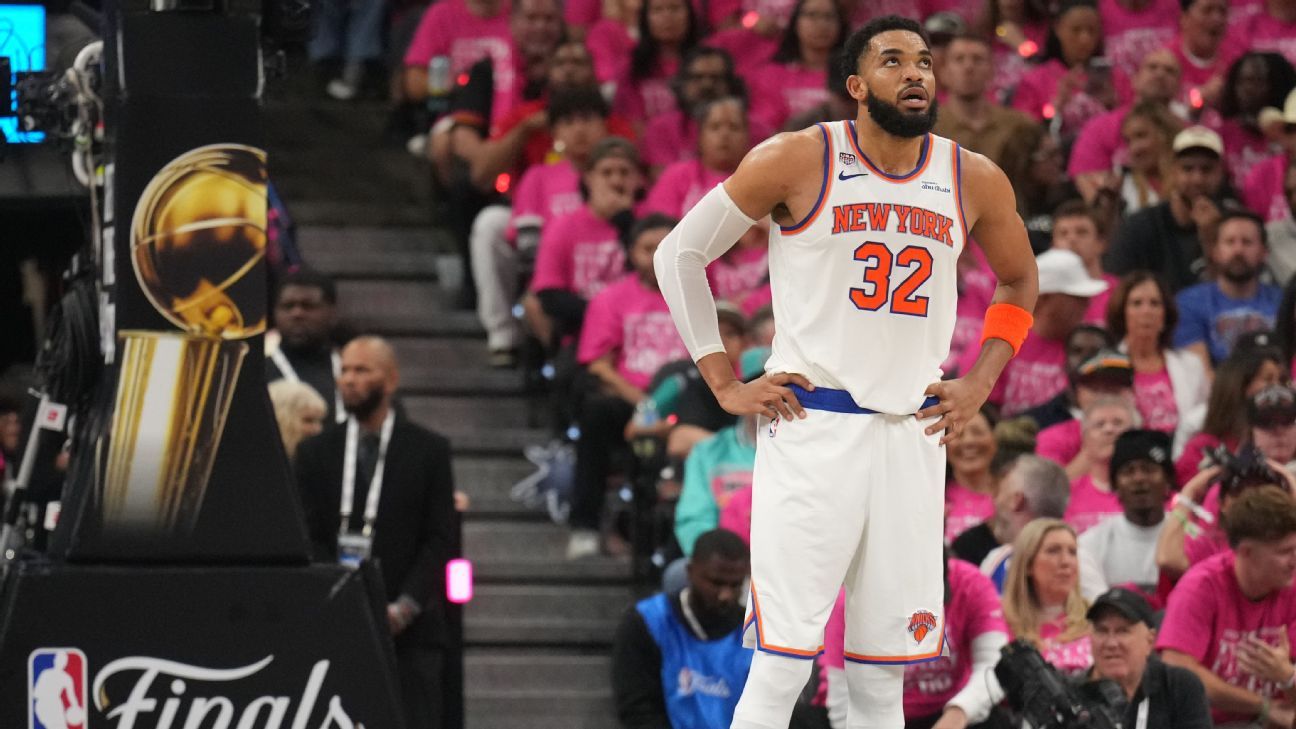
2026年NBA总决赛的第一场较量是一场防守战术的肉搏战。相比于2026年的现代篮球,这场比赛更像是上世纪90年代的风格——那是纽约尼克斯上一次打进总决赛的年代。
尼克斯在本场比赛中105.0的进攻效率在今年常规赛中只能排在第30位,而圣安东尼奥马刺96.0的进攻效率更是会以两位数的差距惨遭垫底。两队合计投篮命中率仅为39%,三分命中率更是低至28%。
凭借当家球星的优异表现和末节的强势收官,尼克斯克服了14分的落后劣势,在客场以105-95逆转险胜,偷走总决赛首场胜利。纽约目前已豪取12连胜,距离夺得53年来的首个总冠军仅差三场胜利。
让我们从全方位拆解第一场比赛,从最关键的回合到关键指标,再到第二场比赛(美东时间周五晚8:30,ABC/ESPN app直播)值得关注的核心对位。
快速链接:
赛程表 | 对阵图 | 核心要点
现场花絮 | 季后赛专题报道
第一场比赛最关键的回合
主场作战的马刺在第一场的大部分时间里都掌控着局势。第三节中段,圣安东尼奥一度以65-51领先14分,随后纽约尼克斯开始苏醒。
随着马刺替补中锋卢克·科内特 (Luke Kornet)上场换下维克托·文班亚马 (Victor Wembanyama),卡尔-安东尼·唐斯 (Karl-Anthony Towns)助攻兜出来的米卡尔·布里奇斯 (Mikal Bridges)跳投命中。紧接着,唐斯妙传空切的兰德里·沙梅特 (Landry Shamet)——由于没有文班亚马在篮下镇守,沙梅特轻松完成空切再拿两分。随后一次进攻,唐斯直接一步过掉科内特,打成2+1上篮。
— KramClips (@ KramClips) June 4, 2026
马刺主帅米奇·约翰逊 (Mitch Johnson)请求暂停并重新换上文班亚马,但唐斯滚烫的手感并未冷却。他顶着这位年轻法国新星的防守抢下进攻篮板补篮得手。在随后的回合中,他更是展现了为什么马刺在今年总决赛中面临着如此艰难的对位抉择。
在文班亚马名义上防守乔什·哈特 (Josh Hart)的情况下——这是马刺更倾向的防守对位,因为这能让这位全票当选的最佳防守球员像自由安全卫一样在底线附近游弋协防——尼克斯的进攻很难创造出机会。文班亚马延误了杰伦·布伦森 (Jalen Brunson)的挡拆,阻止了哈特的突破,并让沙梅特不敢轻易杀入禁区。随着进攻时间一分一秒流逝,哈特被迫迎着文班亚马伸展的左臂,投出了一个受到干扰的三分球。这通常是圣安东尼奥最希望看到的防守结果。
事实上,哈特的投篮确实偏出了。然而,由于文班亚马此时被拉到了外线,唐斯在内线获得了宝贵的空间。他力压凯尔登·约翰逊 (Keldon Johnson)再次抢下进攻篮板,顶着对抗强行打成又一次2+1上篮。在不到四分钟的时间里,14分的领先优势被蚕食到仅剩2分。
— KramClips (@ KramClips) June 4, 2026
当唐斯处于最佳状态时,他能将篮下的统治力、可靠的三分投射以及新开发出的组织策应能力融为一体。马刺的侧翼球员如凯尔登·约翰逊、德文·瓦塞尔 (Devin Vassell)和朱利安·尚帕尼 (Julian Champagnie)在身材上无法限制他,而科内特在速度上又跟不上。这使得文班亚马成为了马刺阵中唯一有可能阻止他得分的人。
在第一场比赛中,马刺让文班亚马防守唐斯的时间超出了预期,但只有当文班亚马能够扮演联盟最顶级的底线协防者,而不是被投手拉开到外线时,马刺才能制造出最大的防守威胁。他们希望用他来对位哈特。然而,正如唐斯在尼克斯第三节关键反扑波中所展现的那样,对于马刺的其他防守人来说,他可能是一个过于棘手的对位。
唐斯与切特·霍姆格伦 (Chet Holmgren)之间的这种差异——后者在面对马刺用侧翼球员防守自己时,并没有让马刺付出代价——正是尼克斯赢下总决赛首战(而俄克拉荷马雷霆没能赢下西部决赛抢七大战)的原因。
唐斯最终交出的18分、12个篮板和4次助攻的数据,并不能完全体现他在周三晚上所起到的全面作用。他不仅仅是在进攻端发力,在防守端他的表现甚至更加出色,在顶防文班亚马时展现出了超出预期的坚韧。
尼克斯几乎完全用中锋(唐斯和米切尔·罗宾逊 (Mitchell Robinson))来防守文班亚马,而不是穿插使用哈特或OG·阿奴诺比 (OG Anunoby)等身体强壮的侧翼进行防守。事实证明,这种策略起到了效果。虽然文班亚马在唐斯身上制造了几次犯规,但根据GeniusIQ的数据统计,当唐斯作为他的主要防守人时,他的运动战投篮仅为13投2中。在面对唐斯的防守时,他仅得到9分,并出现了5次失误。
总体而言,文班亚马在第一场比赛中出现了6次失误,投丢了15个球,这两项数据均创下了他今年季后赛单场新高。在接下来的比赛中,他需要在攻防两端都找到破解唐斯这一难关的办法。
第一场比赛的三大启示
1. 哈特在今年季后赛中依然在寻找投篮手感——他的三分命中率目前已跌至29%——但他依然是尼克斯最重要的粘合剂球员,并且在这轮系列赛中扮演着举足轻重的角色。尽管他在第一场比赛中仅得3分,但他贡献了15个篮板、6次助攻和4次抢断,正负值达到了全场最高的+22。
根据ESPN的数据统计,拉里·伯德是NBA总决赛历史上唯一一位单场至少拿到15个篮板、6次助攻和4次抢断的球员。而哈特则是首位在总决赛单场比赛中,这三项数据均独占全场第一的球员。
马刺赢下了上半场(当时哈特因陷入犯规麻烦仅打了7分钟),但在下半场(哈特打了20分钟)遭遇完败,这绝非巧合。
2. 达龙·福克斯 (De’Aaron Fox)在上半场结束前打成了几次精彩回合:他抢断了布伦森,完成快攻扣篮,并送出一次精妙的分球,助攻朱利安·尚帕尼投中底角三分。
但在第一场比赛的其他时间里,福克斯几乎隐形。他仅得7分,是马刺所有首发球员中得分最少的,并且他的失误次数(3次)和运动战进球数(3个)一样多。(文班亚马也是如此,两项数据均为6次/个。)在比赛最后几分钟布伦森投中反超比分的三分球后,福克斯随即错失了一个本可以扳平比分的空位急停跳投。
换句话说,一位左手全明星控卫投进了他的关键球,而另一位左手全明星控卫则没有。有时候,篮球运动就是这么简单。
与此同时,另一位充满活力的左手控卫——马刺新秀迪伦·哈珀 (Dylan Harper)——可以说是周三晚上圣安东尼奥表现最好的球员。这位20岁的替补后卫在他的首场总决赛中表现得侵略性十足且毫无畏惧,10投6中砍下16分;他是马刺阵中唯一一位投篮命中率达到或超过50%的球员。
福克斯作为一名老将,在比赛收尾阶段有着极佳的声誉——谁能忘记他是2023年首届年度最佳关键球员奖得主,而布伦森是在两年后才拿到这一奖项的?——但哈珀没有出现在米奇·约翰逊的收官阵容中,依然令人感到意外。如果这两位球员的表现差距继续存在,那么这一用人动态将非常值得关注。
3. “我们上半场的退防简直太糟糕了,”尼克斯主帅迈克·布朗 (Mike Brown)在半场休息时对场边记者丽莎·塞尔特斯 (Lisa Salters)说道。
他说得没错。根据ESPN的数据统计,马刺在上半场打出了16次转换进攻,追平了自2013-14赛季有追踪数据以来,总决赛半场转换进攻次数的最高纪录。他们通过这些转换回合砍下了21分。
然而,尼克斯在下半场切断了马刺轻松得分的这一途径。下半场纽约仅出现1次失误,而圣安东尼奥在仅有的3次转换机会中仅得到1分。
鉴于马刺在第一场的阵地战中得分举步维艰,他们需要通过奔跑来创造进攻机会。但尼克斯在季后赛中场均失分快攻分是第二少的,仅次于多伦多猛龙。(马刺排名第三。)马刺需要在第二场比赛中寻找更多推速度的机会。
展望第二场比赛的细节与观察
• 对圣安东尼奥来说,一个令人欣慰的迹象是,他们的进攻过程并没有最终呈现出的结果那么糟糕。根据GeniusIQ的数据,两队在量化投篮概率(根据投篮人身份和防守人位置等因素估算的“预期”有效命中率)上几乎持平。
马刺的实际有效命中率比预期低了10.1%,这是他们本赛季所有比赛中的第二差表现,也是季后赛中的最差表现。尼克斯的实际表现也低于预期,但5.1%的偏差并没有那么极端。
如果马刺在第二场比赛中能有更好的投篮手感,将对扳平总决赛大比分大有裨益。
• 马刺在第二节曾尝试让新秀卡特·布莱恩特 (Carter Bryant)去防守布伦森。理论上,布莱恩特是那种身材高大、对抗强硬、能够限制布伦森的侧翼。
但在实际对位中,布伦森通过一次次冲击篮下将这位新秀彻底打爆。在布莱恩特作为主要防守人时,他4投3中,而布莱恩特在下半场再也没有获得出场机会。
再加上哈里森·巴恩斯 (Harrison Barnes)低效的出场表现,以及年度最佳第六人凯尔登·约翰逊仅出场8分钟(创下他今年季后赛单场新低),马刺在锋线位置上显得有些捉襟见肘。
• 不过,除了与布莱恩特对位的短暂时间外,马刺在第一场比赛中让布伦森为了得到30分付出了巨大的努力。他的效率并不高,出手了31次,根据GeniusIQ的数据,他的量化投篮概率仅为48%——这是他今年季后赛所有比赛中的最低纪录。
面对马刺的防守,这就是常态。在谢伊·吉尔杰斯-亚历山大 (Shai Gilgeous-Alexander)今年季后赛打过的15场比赛中,投篮质量最差的6场全部发生在上一轮对阵马刺的系列赛中。
布伦森一次又一次地证明了自己投进高难度球的能力。但第一场的投篮选择和难度,即使对他来说也太难了。
• 这轮系列赛的主要战场之一是尼克斯对篮下的无情冲击与马刺统治级护筐防守的较量。在进入总决赛之前,尼克斯以每百回合54.8分的内线得分领跑所有季后赛球队,而马刺则以场均仅让对手在内线得到40.9分领跑所有季后赛防守。
尼克斯赢下了第一场的内线之争,在禁区内砍下了50分,而这一数据继续对马刺今年春天的比赛结果起着预测性作用。在今年季后赛中,当马刺让对手内线得分至少达到40分时,他们的战绩仅为3胜6负;而当他们将对手的内线得分限制在40分以下时,战绩则为傲人的9胜1负。
由生成式 AI 翻译,译文内容可能不准确或不完整,以原文为准。
点击查看原文:2026 NBA Finals: Important plays, lessons from Knicks-Spurs Game 1
2026 NBA Finals: Important plays, lessons from Knicks-Spurs Game 1
Game 1 of the 2026 NBA Finals was a tactical defensive slugfest more emblematic of the 1990s, when the New York Knicks last made the Finals, than of 2026.
The Knicks’ 105.0 offensive rating in the game would have ranked 30th in this regular season, and the San Antonio Spurs’ 96.0 offensive rating would have ranked last by a double-digit margin. The two teams shot a combined 39% from the field and 28% from 3-point range.
Thanks to superior performances from their stars and a tremendous closing kick, the Knicks overcame a 14-point deficit to steal Game 1 on the road, 105-95. New York has now won 12 games in a row and needs just three more victories to claim its first championship in 53 years.
Let’s break down Game 1 from all angles, from its most important plays to the key indicators and matchups to watch in Game 2 (Friday, 8:30 p.m. ET, ABC/ESPN app).
Quick links:
Schedule | Bracket | Takeaways
Sights, sounds | Playoff coverage
The most important plays of Game 1
The home team was in control for most of Game 1. San Antonio led by 14 points midway through the third quarter, 65-51, before New York came alive.
With Spurs backup center Luke Kornet in the game in place of Victor Wembanyama, Karl-Anthony Towns found a curling Mikal Bridges for a jumper. Then Towns dished to a cutting Landry Shamet – who benefitted from no Wembanyama blockading the rim – for two more points. Towns then blew past Kornet for an and-1 layup on the next trip down the floor.
— KramClips (@ KramClips) June 4, 2026
Spurs coach Mitch Johnson called a timeout and reinserted Wembanyama, but Towns’ hot hand didn’t dissipate. He grabbed an offensive rebound over the young Frenchman for a putback layup, and on the next possession, he showed why the Spurs have such difficult matchup choices in these Finals.
With Wembanyama nominally guarding Josh Hart – the Spurs’ preferred assignment, because it allows the unanimous Defensive Player of the Year to roam the baseline in a free safety role – the Knicks offense struggled to create an opening. Wembanyama corralled a Jalen Brunson pick-and-roll, halted a Hart drive and deterred Shamet from venturing into the lane. The shot clock wound down, and Hart was forced to launch a semi-contested 3-pointer over Wembanyama’s outstretched left arm. That’s normally a great outcome for San Antonio.
And indeed, Hart’s shot missed. With Wembanyama now on the perimeter, though, Towns had precious room to work down low. He outmuscled Keldon Johnson for another offensive rebound, shook off the contact and scored another and-1 layup. A 14-point lead had dwindled to two in less than four minutes.
— KramClips (@ KramClips) June 4, 2026
When Towns is at his best, he blends force at the basket with a reliable 3-pointer with a newly discovered playmaking spark. Spurs wings such as Johnson, Devin Vassell and Julian Champagnie aren’t big enough to stop him, and Kornet isn’t fast enough. That leaves Wembanyama as perhaps the only Spur who can keep him off the scoreboard.
The Spurs used Wembanyama on Towns more than expected in Game 1, but they create the most defensive havoc when Wembanyama can serve as the league’s best backline helper, rather than spacing out with a shooter. They want to match him with Hart. Yet as Towns showed on this key play in the Knicks’ crucial third-quarter run, he might be too tricky a matchup for anyone else to handle.
That difference between Towns and Chet Holmgren – who did not make the Spurs pay for guarding him with a wing – is why the Knicks won Game 1 in the Finals (and the Oklahoma City Thunder didn’t win Game 7 of the Western Conference finals).
Towns’ final stat line of 18 points, 12 rebounds and four assists doesn’t capture his holistic impact on Wednesday night. He wasn’t solely a one-way player; if anything, he excelled even more on the defensive end, where he held up better than expected against Wembanyama.
The Knicks almost exclusively defended Wembanyama with centers (Towns and Mitchell Robinson), rather than mixing in coverage from a physical wing such as Hart or OG Anunoby. And that approach worked. Wembanyama drew several fouls on Towns, but he shot just 2-for-13 from the field when Towns was his primary defender, according to GeniusIQ tracking. He had nine points and five turnovers against Towns.
Overall, Wembanyama finished Game 1 with his most turnovers (six) and missed shots (15) in any game this postseason. He’ll need to solve Towns’ challenge – on both ends – going forward.
Three key Game 1 lessons
1. Hart continues to struggle with his jumper in this postseason – he’s now down to 29% on 3-pointers – but he remains the Knicks’ most important glue guy, and he has a clear place in this series. Although he ended Game 1 with just three points, he contributed 15 rebounds, six assists and four steals, and he was a game-high plus-22.
Larry Bird is the only other player in NBA Finals history with at least 15 rebounds, six assists and four steals in a game. And Hart is the first player to lead a Finals game outright in all three categories, per ESPN Research.
It’s no coincidence that the Spurs won the first half (when Hart played just seven minutes due to foul trouble) but lost the second half (when Hart played 20 minutes) convincingly.
2. De’Aaron Fox made a couple of huge plays to end the first half: He swiped the ball from Brunson, converted a fast-break dunk and made a nifty kickout pass to Julian Champagnie for a corner 3.
But Fox was otherwise invisible in Game 1. His seven points were the fewest for any Spurs starter, and he recorded as many turnovers (three) as made field goals. (So did Wembanyama, with six of each.) Immediately after Brunson made a go-ahead 3-pointer in the final minutes, Fox missed an open pull-up jumper that would have tied the score.
Put another way, one lefty All-Star point guard made his clutch shot, and one lefty All-Star point guard didn’t. Sometimes, the sport is that simple.
Meanwhile, another dynamic lefty point guard – Spurs rookie Dylan Harper – was arguably San Antonio’s best player on Wednesday. The 20-year-old backup was aggressive and fearless in his first Finals game, scoring 16 points on 6-of-10 shooting; he was the only Spur who made at least half of his shot attempts.
Fox is a veteran with a solid end-of-game reputation – who can forget that he was the inaugural Clutch Player of the Year winner in 2023, two years before Brunson claimed that award? – but it was still a surprise that Harper wasn’t in Mitch Johnson’s closing group. That dynamic is worth watching if a gap between the two players’ performances persists.
3. “Our transition defense was terrible in the first half,” Knicks coach Mike Brown said to sideline reporter Lisa Salters at halftime.
He wasn’t wrong. According to ESPN Research, the Spurs had 16 transition plays in the first half, which was tied for the most by any team in a Finals half in the tracking era (since 2013-14). They scored 21 points on those plays.
The Knicks shut down that outlet for easy Spurs points after the break, however. In the second half, New York committed only one turnover, and San Antonio scored just one point from three transition opportunities.
Given how much the Spurs struggled to score in the halfcourt in Game 1, they needed to run to generate offense. But New York has allowed the second-fewest fast-break points in the playoffs, behind only Toronto. (San Antonio ranks third.) The Spurs need to identify more opportunities to push the pace throughout Game 2.
Notes and loose ends looking ahead to Game 2
• One encouraging sign for San Antonio is that its offensive process wasn’t as dire as its offensive results. According to GeniusIQ, the two teams were just about equal in quantified shot probability, which estimates a team’s “expected” effective field goal percentage based on factors like shooter identity and defender location.
The Spurs underperformed their expected effective field goal percentage by 10.1%, their second-worst mark in any game this season, and their worst in the postseason. The Knicks also underperformed, but by a less outlier-y 5.1%.
Better shooting luck for the Spurs in Game 2 would go a long way toward evening the Finals.
• The Spurs attempted to defend Brunson with rookie Carter Bryant for a stretch in the second quarter. Bryant is the sort of big, physical wing who can slow Brunson in theory.
But in practice, Brunson torched the rookie with repeated drives to the basket. He shot 3-for-4 with Bryant as his primary defender, and Bryant didn’t get off the bench in the second half.
Add in an ineffective stint from Harrison Barnes and just eight minutes for Sixth Man of the Year Keldon Johnson, his fewest in any playoff game, and the Spurs are looking thin at the forward positions.
• Beyond that abbreviated stretch with Bryant, however, the Spurs made Brunson work for every one of his 30 points in Game 1. He wasn’t very efficient, with 31 field goal attempts, and his quantified shot probability was just 48%, per GeniusIQ – his lowest mark in any game this postseason.
Such is life against the Spurs defense. Out of the 15 games that Shai Gilgeous-Alexander played in these playoffs, the bottom six in shot quality all came against San Antonio last round.
Brunson has demonstrated, time and again, his ability to make tough shots. But the shot diet in Game 1 was difficult even for him.
• One of the main battlegrounds in this series is the Knicks’ relentless rim attacks versus the Spurs’ dominant rim defense. Entering the Finals, New York led all playoff offenses with 54.8 points in the paint per 100 possessions, while the Spurs led all playoff defenses by allowing just 40.9.
The Knicks won that battle in Game 1, with 50 points in the paint, and that stat continues to be predictive of San Antonio’s results this spring. The Spurs are now 3-6 in the playoffs when they allow at least 40 points in the paint, versus 9-1 when they hold teams below 40.
By Zach Kram, via ESPN