By Dave DuFour | The Athletic, 2026-06-20 10:30:06
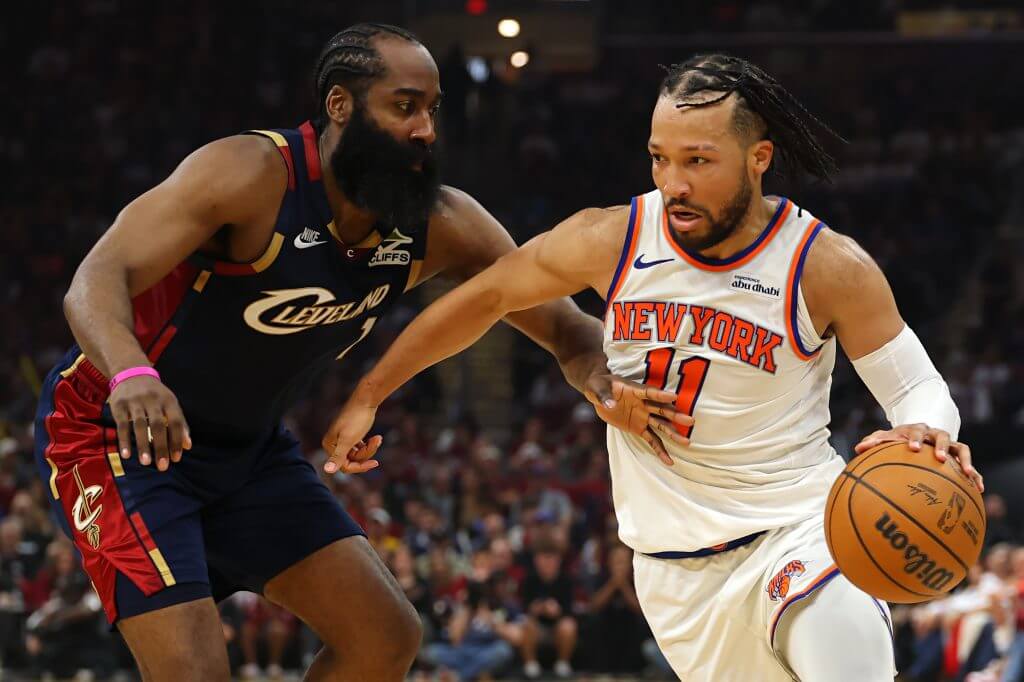
纽约尼克斯在东部决赛和总决赛中对阵克利夫兰骑士和圣安东尼奥马刺,取得了8胜1负的战绩。但如果你在赛后去听听对手教练、球员和球迷的言论,你可能会以为这个战绩反过来了。
为什么会这样?
在这或许是2026年季后赛最经典的一段语录中,骑士队主教练肯尼·阿特金森 (Kenny Atkinson) 在系列赛大比分0-3落后尼克斯时,向台下目瞪口呆的记者们声称:“从数据分析来看……在期望得分(expected score)上,我们三场里赢了两场。我不知道你们有没有关注过这个,期望得分。
“我知道你们现在看起来很困惑,”他继续说道。
因为我们确实很困惑!
骑士后卫詹姆斯·哈登 (James Harden) 在系列赛结束后补充道:“他们4-0横扫了我们。……但说实话,我真的觉得我们是那支更好的球队。”
让我们从一开始就挑明吧。骑士绝对不是那支更好的球队。他们被彻底击败了,在系列赛的16个单节中输掉了12节,还输掉了一个加时赛。尼克斯的有效命中率高达58.5%,而骑士仅为49.8%,这两个数字如果放在常规赛,将分别排名联盟第1和第30。这几乎是本赛季排名第一的丹佛掘金与垫底的布鲁克林篮网之间5.7个百分点差距的两倍。
纽约在攻防两端的篮板球上都摧毁了克利夫兰,他们抢下了34.8%的前场篮板(自身投失的球),同时将骑士的前场篮板率限制在26.5%。在决定胜负的“四要素”(投篮、前场篮板率、失误率、罚球率)中,尼克斯在其中两项上甩了骑士几条街。在这个“投进或投丢”的联盟里,尼克斯投进了大量的球,而骑士投丢得更多,并且当纽约投丢时,他们还能获得二次进攻的机会。
这是一个经典的案例,正如我以前的播客搭档塞斯·帕特诺 (Seth Partnow) 会指出的那样:“数据自己不会说话,说话的是你。”
那么,圣安东尼奥马刺呢?他们确实有理由争辩一下。在总上场时间里有72%的时间处于领先,并且在每场比赛中都曾取得过两位数的领先(包括第四场比赛中曾领先多达29分),马刺在场上往往看起来是更出色的那支球队。在这场堪称史上竞争最激烈的五场系列赛之一中,两队在大多数数据统计上都旗鼓相当也就不足为奇了。尼克斯唯一拥有明显优势的地方是在篮板球上,他们抢下了33.2%的前场篮板,创下了马刺季后赛对手的新高,同时将圣安东尼奥的前场篮板率限制在仅有28.6%。
马刺的防守将尼克斯的进攻效率限制在110.1,而尼克斯在晋级总决赛期间的进攻效率高达123.3。但尼克斯同样限制住了马刺的进攻,并凭借关键时刻的投篮艰难赢下了比赛。这是否需要对手经历一系列历史性的崩盘?是的。这理想吗?绝对不。但这或许是因为尼克斯能够打满整整48分钟,而不是只打好第一节和第三节。
在系列赛的每一场比赛中,马刺都开局火热,而尼克斯则频频打铁。在这五场系列赛的第一节中,圣安东尼奥的投篮命中率高达54.1%,而纽约仅为惨淡的32%。但在随后的比赛中,这些数据发生了反转。尼克斯在第二节找到了节奏,命中率提升至51.4%,而马刺的命中率则断崖式下跌至37.6%。圣安东尼奥在第三节稍有回暖,但第四节33.7%的命中率让他们的努力化为泡影。尼克斯在第三节和第四节的命中率分别为45.2%和38.7%。
纽约尼克斯主教练迈克·布朗 (Mike Brown) 在系列赛的大部分时间里都在应对卡尔-安东尼·唐斯 (Karl-Anthony Towns) 的犯规麻烦,他尝试了59种阵容组合,而米奇·约翰逊 (Mitch Johnson) 和马刺仅尝试了40种。有时候,教练必须带领球队打好每一个回合。布朗展现出了调整阵容的意愿,而约翰逊则更倾向于坚持使用他的常规轮换。在比赛的关键时刻,尼克斯显然更有活力。
但这不仅仅是投篮运气的问题:尼克斯的防守也在细节上让马刺的进攻陷入停滞。尼克斯在二次进攻得分上场均净胜5.2分,将马刺的二次进攻得分限制在比他们之前的对手少2.4分。纽约充分利用了快攻机会,在这项对比中场均净胜3.2分,同时将圣安东尼奥的快攻得分限制在比他们在季后赛其他比赛中场均少5分。
尼克斯最大的胜利可能发生在内线。与对阵西部对手时相比,马刺在对阵尼克斯时内线场均得分减少了9分,而尼克斯在这一项上几乎与他们平分秋色。
马刺的进攻效率从进入总决赛前的115.4下降到对阵尼克斯时的107.4。圣安东尼奥在半场进攻中受阻,而纽约让他们很难通过前场篮板和转换进攻获得轻松得分的机会。
系列赛结束后,维克托·文班亚马 (Victor Wembanyama) 表示:“我们统治比赛的阶段是绝对的。在系列赛的大部分时间里,我们绝对占据了统治地位。但我们的失误、我们的犯错,受到的惩罚太严重了,我们不能再有这么多起伏了。”
尼克斯的首发阵容在总决赛中拥有+21.8的净效率,比马刺的首发阵容每百回合好9分多。因此,如果说圣安东尼奥的失误是钉子,那么尼克斯的首发就是雷神之锤(Mjölnir)。尽管开局慢热,但纽约的首发在比赛的其余时间里都占据了统治地位。
在NBA定义的18分钟关键时刻(clutch time)里,尼克斯的防守效率为95.1,净效率为+7.6。在最关键的时刻——第五场比赛的最后八分钟里,杰伦·布伦森 (Jalen Brunson) 仅用6次出手就砍下了15分,而马刺在16次出手里仅得到7分。这就是系列赛的缩影。尼克斯每晚能拼凑出完整的48分钟,而马刺只有大约36分钟。
篮球不是在纸上打出来的。唯一重要的数据是最终的比分。而这正是尼克斯占据统治地位的地方。凭借季后赛的13连胜,以及在分区决赛和总决赛中取得的8胜1负战绩,尼克斯非常擅长赢下篮球比赛。
由生成式 AI 翻译,译文内容可能不准确或不完整,以原文为准。
点击查看原文:Why did the Spurs, Cavs feel like they outplayed the Knicks in the playoffs?
Why did the Spurs, Cavs feel like they outplayed the Knicks in the playoffs?
The New York Knicks went 8-1 against the Cleveland Cavaliers and San Antonio Spurs in the Eastern Conference finals and NBA Finals. But if you listened to opposing coaches, players and fans after the games, you’d have thought that record was reversed.
Why?
In what may have been the quote of the 2026 playoffs, Cavaliers head coach Kenny Atkinson, while facing a 3-0 series deficit to the Knicks, professed to a stunned audience of reporters that “Analytically … we’re two out of three in the expected (score). I don’t know if you guys follow that, the expected score.
“And I know you’re looking confused,” he continued.
Because we were!
Cavs guard James Harden added after the series, “They dominated us 4-0. … Genuinely, I do feel like we are the better team.”
Let’s clear this up from the jump. The Cavaliers were not the better team. They were thoroughly outplayed, losing 12 out of 16 quarters and an overtime in the series. The Knicks had a 58.5 effective field goal percentage compared to only 49.8 percent for the Cavs, which would have ranked 1st and 30th in the regular season, respectively. That’s almost double the 5.7 percentage points difference between the first-place Denver Nuggets and the last-place Nets this season.
New York destroyed Cleveland in rebounding on both ends, snagging 34.8 percent of their own misses and holding the Cavs to a 26.5 percent offensive rebound rate. That’s two out of the four factors (shooting, offensive rebound rate, turnover ratio, free-throw rate) to winning where the Knicks lapped the Cavaliers. In a make-or-miss league, the Knicks made a lot and the Cavs missed even more and when New York missed, they got second chances.
This is a classic case where my former podcast partner Seth Partnow would point out, “The numbers don’t say. You say.”
Now, the San Antonio Spurs? They have an argument. Between leading for 72 percent of the minutes played and holding double-digit leads in every game, including a series high 29 during Game 4, the Spurs often seemed to be the better team on the court. In one of the closest five-game series ever, it should come as no surprise that the two teams are close in most statistical categories. The only place the Knicks had a clear advantage was on the glass, snagging 33.2 percent of their misses, a playoff high for a Spurs opponent, while holding San Antonio to only 28.6 percent on their offensive rebounding opportunities.
The Spurs defense limited the Knicks to a 110.1 offensive rating compared to 123.3 in their run to the finals, but the Knicks were able to stifle the Spurs offense equally and eked out just enough shot-making to win games. Did it require a historic string of collapses? Yes. Was it ideal? Definitely not. But maybe that is because the Knicks were able to play for the full 48 minutes, instead of just first and third quarters.
Every game of the series, the Spurs started hot and the Knicks missed a lot of shots. San Antonio shot 54.1 percent from the field in first quarters over the five-game series, while New York was a paltry 32 percent. Those numbers flipped the rest of the way. The Knicks seemed to catch their stride heading into halftime at 51.4 percent in second quarters, while the Spurs’ shooting numbers fell off a cliff to 37.6 percent. A slight bounce back in third quarters for San Antonio was obliterated by shooting 33.7 percent in fourth quarters. The Knicks shot 45.2 percent and 38.7 percent in third and fourth quarters, respectively.
New York Knicks head coach Mike Brown, battling through Karl-Anthony Towns’ foul trouble for a lot of the series, tried 59 lineup combinations to only 40 from Mitch Johnson and the Spurs. Sometimes a coach just has to get their team from possession to possession. Brown showed a willingness to mix it up, whereas Johnson tended to stick to his guys. The Knicks had more juice when the games mattered.
But it wasn’t just shooting luck: The Knicks defense made the Spurs offense sputter around the margins as well. The Knicks were plus-5.2 points per game in second-chance points, holding the Spurs to 2.4 fewer compared to their previous opponents. New York capitalized on fast breaks, winning that battle by 3.2 ppg, while holding San Antonio to five fewer points per game than they had during the rest of the playoffs.
The biggest win for the Knicks may have occurred in the paint. The Spurs were nine points per game worse against the Knicks compared to their Western Conference opponents, while the Knicks nearly equaled them in the same category.
The Spurs’ offensive rating went from 115.4 entering the finals to 107.4 against the Knicks. San Antonio was stifled in the half court and New York made it harder to get easy offense from offensive rebounding and transitions.
After the series ended, Victor Wembanyama said, “Our domination stints are absolute. We absolutely dominated for most of the series. But our errors, our mistakes, are punished so hard that we can’t have ups and downs like this so much.”
The Knicks’ starting lineup had a plus-21.8 net rating for the finals, which is a little over nine points per 100 possessions better than the Spurs’ starters. So if San Antonio’s mistakes were nails, the Knicks starters were Mjölnir. Despite their slow starts, New York’s starters were dominant the rest of the game.
In 18 minutes of what the NBA defines as clutch time, the Knicks had a 95.1 defensive rating and a plus-7.6 net rating. When it mattered the most, in the final eight minutes of Game 5, Jalen Brunson scored 15 points on six shot attempts and the Spurs had seven points on 16 attempts. That was the series. The Knicks pieced together 48 minutes a night and the Spurs only had about 36.
Basketball isn’t a game played on paper. The only stat that matters is the final score. That’s where the Knicks were dominant. Between their 13-game playoff winning streak and their 8-1 record over the conference finals and finals, the Knicks were great at winning basketball games.
By Dave DuFour, via The Athletic