By Zach Kram, 2026-05-26 19:00:00
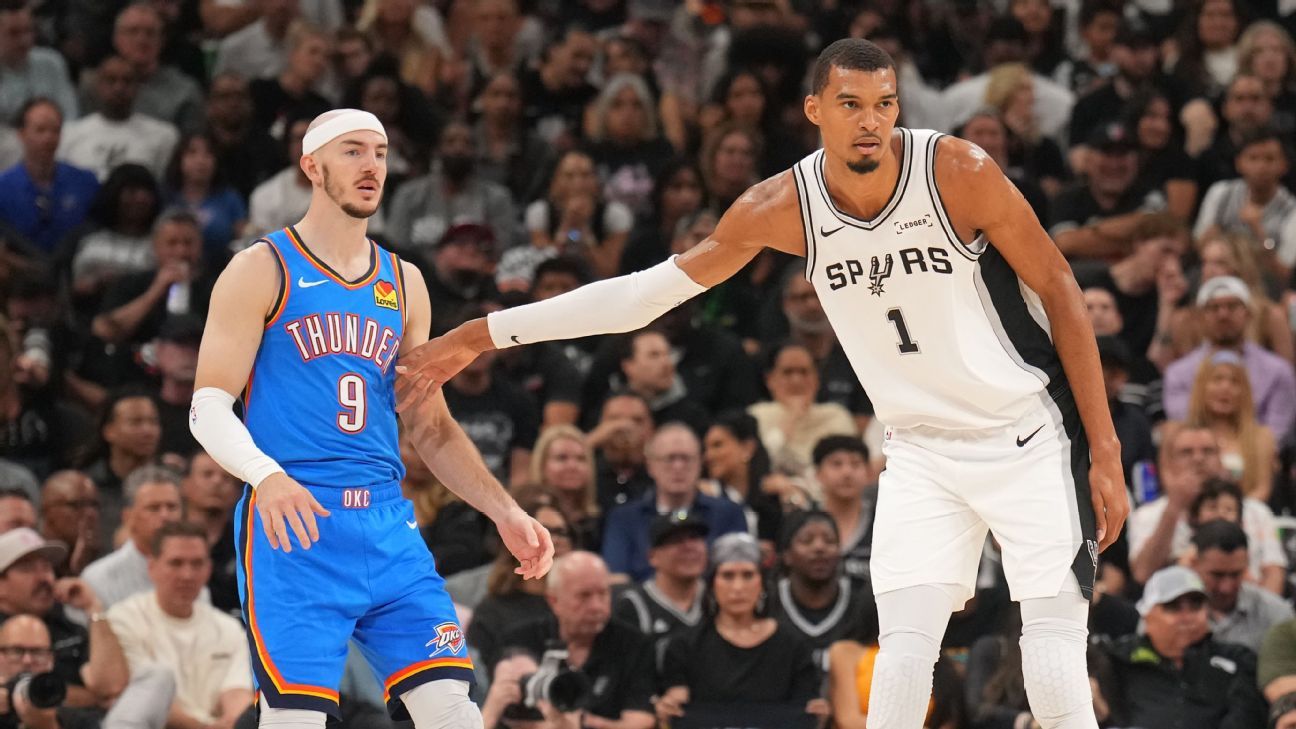
2026年NBA分区决赛在季后赛对阵图的一侧正渐入高潮,而在另一侧则已早早失去悬念。
在西部,俄克拉荷马城雷霆与圣安东尼奥马刺不负众望,正上演着系列赛经典对决,双方带着2-2的比分进入周二的第五场天王山之战(美东时间晚上8:30,NBC直播)。与此同时在东部,纽约尼克斯在周一以4-0横扫克利夫兰骑士,自1999年以来首次杀入NBA总决赛。
随着2025-26赛季NBA进入最后一个月,让我们来盘点最后四支球队的六大关键趋势和启示。我将从圣安东尼奥开始,聊聊截至目前季后赛的MVP。
跳转至相应板块:
文班即MVP | 卡鲁索的传奇色彩 | 尼克斯首发阵容
尼克斯的运气 | 骑士的得分难题 | 不可或缺的哈特
维克托·文班亚马是(目前为止的)季后赛MVP
马刺是否能爆冷击败卫冕冠军并晋级总决赛,目前还很难说。但显而易见的是,文班亚马是今年季后赛至今表现最好、最具有价值的球员。
尽管他有两场比赛因伤病和被驱逐而过早离场,但文班亚马在季后赛中依然场均贡献23.1分、11.4个篮板和3.8次盖帽。他的三分命中率达到37%,罚球命中率高达86%。当他在场时,马刺的净效率为+17.3;而当他下场时,马刺的净效率则跌至-0.3。
在分区决赛中,这一差距更加触目惊心:文班亚马在场时,马刺的净效率为+6.1;而当他不在场时,这一数字是令人震惊的-60.3。
在高阶数据方面,文班亚马在ESPN的净得分指标中高居今年季后赛所有球员之首。他的预估正负值(EPM)排名第一,而在高阶正负值(BPM)上排名第二,仅次于卡尔-安东尼·唐斯 (Karl-Anthony Towns)。
很难说唐斯是否甚至是今年春天他所在球队中最有价值的球员。在季后赛净得分排行榜上,杰伦·布伦森 (Jalen Brunson)、唐斯和OG·阿奴诺比 (OG Anunoby) 分别位列第二、第三和第四。
但文班亚马显然是马刺阵中无可争议的头牌,他在季后赛中的净得分几乎相当于马刺队内价值第二、第三和第四高的球员——迪兰·哈珀 (Dylan Harper)、斯蒂芬·卡斯尔 (Stephon Castle) 和朱利安·尚帕尼 (Julian Champagnie)——三人的总和。
2026年季后赛净得分榜
| 球员 | 球队 | 净得分 |
|---|---|---|
| 维克托·文班亚马 (Victor Wembanyama) | 马刺 | +72.2 |
| 杰伦·布伦森 | 尼克斯 | +57.3 |
| 卡尔-安东尼·唐斯 | 尼克斯 | +56.6 |
| OG·阿奴诺比 | 尼克斯 | +53.1 |
| 谢伊·吉尔杰斯-亚历山大 (Shai Gilgeous-Alexander) | 雷霆 | +37.6 |
对于一个首次参加季后赛的22岁年轻人来说,这绝对是现象级的表现。但这不过是再次证明了,文班亚马是NBA历史上前所未见的奇才。
亚历克斯·卡鲁索正在让自己的传奇履历更添光彩
卡鲁索可以说是雷霆在分区决赛中表现最好的球员。和队友们一样,他在第四场比赛中表现糟糕,但在前三场比赛中,他场均贡献21分,三分命中率高达61%,彻底粉碎了马刺在防守端放空他外线的企图。前三场比赛中,他的场均正负值(+15.3)并列全队第一。
这些进攻端的爆发相比于卡鲁索在防守端的常规贡献而言只是锦上添花,他是NBA最顶级且最全能的防守者之一。根据预估正负值(EPM),卡鲁索目前在每回合防守价值上排名全联盟第四,仅次于文班亚马、奥萨尔·汤普森 (Ausar Thompson) 和鲁迪·戈贝尔 (Rudy Gobert)。而在xRAPM数据上,他高居第二,仅次于文班亚马。
GeniusIQ的数据进一步印证了他的全能防守属性:在过去两轮比赛中,卡鲁索最频繁的防守对位对象分别是勒布朗·姆斯 (LeBron James)、文班亚马和卡斯尔。这三人分别对应前锋、中锋和后卫,且都是身体天赋异禀、技术特点迥异的球员。而卡鲁索能够胜任对他们每一个人的防守。
很难在历史上为卡鲁索找到一个完美的先例,这位随雷霆和湖人两度夺冠的球员确实独一无二。但我设定了三个筛选标准,试图找出一些对比模板。首先,该球员必须至少拥有两枚总冠军戒指,且在这些夺冠季后赛中场均出场时间至少达到15分钟;其次,这些冠军必须是在不同的球队获得的;第三,该球员必须从未入选过全明星,以彰显其纯粹的角色球员属性。
这些标准看似并不算特别苛刻,但筛选出来的名单却极度精简:除卡鲁索外,历史上仅有罗伯特·霍里 (Robert Horry,7冠)、罗恩·哈珀 (Ron Harper,4冠)、丹尼·格林 (Danny Green,3冠)、马里奥·埃利 (Mario Elie,3冠)、肯塔维奥斯·考德威尔-波普 (Kentavious Caldwell-Pope,2冠)、詹姆斯·波西 (James Posey,2冠) 和查尔斯·约翰逊 (Charles Johnson,2冠) 符合这些条件。
而卡鲁索甚至比他们还要特殊,因为他还有一个额外加成:在他所有的夺冠历程中,他都是替补出场。相比之下,哈珀、格林、埃利、考德威尔-波普和约翰逊在各自的夺冠赛季中至少有一半的场次是首发,这使得最终的“多队夺冠超级替补”名单中只剩下了卡鲁索、霍里和波西三人。
霍里名声在外,不仅是因为他投进了无数个价值连城的关键三分,更是因为他在季后赛中的整体贡献。他的生涯BPM从常规赛的+1.9飙升至季后赛的+3.7。波西的BPM升幅甚至更大,从常规赛的+0.3暴涨到季后赛的+3.2。
同样,卡鲁索的BPM也从常规赛的+1.1提升到季后赛的+2.6。而在雷霆,他的场均出场时间也从常规赛的18.9分钟(期间缺席了33%的比赛)增加到了季后赛的23.6分钟(保持全勤)。
就终极的团队荣誉而言,横跨三支球队夺得七冠的霍里显然还在另一个维度。但卡鲁索与他是同一类球员——一个真正意义上的“季后赛型选手”。
尼克斯首发阵容强势爆发
当尼克斯在2024年夏天交易得到唐斯和米卡尔·布里奇斯 (Mikal Bridges),并将这对双人组与队内原有的布伦森、阿奴诺比和乔什·哈特 (Josh Hart) 三人组结合时,他们似乎组建了一套完美平衡的现代首发五虎。至少在纸面上,纽约这套全新的主力阵容能够实现无死角得分、投射极其神准,并且具备精英级别的外线防守。
然而在过去两年里,这套阵容在实际配合中从未达到理论上的高度。上赛季,尼克斯的首发五人组净效率仅为+3.3;而本赛季,这一数字仅为+2.3,在全联盟所有共同出场至少200分钟的19套阵容中仅排在第16位。
在上赛季的季后赛中,尽管尼克斯时隔四分之一个世纪首次杀入分区决赛,但这套首发五人组在场时,每百回合反而净输6.2分。
但随着唐斯和阿奴诺比打出生涯至今最棒的季后赛表现、布里奇斯迎来蜕变,以及哈特和布伦森各司其职,尼克斯的首发阵容终于兑现了他们作为整体的全部潜力。
在纽约此前的十连胜期间(一直持续到分区决赛第二场),这套五人组的净效率达到了惊人的+15.2。在此期间,他们123.0的进攻效率如果放在常规赛可以高居联盟榜首,而107.8的防守效率则能排在联盟第二。
尼克斯的各种替补轮换组合——比如用迈尔斯·麦克布莱德 (Miles McBride)、兰德里·沙梅特 (Landry Shamet) 和米切尔·罗宾逊 (Mitchell Robinson) 替换一两名首发——在他们登场的时间里甚至能赢下更多的分差。但首发阵容终于在长时间的登场中展现出了统治力;尽管阿奴诺比缺席了两场比赛,他们依然是今年季后赛所有五人组合中总出场时间最长的。这正是打出历史级统治力的绝佳方程式。
篮球之神或许也是尼克斯球迷
在今年春天取得历史性成功的众多原因中,尼克斯也受益于那个老生常谈的“小样本事件”:投篮运气。
根据GeniusIQ的数据,截至分区决赛第三场,尼克斯的对手在今年季后赛中的“大空位”三分(最近的防守队员至少在6英尺外)命中率仅为32.0%。这是自2013-14赛季有数据追踪记录以来,所有分区决赛球队中对手大空位三分命中率的最低纪录。
季后赛对手大空位三分命中率
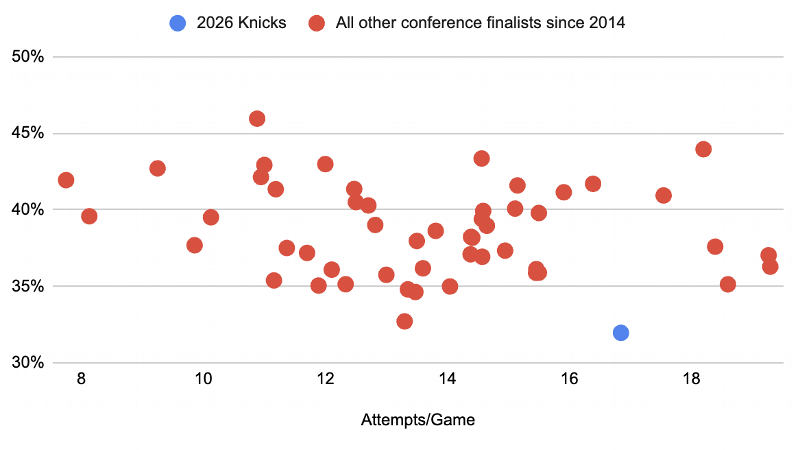
这是一个极不寻常的数据发现。在常规赛中,尼克斯对手的大空位三分命中率为37.8%。今年季后赛的整体大空位三分平均命中率同样是37.8%。而根据投篮球员身份、出手位置等因素计算出的尼克斯对手大空位三分“预期命中率”更是高达38.1%。
因此,无论从哪个角度来看,多伦多猛龙、费城76人和骑士投丢了如此多的大空位三分,只能说明尼克斯的运气简直好到了极点。
必须明确的是,这种运气并不是他们取得成功的主要原因。投篮质量数据表明,在这次季后赛之旅中,尼克斯在大空位三分防守上“本应该”多丢大约40分。这确实是个不小的数字,但与他们整体+234的净胜分相比,依然相去甚远。
然而,[如果他们打进/在](if they reach/in)总决赛,尼克斯很可能无法指望这种趋势能延续下去。他们不能奢望对手会继续投丢这么多平时十拿九稳的大空位机会。
克利夫兰骑士的得分难题
在今年季后赛早些时候,我曾撰文指出,尽管外界将大量注意力放在了掘金在数据上表现糟糕的防守上,但他们在季后赛中的挣扎很大程度上其实应该归咎于进攻。
这种反直觉的规律同样适用于克利夫兰。尽管外界对骑士排名联盟第15位的防守及其各种对位漏洞进行了大量分析——从詹姆斯·哈登 (James Harden) 单防布伦森,到骑士在对阵没有凯德·康宁汉姆 (Cade Cunningham) 的活塞时所做的努力——但在今年季后赛中,防守端的问题似乎根本无关痛痒。
相反,克利夫兰每场比赛的胜负完全取决于他们排名联盟第六的进攻。在骑士赢下的8场季后赛中,他们的进攻效率达到116.2或更高;而在输掉的9场季后赛中,他们的进攻效率则跌至110.2或更低。
任何球队在赢球时自然会比输球时得更多分。但这种因果关系通常不会像骑士这样黑白分明。例如,马刺在分区决赛第一场和第四场赢球时的进攻效率,反而低于他们输球的第二场和第三场。
但对克利夫兰来说,这种关系是直接且一一对应的。如果他们的得分达到联盟平均水平以上,他们就能赢;如果他们的进攻退化到联盟垫底水平,他们就会输。
对于一支围绕多诺万·米切尔 (Donovan Mitchell) 和哈登两位进攻天赋异禀的后卫建队的球队来说,这样的表现显然是不合格的。部分原因在于骑士的三分射手群在错误的时间集体手冷,但米切尔和哈登在今年季后赛中也缺乏足够的稳定性和效率。
结果就是,这支自1992年以来首次在没有詹姆斯的情况下杀入分区决赛的球队,最终在季后赛中却只拿到了胜少负多的战绩,如今在休赛期面临着巨大而棘手的难题。
满盘哈特与哈滕,所向披靡
在季后赛中,角色球员因为个人短板在季后赛熔炉中被无限放大而无法上场,这是相当普遍的现象。这就是著名的“不能上坎特”难题——大个子球员不够敏捷、无法防守挡拆,或者侧翼球员投篮不稳导致对手防守端直接将其放空,亦或是后卫身材太矮小而成为被对手点名单打的靶子。
想要在轮换阵容中塞满没有这些致命短板的球员绝非易事,因此对于争冠球队来说,角色球员能够克服自身局限性留在场上显得尤为重要。在分区决赛中,纽约和俄克拉荷马城都收获了这样的喜人结果。
对于尼克斯而言,哈特在第一场比赛的第四节和加时赛中被按在了替补席上,因为骑士在防守端完全放空他的外线,转而堵塞了他队友的突破路线。在他上场的31分钟里,纽约净输23分;而在他不在场的22分钟里,纽约反而净胜34分。
但哈特在第二场比赛中迎来反弹,砍下全场最高的26分并投进5记三分。当他在场时,纽约净胜18分。而在第三场比赛中,他的表现足够稳健,再次出场了35分钟。
同样,在俄克拉荷马城,中锋以赛亚·哈滕施泰因 (Isaiah Hartenstein) 在第一场比赛仅打了两分钟就因为对位文班亚马效果不佳而被换下。当晚他最终仅出场12分钟,且几乎都是在对抗马刺的替补阵容。
但雷霆主帅马克·戴格诺特 (Mark Daigneault) 在第二场比赛中改变了策略,让哈滕施泰因成为防守文班亚马的主要人选,意图利用哈滕施泰因的身材和对抗来消耗这位圣安东尼奥中锋。哈滕施泰因在第二场比赛的27分钟里贡献了10分和13个篮板(其中8个前场篮板),随后在第三场赢球的比赛中又打了21分钟,并且是第四场惨败中雷霆阵中极少数表现尚可的球员之一。
哈特和哈滕施泰因即使在自身存在不完美的情况下依然能够留在场上,这为各自的球队提供了更多的选择和战术灵活性,随着他们季后赛征程的继续,这一点可能会被证明至关重要。NBA固然是超级巨星的联盟,像布伦森和吉尔杰斯-亚历山大这样的球员也将永远是总决赛MVP的热门人选。但在如今这个群雄割据的时代,夺冠需要依靠整支球队的力量。
由生成式 AI 翻译,译文内容可能不准确或不完整,以原文为准。
点击查看原文:The on-court trends defining the 2026 NBA playoffs
The on-court trends defining the 2026 NBA playoffs
The 2026 NBA conference finals are approaching their climax on one side of the bracket and fizzling out in the other.
Out West, the Oklahoma City Thunder and San Antonio Spurs are fulfilling expectations of a classic, with a 2-2 tie entering Tuesday’s Game 5 (8:30 p.m. ET, NBC). Meanwhile in the Eastern Conference, the New York Knicks completed a four-game sweep over the Cleveland Cavaliers on Monday to reach the NBA Finals for the first time since 1999.
Let’s take stock of six key trends and takeaways for the final four teams, as the 2025-26 NBA season enters its final month. I’ll start in San Antonio, with the MVP of the playoffs to this point.
Jump to a section:
Wemby is MVP | Caruso’s legacy | Knicks’ starters
Knicks’ luck | Cavs can’t score | Gotta have Hart
Victor Wembanyama is the playoff MVP (so far)
It’s far from clear whether the Spurs will pull off the upset of the defending champs and advance to the Finals. But it’s very clear that Wembanyama has been the best and most valuable player this postseason.
Even though he left two games very early, due to an injury and ejection, Wembanyama is still averaging 23.1 points, 11.4 rebounds and 3.8 blocks per game in the playoffs. He’s making 37% of his 3-pointers and 86% of his free throws. And the Spurs have a plus-17.3 net rating with him on the court, versus a minus-0.3 net rating without him.
In the conference finals, that gap is even starker: a plus-6.1 net rating with Wembanyama but an astonishing minus-60.3 without him.
In advanced stats, Wembanyama ranks first among all players in the playoffs in ESPN’s net points metric. He’s first in estimated plus-minus. And he’s second in box plus-minus, behind only Karl-Anthony Towns.
It’s difficult to say whether Towns has even been the most valuable player on his own team this spring. Jalen Brunson, Towns and OG Anunoby rank second, third and fourth, respectively, on the playoff net points leaderboard.
But Wembanyama is clearly the top Spur, with almost as many net points in the playoffs as the second-, third- and fourth-most-valuable Spurs (Dylan Harper, Stephon Castle and Julian Champagnie) combined.
2026 Playoff Net Points Leaders
| Player | Team | Net Points |
|---|---|---|
| Victor Wembanyama | Spurs | +72.2 |
| Jalen Brunson | Knicks | +57.3 |
| Karl-Anthony Towns | Knicks | +56.6 |
| OG Anunoby | Knicks | +53.1 |
| Shai Gilgeous-Alexander | Thunder | +37.6 |
That’s quite a showing for a 22-year-old in his first postseason. But it’s just one more way that Wembanyama is unlike anything the NBA has seen before.
Alex Caruso is burnishing his legacy
Caruso has arguably been Oklahoma City’s best player in the conference finals. Like the rest of his teammates, he was lousy in Game 4, but he averaged 21 PPG while making 61% of his 3-pointers through the first three games, throwing a wrench in the Spurs’ plans to leave him open on the perimeter. His plus-minus through the first three games (plus-15.3 points per game) was tied for the best mark on the team.
Those offensive boosts are secondary to Caruso’s regular contributions on the other end, as he’s one of the best and most versatile defenders in the NBA. According to estimated plus-minus, Caruso is currently the NBA’s fourth-most-valuable defender on a per-possession basis, behind Wembanyama, Ausar Thompson and Rudy Gobert. According to xRAPM, he’s second behind Wembanyama.
Emphasizing his versatility, Caruso’s most frequent defensive matchups in the past couple of rounds, per GeniusIQ, are against LeBron James, Wembanyama and Stephon Castle: a forward, center and guard, all three of them physical outliers with very different skill sets. And Caruso can guard each of them.
It’s difficult to think of a good historical precedent for Caruso, a two-time champion with the Thunder and Lakers. He’s a unique player. But I set three criteria to try to come up with some comps. First, the player has to have at least two titles while playing at least 15 minutes per game in those postseasons. Second, those titles have to come with multiple franchises. And third, the player has to be a zero-time All-Star, to emphasize the true nature of a role player.
Those don’t seem like particularly prohibitive benchmarks, yet they produce a select list: In addition to Caruso, only Robert Horry (seven championships), Ron Harper (four), Danny Green (three), Mario Elie (three), Kentavious Caldwell-Pope (two), James Posey (two) and Charles Johnson (two) fit those criteria.
And Caruso is even more special because of one extra step: He’s come off the bench in each of his title runs. In contrast, Harper, Green, Elie, Caldwell-Pope and Johnson started for at least half of their championship campaigns, which leaves only Caruso, Horry and Posey in this final select class of multiteam championship reserves.
Horry deserved his reputation, not only because of his clutch 3-pointers – of which there were many – but because of his overall playoff production. His career box plus/minus rose from plus-1.9 in the regular season to plus-3.7 in the playoffs. Posey’s BPM rose by even more, from plus-0.3 in the regular season to plus-3.2 in the playoffs.
Similarly, Caruso’s BPM rises from plus-1.1 in the regular season to plus-2.6 in the playoffs. And in Oklahoma City, his playing time has increased from 18.9 minutes per game in the regular season (while missing 33% of games) to 23.6 in the playoffs (while missing zero games).
Horry is still on another level in terms of ultimate team success, with seven titles across three franchises. But Caruso is in the same mold – a so-called “playoff riser” in the truest sense.
The Knicks are starting strong
When the Knicks traded for Towns and Mikal Bridges in the summer of 2024, adding that duo to the incumbent trio of Brunson, Anunoby and Josh Hart, they seemed to be constructing a perfectly balanced modern starting five. On paper, at least, New York’s new main lineup could score at all three levels, shoot the lights out and defend the perimeter at an elite level.
Yet for two years, that group never clicked in practice like it did in theory. Last season, the Knicks’ starting five had a mere plus-3.3 net rating, and this season, they were at plus-2.3, which ranked 16th out of 19 units with at least 200 minutes.
In the playoffs last season, this Knicks quintet was outscored by 6.2 points per 100 possessions, even as the franchise reached the conference finals for the first time in a quarter-century.
But with Towns and Anunoby playing the best playoff basketball of their careers, Bridges reaching a new level, and Hart and Brunson embracing their typical roles, the Knicks’ starters are finally living up to their potential as a group.
During New York’s 10-game winning streak, through Game 2 of the conference finals, this fivesome had a plus-15.2 net rating. Its 123.0 offensive rating in that span would have led the league in the regular season, and its 107.8 defensive rating would have ranked second.
The Knicks’ various bench permutations – slotting in the likes of Miles McBride, Landry Shamet and Mitchell Robinson for a starter or two – are winning their minutes by an even greater margin. But the starters are finally rolling in big minutes; they lead all five-man lineups in minutes this postseason, even though Anunoby missed two games. That’s a recipe for historic dominance.
The basketball gods might be Knicks fans, too
Amid all the other factors behind their historic success this spring, the Knicks are also benefiting from that old small-sample culprit: shooting luck.
Through Game 3 of the conference finals, Knicks opponents made just 32.0% of their wide-open 3-pointers (with the closest defender at least 6 feet away) this postseason, per GeniusIQ. That’s the lowest percentage for any conference finalist in the tracking era (since 2013-14).
Opponents’ wide-open 3-point percentage in playoffs
This is an unusual statistical finding. In the regular season, the Knicks’ opponents made 37.8% of their wide-open 3s. The overall playoff average this year is also 37.8%. And the quantified shot probability for Knicks opponents on wide-open 3s – in other words, the amount they would expect to make, based on factors such as shooter identity and shot location – is 38.1%.
By any measure, then, the Knicks have been incredibly lucky that the Toronto Raptors, Philadelphia 76ers and Cavaliers have missed so many 3s.
To be clear, that luck is not the main reason for their success. Shot quality data suggests the Knicks “should have” allowed about 40 more points on wide-open 3s than they actually have in this playoff run. That’s a lot, but it’s nowhere near their plus-234 scoring margin overall.
Yet [if they reach/in] the Finals, the Knicks likely won’t be able to rely on this trend persisting. They can’t expect their opponents to continue missing so many wide-open looks they normally make.
The Cavaliers have a scoring problem
Earlier this postseason, I wrote about how the Nuggets’ playoff struggles could be largely ascribed to their offense, despite so much attention going to their statistically inferior defense.
The same counterintuitive pattern applies to Cleveland. Despite all the analysis of the Cavaliers’ 15th-ranked defense and its various matchup foibles – from James Harden’s one-on-one defense against Jalen Brunson to Cleveland’s efforts against the non-Cade Cunningham Pistons – seemingly nothing on that side of the ball actually mattered this postseason.
Rather, Cleveland’s game-by-game results were dictated entirely by its sixth-ranked offense. In the Cavaliers’ eight playoff wins, their offensive rating was 116.2 or better. And in their nine playoff losses, their offensive rating was 110.2 or worse.
All teams naturally tend to score more points in their wins than in their losses. But the relationship isn’t usually so clear-cut as the one the Cavaliers have had. The Spurs, for instance, had a worse offensive rating in Games 1 and 4 of the conference finals, which they won, than in Games 2 and 3, which they lost.
For Cleveland, though, the relationship was direct and one-to-one. If they scored at an above-average rate, they won; if they scored like a bottom-of-the-league offense, they lost.
For a team built around two offensively gifted guards, in Donovan Mitchell and James Harden, that split is just not good enough. Part of the problem is that Cleveland’s 3-point shooters went cold at the wrong time, but Mitchell and Harden also weren’t consistent or efficient enough this postseason.
The result is a team that reached the conference finals for the first time without LeBron James since 1992, but still managed to amass a losing record in the playoffs, and now faces big thorny questions this offseason.
Full Hart(enstein)s, can’t lose
It’s fairly common for role players to be played off the court in the postseason, due to individual weaknesses that magnify in the playoff crucible. It’s the “can’t play Kanter” problem – a big man isn’t agile enough to defend pick-and-rolls, or a wing’s shaky jumper means opposing defenses leave him open, or a guard isn’t big enough to avoid being targeted.
It’s not easy to fill a rotation with players who lack such weaknesses, so it’s all the more important for a contender’s role players to stay on the right side of that border. That positive outcome has occurred for both New York and Oklahoma City in the conference finals.
For the Knicks, Hart was benched in the fourth quarter and overtime of Game 1, as the Cavaliers didn’t guard him on the perimeter and instead mucked up his teammates’ driving lanes. New York had a minus-23 scoring margin in his 31 minutes, versus a plus-34 margin in 22 minutes without him.
But Hart rebounded in Game 2, leading all players with 26 points and five 3-pointers. New York was plus-18 with him on the floor. And he was solid enough to play 35 more minutes in Game 3.
Similarly, in Oklahoma City, center Isaiah Hartenstein was benched just two minutes into Game 1 due to a seemingly inopportune matchup against Wembanyama; he ended up playing just 12 minutes that night, almost all of them against the Spurs’ backup units.
But Thunder coach Mark Daigneault changed tact in Game 2, instead making Hartenstein the primary defender on Wembanyama, with the aim of leveraging Hartenstein’s size and physicality against the San Antonio center. Hartenstein scored 10 points and grabbed 13 rebounds (eight offensive) in 27 minutes in Game 2, then played 21 more minutes in a Game 3 win and was one of the only Thunder players who had a decent individual night in Game 4.
Hart and Hartenstein’s ability to stay on the court despite their imperfections gives their teams more options and versatility, which could prove critical as their playoff journeys continue. The NBA is a star’s league, and the likes of Brunson and Shai Gilgeous-Alexander will always be the Finals MVP favorites. But especially in this era of parity, it takes a whole team to win a title.
By Zach Kram, via ESPN