By Jared Weiss | The Athletic, 2026-05-01 10:00:53
圣安东尼奥——“压力即荣幸(Pressure is a privilege)。”这是许多运动员信奉的格言。作为一名 NBA 球员,必须成为心理调节的专业人士。当你功亏一篑时,你不仅是在目之所及的人面前失败,而是在整个抽象的外部世界面前失败。成功与失败往往取决于瞬间的决定,而你必须努力专注于信任训练成果,而非畏惧评判。
内心期望的重量以及对球队承担的责任,其压力已足以将一名 NBA 球员推向崩溃边缘。前提是,如果他们真的在乎。如果这确实是他们倾注一切想要达成的目标。
关于维克托·文班亚马 (Victor Wembanyama) 的感受,无需多言。他的行动整个赛季都在印证他的话语。大多数时候,文班亚马是冷静且精于计算的,但偶尔也会展现出凶狠而原始的一面。随着季后赛生涯的开启,他开始更多地展现出后者。
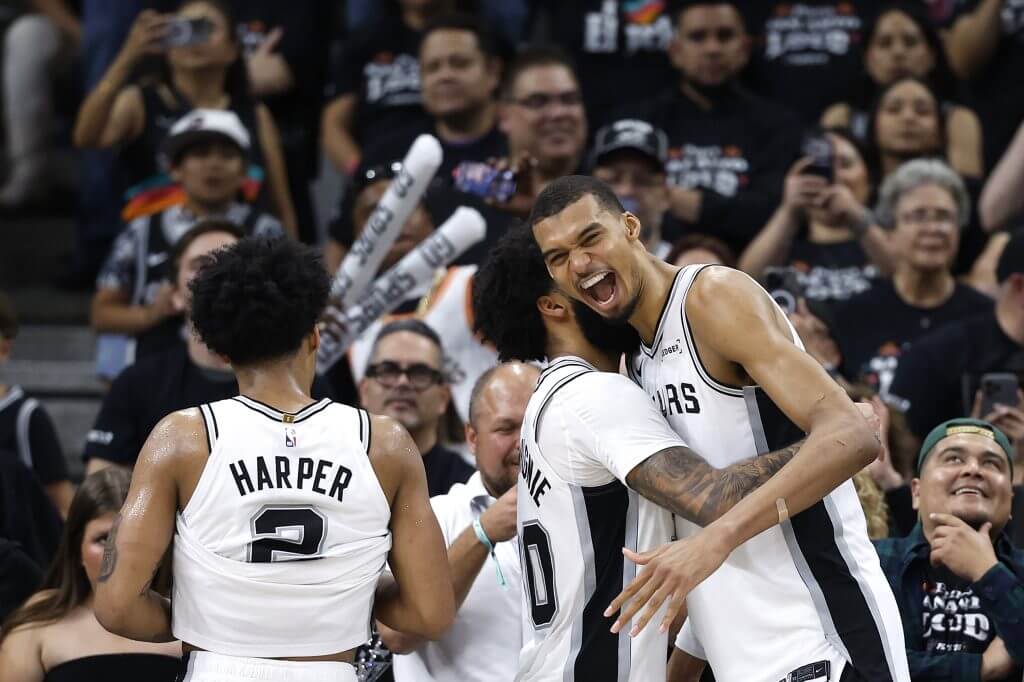
这一切在圣安东尼奥马刺队淘汰波特兰开拓者队时,他在替补席上与队友共度的感性时刻达到了顶点,这场胜利为他和许多队友带来了职业生涯首场季后赛系列赛的胜利。
赛后,《队报》的马克西姆·奥宾 (Maxime Aubin) 用法语询问文班亚马,他是如何将赛场上的各种情绪转化为力量的,以及为什么他认为这在精英运动员中如此罕见。
“这是一个很难回答的问题。我认为首要原因是畏惧他人的评判,”据奥宾报道,文班亚马用法语回答道,“就像是,你觉得必须以某种特定的方式行事,受限于所谓的社交准则。就我个人而言,我拒绝背负必须隐藏情感的包袱。”
考虑到文班亚马对自己的期望,这种释放是必要的。他的独特性——那种他是我们所知唯一能做到这些事的人类的感觉——使他成为了当今人类故事中的一个标志性人物。或许他可以将自己从对社会的责任压力中剥离出来,但这种压力渗透到了他试图实现的每一件事中。
他的特别之处在于,即使脑海中可能闪过追求卓越所带来的存在主义意义,他仍在追逐自己定义的伟大。他正在将自己推向极限,尽管这些极限可能比我们见过的任何人都更高。当他展现情感时,这提醒了世界,他实际上和每个人一样,也是血肉之躯。
“作为场上最出色的球员,展现出这一点对他有好处,”队友朱利安·尚帕尼 (Julian Champagnie) 周四表示,“表达出来对他有好处。对篮球运动也有好处,这展示了球员们是真的在乎,渴望胜利,并渴望所有这些美好的事物。”
尚帕尼喜欢看到文班亚马不惧怕展现脆弱的一面,他认为比赛是充满情感的,除非身处场上,否则没人能真正理解这一点。早在三月,当马刺队完成对洛杉矶快船队的 25 分大逆转哨声响起时,文班亚马将头埋在队友达龙·福克斯 (De’Aaron Fox) 和凯尔登·约翰逊 (Keldon Johnson) 的肩膀上,情绪激动不已。当他停留在那里时,更多的马刺球员走过来,带着喜悦与他一同庆祝。
“从第一节开始我就因为精疲力竭快要晕倒了,”文班亚马在随后的场边采访中告诉 ESPN,“这接近于我人生中最艰难的一场比赛。”
去年 12 月,在马刺队于NBA 杯决赛负于纽约尼克斯队后,文班亚马流着泪走上了赛后新闻发布会的讲台。他说他在那天早上失去了一位亲人(后来证实是他的外祖母),在回答了一个问题后便礼貌地请辞离开。
大多数球员在哀悼亲人时都会选择缺席媒体任务。文班亚马本可以这样做,在场的媒体也会对此表示尊重。文班亚马在媒体沟通方面付出了极大的努力,以至于他最终获得了职业篮球作家协会颁发的魔术师约翰逊奖,以表彰他在对待媒体和球迷时的卓越配合与风度。在这种特殊情况下,他完全有权休息一晚。
但文班亚马明白这一晚对这项运动以及他个人职业生涯的价值。他意识到,作为球队的核心和联盟的门面,他有责任在这样一场备受瞩目的失利后现身并承担责任。
他尝试了,愿意流着泪走向讲台,希望能够履行推动比赛发展的使命——这一使命既是赋予他的,也是他主动追求的。随着他的知名度飙升,职业轨迹突然从冉冉升起的天才转变为“那个核心球员”,外界的期望也终于追上了他自我的期许。
虽然文班亚马公众形象的许多方面看起来像是一种进化,但实际上很大程度上只是因为聚光灯终于 24 小时全天候聚焦在他身上。他已从那个“远方发生的新鲜事”变成了 NBA 最大的故事。
在过去的一年里,文班亚马为这份工作带来了一种令人耳目一新的坦诚。他透明地回答问题,同时大多数时候保持情绪平稳。然而,他之所以能赢得这么多人的心,特别是在本赛季,是因为他将自己的一部分作为礼物奉献给了世界。有一种感觉是,当你看到他时,你看到的是真实的文班亚马。通过屏幕滤镜见证一个伟大的人不仅是一种快感,更是一种认知——即他们的真实自我正在渗透出来。
他的队友卢克·科内特 (Luke Kornet) 注意到,暴露在媒体、电视和互联网之下的经历是很奇特的。人们在不在场的情况下观察你,而你只能在那个时刻体验自己的存在。这种感悟促使科内特远离社交媒体,专注于以一种符合他在现实世界中真正负责的对象的方式来要求自己。
“在我的家人和球队之间,已经有足够多的人需要我去用行动去回应了,”科内特周四说道,“因为否则,如果你在意太多的声音,那么最终满足他们的能力将是不完整的,而且几乎是不可能的。……知道自己在为谁工作、在听谁的意见,你会感到一种平静。如果任何声音最大的那个就是你要听的,那这种生活方式会非常不平静。”
科内特相信大多数媒体成员都在努力向公众真实地展示球员,但他承认,他觉得自己是篮球故事中的一个角色。关键是要明白,他在那个故事中的地位是通过他的所作所为来讲述的,而不一定是他的意图。
尽管科内特也同样开放且健谈,经常利用媒体露面和写作作为思维练习来探索内心深处,但他觉得拥有隐私并专注于更亲密的关系对他来说已经足够了。他欣赏像文班亚马这样选择拥抱公众曝光并展现完整自我的运动员,但目标不能是让每个人都理解。
“即使是你的配偶、孩子或家人,也没有人真正确切地知道你对每件事的内心视角和体验,”科内特说,“这就是信仰和宗教最终介入的地方。所以显然,拥有那些更了解你、能亲密理解你的人是很棒的。但从某种意义上说,你必须对‘允许谁接近你’以及‘与谁分享这些’感到平静,并且对于被误解感到释然。”
这种区分帮助科内特培养了一种他称之为“第三人称自我意识”的能力,即意识到外界看到的那个角色会有他们自己的故事,而他必须生活在自己的故事里。这迫使他在内心做出真正的决定,即如何保持自己的真实。
这是他能看到文班亚马正在实时解决的问题。
“我认为那是你最终的平静所在,”他说,“能够生活在那个地方。”
由生成式 AI 翻译,译文内容可能不准确或不完整,以原文为准。
点击查看原文:Victor Wembanyama isn't afraid to cry. His teammates say that's refreshing
Victor Wembanyama isn’t afraid to cry. His teammates say that’s refreshing
SAN ANTONIO — “Pressure is a privilege.” That’s a creed many athletes live by. To be an NBA player is to be a professional in compartmentalization. When you come up short, you don’t just fail in front of the people you see, but the abstract world at large. Success and failure hinge on split-second decisions as you try to focus on trusting the training rather than fearing judgment.
The weight of internal expectations and upholding the responsibility to the team is already enough pressure to push an NBA player to their breaking point. That is, if they truly care. If it genuinely is the goal they sink everything into.
There are no questions about how Victor Wembanyama feels. His actions have backed up his words all season. He is cold and calculated most of the time, but vicious and primal on occasion. As he begins his playoff career, he’s starting to show the latter more.
All of it culminated in an emotional moment on the bench with his teammates as the San Antonio Spurs eliminated the Portland Trail Blazers, delivering him and many of his teammates their first playoff series victory.
After the game, he was asked in French by L’Equipe’s Maxime Aubin about how he turns his whole range of emotions on the court into a strength, and why he feels it’s so rare for elite athletes in general.
“That’s a tough question. I think it’s first and foremost a fear of judgment,” Wembanyama said in French, according to Aubin. “Like, this feeling that you have to act a certain way, social codes, I guess. Personally, I refuse to carry the burden of having to hide my emotions.”
The release is necessary with the expectations he puts on himself. His uniqueness, that feeling that he is the only human we know of to do what he is doing, makes him a defining character in today’s story of humanity. Maybe he can divorce himself from the pressure of that responsibility to society, but it permeates into everything he is trying to achieve.
What makes him special is that he is chasing his own definition of greatness even while the existential implications of his pursuit may be on his mind. He is pushing himself to his own limits, even though those limits may be greater than any person’s we’ve seen. When he shows his emotions, it reminds the world that he is, in fact, as human as everyone else.
“Being the best player out there, it’s good for him to show that,” teammate Julian Champagnie said Thursday. “It’s good for him to express that. It’s good for the sport of basketball to show that guys actually care and want to win, and want all these great things.”
Champagnie loves seeing Wembanyama unafraid of vulnerability, saying that the game is emotional and nobody truly understands it unless they’re on the court. Back in March, when the final buzzer sounded on a 25-point Spurs comeback against the Los Angeles Clippers, Wembanyama threw his head onto the shoulders of his teammates De’Aaron Fox and Keldon Johnson, overwhelmed with emotion. As he remained there, more Spurs came to celebrate him with joy.
“I was about to pass out from the first quarter from exhaustion,” Wembanyama told ESPN in his walk-off interview moments later. “That’s close to being the hardest game of my life.”
In December, following the Spurs’ NBA Cup Final loss to the New York Knicks, Wembanyama went to the post-game press conference podium in tears. He said he had lost someone that morning (it was later revealed to be his maternal grandmother) and took one question before excusing himself for the evening.
Most players would take the night off from media duties when they were grieving a loved one. He could have done so, and the media in attendance would have respected it. Wembanyama gives so much of himself to the point that he would eventually win the Magic Johnson Award from the Pro Basketball Writers Association for excellence in cooperation and grace in dealing with the media and fans. He had more than earned the right to take a night off in such an extenuating circumstance.
But Wembanyama understood the value of the evening to the sport and to his own career. He recognized that, as the star of the team and a face of the league, he was responsible for showing up and taking accountability after such a high-profile loss.
He tried, willing to step to the podium while crying, hoping he could fulfill this mandate to carry the game forward, one that has been bestowed upon him as much as he has reached out for it. As his profile has skyrocketed and his career arc has suddenly shifted from burgeoning talent to the guy, the external expectations have only caught up to his own.
While so much of Wembanyama’s public persona seems like an evolution, so much of it is really just that the spotlight is finally on him 24/7. He has gone from the cool little thing happening over there to the biggest story in the NBA.
Wembanyama has brought a refreshing honesty to the job over this past year. He answers questions transparently while keeping his emotions level most of the time. Yet the reason he has won so many hearts and minds, particularly this season, is that he gives pieces of himself as an offering to the world. There is this feeling that when you see him, you see the real him. It’s a thrill not just to witness someone great through the filter of a screen, but to know that their true self is permeating.
His teammate Luke Kornet noted how the experience of being exposed to the media, television and the internet is weird. People are watching you without being present, yet you can only experience your own presence in that moment. That realization pushed Kornet to get away from social media and focus on carrying himself in a way to fit within the construct of those to whom he is actually accountable in his world.
“Between my family and then my team, it’s like, that’s enough people to try to have your actions reflect,” Kornet said Thursday. “Because otherwise, if you’re caring about so many voices, then the ability to satisfy them is just going to be incomplete at the end of the day and kind of impossible. … You kind of have peace of knowing who you’re trying to work for and who you’re trying to listen to. It’s a pretty im-peaceful way to live your life (if) any voice that’s the loudest is going to be the one that you listen to.”
Kornet believes most media members are trying to honestly represent the players to the public, but admits he feels a sense that he is a character in the story of basketball. The key is to understand that his place in that story is told through what he does and not necessarily his intentions.
Though Kornet is also open and talkative, often using media appearances and writing as thought exercises to explore the deeper recesses of his mind, he felt that having his privacy and focusing on his more intimate relationships was enough for him. He appreciates when some athletes like Wembanyama choose to embrace their exposure in the public domain and put their full selves out there, but the goal can’t be to be understood by everyone.
“Even your spouse or children or family, no one actually knows your exact interior perspective and experience in everything,” Kornet said. “This is where faith and religion ultimately come in. So obviously, it’s great to have people who do know you closer and feel like they can intimately understand you. But also, to a certain sense, you have to have peace with knowing who you allow close to you and who you’re going to share that with, and you’re cool being misunderstood.”
That distinction helped Kornet develop what he called an awareness of yourself in the third person, recognizing that the character the outside world sees will have their own story, and he has to live in his own. This has forced him to make a real decision within himself of how to maintain his own truth.
It’s something he can see Wembanyama working out in real time.
“I think that’s where your ultimate peace is,” he said. “To be able to live in that place.”
By Jared Weiss, via The Athletic