By Jared Weiss / The Athletic, 2026-09-21 19:15:28
最近,在2026-27赛季NBA开赛前夕,我向读者征集了关于圣安东尼奥马刺的问题。我根据大家提出的一些问题整理了答案,将在本月内陆续发布。
上周,我们讨论了马刺如何改进半场进攻——正是这一环节在NBA总决赛中拖了后腿。现在,我们来聊聊马刺短期和长期最核心的阵容问题:三名主要持球人(达龙·福克斯、斯蒂芬·卡斯尔和迪伦·哈珀)如何共存。
注:为求清晰简洁,问题内容略有编辑。
考虑到阵容中的诸多选择,你认为马刺会如何安排迪伦·哈珀的出场时间?—— Owen S.
解决三名控卫出场时间分配的难题,与我收到的那些关于马刺长期薪资结构的宏观问题密不可分。那些问题我们稍后再谈,先从短期说起。
哈珀上赛季下半段的表现太过惊艳,以至于改变了全联盟观察者们的许多预期。外界普遍认为,马刺需要让他尽快进入状态、主导进攻,因为他拥有成长为联盟前十球员的天赋。到了五月,我与联盟各路消息人士的许多对话都是这样开场的:“迪伦·哈珀,这也太离谱了吧,哥们?”然后我会说:“难以置信,对吧?”接着我们就会笑上三秒。看到一个20岁的年轻人如此优雅地撕碎对方防线,同时还能在多个位置上锁死对手,实在令人震撼。他就是那种你一看比赛就能发现拥有顶级球感的球员。
话虽如此,在高水准上担任控卫还有一层微妙的门道——福克斯已经完全掌握,而哈珀和卡斯尔还需要数年的成长才能达到。我并不认同“卡斯尔正在从福克斯手中慢慢接过进攻指挥权”这一前提,也不认为本赛季必然会朝这个方向发展。当福克斯在场时,他通常是第一发起人,卡斯尔(和哈珀)则更多进行第二侧攻击。如果你真正坐下来研究马刺的进攻,就能看出卡斯尔偶尔做出几次好的判断,与福克斯策划出需要三次传导才能完成的战术之间的差别。
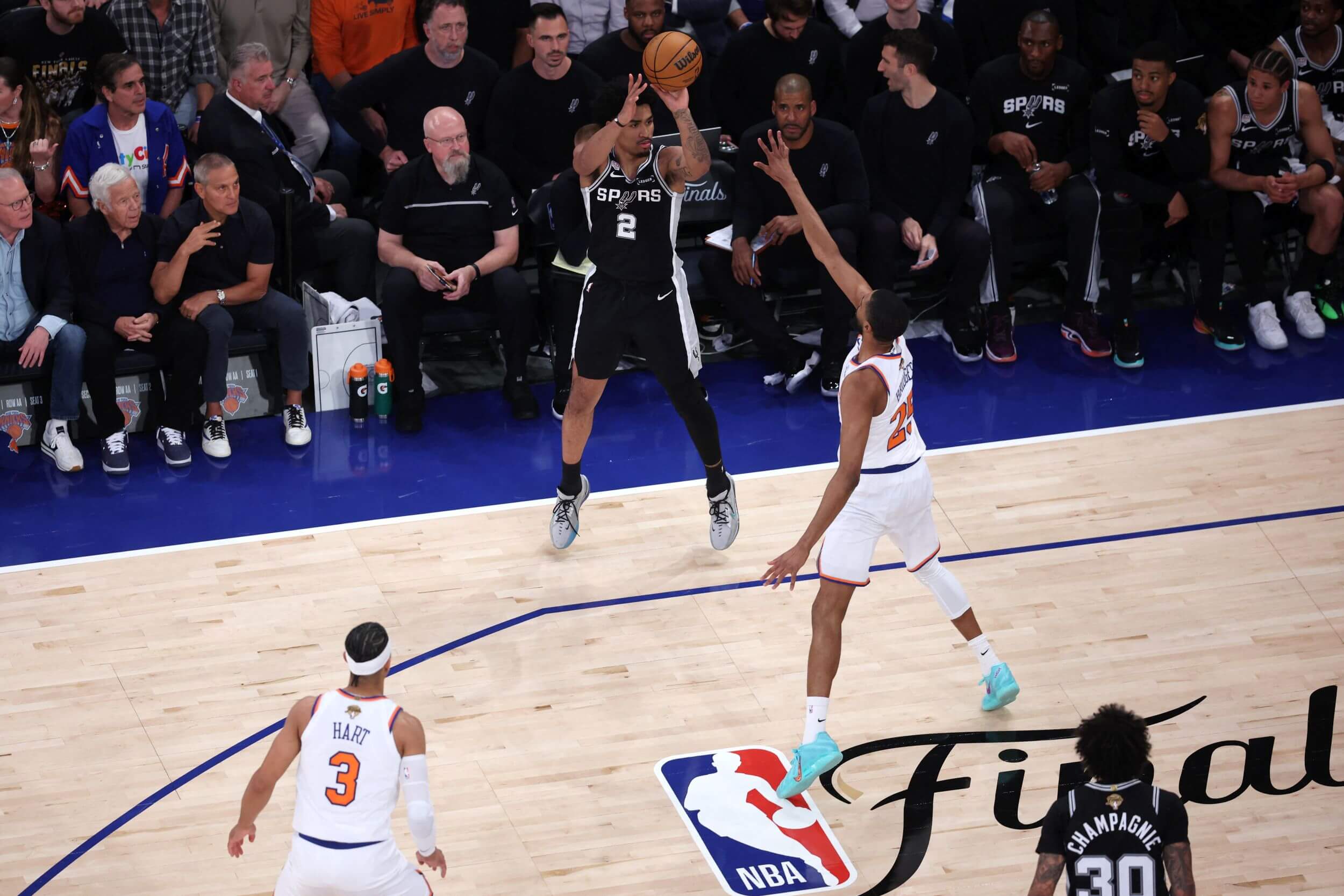
迪伦·哈珀在去年NBA总决赛中出手三分。(Geoff Burke / Imagn Images)
短期内,福克斯仍然需要首发,但马刺主帅米奇·约翰逊必须想办法增加哈珀的锻炼机会,这并不容易。看看上赛季库珀·弗拉格在完全接管达拉斯独行侠后的进化轨迹吧。哈珀以相近的速度在进步,效率更是历史级别,但由于马刺的阵容远强于达拉斯,他没有那么大的空间去打出50分的比赛。
对约翰逊来说,最大化哈珀使用率最简单的方法,就是更频繁地让三名后卫同时留在场上打关键时刻。卡斯尔跳投的进步对这一目标尤为重要。我们看到,上赛季下半段当卡斯尔的三分命中率提升到联盟平均水平后,他变得出色了多少。相应地,哈珀在三月份迎来爆发,当时他的底角三分几乎百发百中。
约翰逊还可以让哈珀更早被换上场,给他更长的轮换时段,同时保证三名后卫中始终有两人在场。约翰逊大概还能在阵容搭配上做一些小调整,让哈珀获得更多机会。不过,上赛季的出场时间在全队分布得相当均衡,而随着托拜厄斯·哈里斯的加盟,马刺如今已拥有可靠的11人轮换深度,这种均衡分配势必延续下去。
这就引出了更长远的问题……
一个前瞻性的问题:两三年后,当卡斯尔和哈珀开始拿大合同时,马刺该如何处理阵容?马刺会不会说“管他呢,我们有文班”,然后默认锋线只能用新秀合同和低价老将来填充?他们是否需要交易卡斯尔或哈珀,才能在其他位置签下更优质的球员?简而言之:真的能把文班当作阵容失衡的作弊码吗,还是仍然需要遵循我们在大多数现代冠军球队身上看到的阵容平衡原则?—— Brendan W.
首先,卡斯尔和哈珀短期内绝对不会被交易。在拉斯维加斯夏季联赛期间与全联盟的球探和教练交流后,共识是:两人下一份合同几乎铁定能拿到至少25%工资帽的顶薪新秀续约,而马刺开出这样的合同也毫不纠结。
除此之外,联盟里还有谁值得你考虑用他们去换?
看过上赛季的表现后,我愿意用来换哈珀的球员名单基本只有七个:谢伊·吉尔杰斯-亚历山大、尼古拉·约基奇、卢卡·东契奇、杰伦·布伦森、安东尼·爱德华兹、凯德·坎宁安和弗拉格。仅此而已。
卡斯尔则稍微难以评判,因为他的比赛还不具备哈珀那种一眼可辨的流畅感。他在季后赛遇到了麻烦:当对手重点布防、他的慢速第一步被化解后,他不得不更多依赖跳投。他必须能命中接球投篮,还需要把高位挡拆后的急停跳投加入武器库,才能迈入常年全明星的行列。但他身上的其他特质,足以让人相信他在未来多年都是最佳阵容的候选人。
许多联盟观察者都认同:21岁的卡斯尔如果今天就有续约资格,就已经是顶薪球员了。坦白说,一个这么年轻的球员,场均接近20分8助攻,同时还是联盟前十的外线防守者,却拿不到顶薪,这是不可能的——尤其是他在心态上每一项都符合理想二当家的标准。
我们不妨先假设两名后卫都拿到25%工资帽的顶薪合同,或者像维克托·文班亚马今年夏天签顶薪时那样接受一定幅度的降薪。(按照卡斯尔目前的发展趋势,他明年有望入选最佳阵容第三阵容,因此可能有资格通过德里克·罗斯条款拿到更高的合同。)
接下来就是联盟圈内人士问得最多的问题:马刺打算怎么处理福克斯?(提醒一下:福克斯那份四年2.217亿美元的续约合同从本赛季开始生效。)
正如我们前面讨论的,我一直认为马刺在下个赛季绝对需要福克斯来主导进攻、引领球队文化。到2027-28赛季事情会变得棘手,但无论如何他们都能维持阵容平衡。凯尔登·约翰逊和哈里森·巴恩斯将在本赛季结束后成为自由球员,球队薪资也刚好在奢侈税线之下。到那时,交易福克斯并没有太大的财务动机。
再往后,一旦卡斯尔开始执行他(大概率)的顶薪续约,薪资压力才可能变得难以承受。即便哈里斯的合同到期离队,马刺距离预计的2028-29赛季奢侈税线仍有3330万美元的空间,因此卡斯尔的续约几乎必然会让球队在仅有10名球员的情况下大幅超出税线。届时他们大概率仍拥有充足的组织深度,以及两名处于公平市场价合同最后一年的首发级球员(朱利安·尚帕尼和德文·瓦塞尔)。此外,卡特·布莱恩特也有望成长到足以接管首发四号位。而且,虽然马刺很少缴纳奢侈税,但届时他们的阵容实力将配得上这份投入。
暂时把福克斯放在一边,马刺2028-29赛季的核心将是文班亚马、哈珀、卡斯尔、瓦塞尔、尚帕尼和布莱恩特,外加卢克·科内特、杰登·昆坦斯、小塔里斯·里德,以及他们用中产特例或其他特例签下或选中的球员。如果布莱恩特继续成长,这套首发阵容看起来相当不错。替补席则完全失衡——不过也许某名新秀内线会证明自己,让马刺有底气放弃科内特的球队选项以节省开支。马刺可以付出高昂代价留下福克斯来补充组织深度,也可以尝试送走福克斯来补强侧翼。
无论如何,在2028年夏天之前,马刺似乎都没有财务上的必要与福克斯分道扬镳。更难的问题是出场时间和队内地位排序。
很难想象2028年还有人希望哈珀继续打替补,也很难说步入30岁的福克斯是否愿意让出首发位置。自来到圣安东尼奥以来,福克斯一直明确表示他不在乎个人数据,只在乎赢球。但让他放弃首发位置?这可是个不小的要求。
归根结底,在当前的薪资框架下,这套后卫阵容能否长期维持,将取决于全队年轻球员作为射手的成长。即便联盟的比赛风格正日益向内线收缩,且文班亚马的存在让马刺可以在外线摆放多名不擅长投篮的球员,但很难想象一支前五号得分手中只有一名稳定射手的球队能够翻越夺冠这座大山。
不过,有足够多的候选人可以挺身而出填补这一空缺——而且他们还有时间去做到这一点。
由生成式 AI 翻译,翻译内容可能不准确或不完整,以原文为准。
查看原文:How the Spurs' lead guards can coexist, and why De'Aaron Fox still needs to start
How the Spurs’ lead guards can coexist, and why De’Aaron Fox still needs to start
Recently, I asked for questions about the San Antonio Spurs leading up to the start of the 2026-27 NBA season. I compiled answers based on some of your prompts, which we’ll release over the course of the month.
Last week, we discussed ways the Spurs can improve their half-court offense, which let them down in the NBA Finals. We’ll now talk about the Spurs’ biggest short- and long-term roster question: how their three lead ballhandlers (De’Aaron Fox, Stephon Castle and Dylan Harper) coexist.
Note: Questions have been lightly edited for clarity and brevity.
How do you think the Spurs will navigate playing time with Dylan Harper, considering all the options on the roster? — Owen S.
The challenge of solving the minutes distribution for the three point guards is intrinsically linked to the bigger-picture questions I got about the Spurs’ long-term cap sheet. We’ll get to those questions shortly, but let’s start with the short term.
Harper had such a stellar second half last season that it shifted a lot of projections from observers around the NBA. There is a widespread perception that the Spurs need to get him revved up quickly to run the offense, as he has the talent to develop into a top-10 player in the league. By May, many conversations with sources across the league started with something along the lines of them saying, “Dylan Harper, what the hell, man?” Then, I’d say, “Unreal, right?” Afterward, we’d just laugh for three seconds. It was jarring to see someone carve up the defense so gracefully at 20 years old while also being a lockdown defender across several positions. He’s one of those guys you watch and see that he has an elite feel.
That said, there is a nuance to running point at a high level, which Fox has on lock and Harper and Castle have years of development to reach. I don’t agree with the premise that Castle was slowly being handed the keys to the offense from Fox, or that it will necessarily trend that way this season. When Fox was out there, he was usually the primary initiator, and Castle (and Harper) had a lot of second-side attacks. If you really sit and study the Spurs’ offense, you can see the difference between Castle being able to make some good reads and Fox orchestrating plays that are three passes away.
Dylan Harper fires a 3 during last season’s NBA Finals. (Geoff Burke / Imagn Images)
In the short term, Fox still needs to start, but Spurs coach Mitch Johnson must find ways to increase Harper’s reps, which is tricky. Look at how Cooper Flagg evolved last season once he was fully given the keys to the Dallas Mavericks. Harper improved at a similar pace, and his efficiency was historic, but he didn’t have the breadth to put up 50-point games with the Spurs’ roster being so much stronger than Dallas’.
The easiest way for Johnson to maximize Harper’s usage is to close games with all three guards on the floor more often. The development of Castle’s jumper is especially important to that effort. We saw how much better Castle became in the second half of last season when he started shooting league-average from 3. Harper, in turn, took off in March when he became nearly perfect from the corners.
Johnson could also get Harper subbed into games earlier and give him longer rotations while keeping two of the three on the floor at all times. There are probably some small tweaks to lineups Johnson can make to get Harper in there more. Still, the minutes load was spread pretty smoothly across the roster last season, and that will certainly continue now that the Spurs are a solid 11 deep with the addition of Tobias Harris.
That takes us to the longer term …
Bit of a forward-looking question: How do the Spurs handle their roster in two to three years when Castle and Harper start getting paid? Do the Spurs say, “Screw it. We’ve got Wemby,” and just assume their forwards will have to be rookie contracts and veterans on lower deals? Do they need to offload Castle or Harper to sign some higher-quality players in other positions? TL;DR: Can you truly use Wemby as a cheat code for an imbalanced roster, or do you still need to adhere to the balanced-roster principles we’ve seen in most modern champions? — Brendan W.
First of all, Castle and Harper are absolutely not getting traded anytime soon. In speaking with scouts and coaches around the NBA during the Las Vegas Summer League, the consensus was that they are both near-locks to get at least the 25 percent maximum rookie extension for their next contracts, and it wouldn’t be a tough call for the Spurs to hand those out.
Aside from that, who else in the NBA would you even consider trading them for?
After what we saw last season, the list of players I’d consider for Harper is basically seven deep: Shai Gilgeous-Alexander, Nikola Jokić, Luka Dončić, Jalen Brunson, Anthony Edwards, Cade Cunningham and Flagg. That’s it.
Castle is a little tougher to judge because he doesn’t quite have the unmistakable smoothness of Harper’s game. He ran into trouble in the postseason when his slow step got neutralized by keyed-in defenses and he had to rely more on his jumper. He must be able to hit spot-up jumpers, and he needs to add that high pick-and-roll pull-up to his game to make the jump to perennial All-Star. But he brings other qualities that make him look like an All-NBA candidate for years to come.
Plenty of league observers agree that Castle, 21, is already a max player today if he were extension-eligible. Frankly, there is no way a guy this young averages somewhere close to 20 points and eight assists per game while also being a top-10 perimeter defender without getting a max deal, especially when he checks every box, mindset-wise, to be an ideal complementary star.
Let’s pencil in max contracts for both guards at 25 percent of the salary cap, give or take them taking the same discount Victor Wembanyama did on his max deal this summer. (Castle seems like a possible third-team All-NBA candidate next year based on how he has been trending, so he could be eligible to receive more via the Derrick Rose rule.)
That brings us to the question I get asked most by people around the league: What are the Spurs going to do with Fox? (Reminder: Fox’s four-year, $221.7 million extension begins this season.)
As we discussed earlier, I’ve always been of the opinion that the Spurs absolutely need Fox next season to run the offense and lead the culture. Things get tricky in 2027-28, but they can maintain roster balance regardless. Keldon Johnson and Harrison Barnes hit free agency after this season, and the team sits just south of the luxury-tax line. There’s not as much financial impetus to move Fox at that point.
It’s after that, once Castle starts his (likely) maximum extension, when the money may become untenable. The Spurs are $33.3 million below the projected 2028-29 luxury-tax line even with Harris’ contract coming off the books, so Castle’s extension would almost certainly push them well over the line with only 10 players on the roster. They likely still would have good playmaking depth, as well as two starter-level players (Julian Champagnie and Devin Vassell) in the last year of their fair-market contracts. There’s also a reasonable hope that Carter Bryant might develop well enough to take over the starting four spot. Plus, while the Spurs rarely pay the luxury tax, they’d be projected to have a team that would be worth it.
Take Fox out of the picture for a second, and the Spurs would be left with a 2028-29 core of Wembanyama, Harper, Castle, Vassell, Champagnie and Bryant, along with Luke Kornet, Jayden Quaintance, Tarris Reed Jr. and whomever else they draft or sign with their midlevel and/or other exceptions in tow. That starting lineup looks good if Bryant continues to develop. The bench is completely imbalanced, though maybe one of the rookie bigs will have proven themselves enough for the Spurs to decline Kornet’s team option for extra savings. The Spurs could keep Fox in the mix at a high cost to provide playmaking depth, or they could try to move off Fox to build out more wing depth.
Regardless, it seems like there isn’t a financial necessity to move on from Fox until the summer of 2028. The harder question is the playing time and pecking order.
It’s hard to believe anyone would want Harper to still come off the bench in 2028, and it’s tough to know if Fox would be willing to cede his starting spot as he enters his 30s. Since arriving in San Antonio, Fox has been very clear that he doesn’t care about his stats, only about winning. But giving up a starting spot like that? That’s a big ask.
Ultimately, whether their current guard group can sustain long-term in this cap scenario will depend on how the young players across the roster develop as shooters. Even if the league’s playstyle is shrinking closer to the paint and Wembanyama allows them to get away with having multiple inside-the-arc players on the perimeter, it’s hard to imagine a team with only one knockdown shooter among its top five players getting over the title hump.
But there are plenty of candidates to step up and fill the void — and time for them to do so.
By Jared Weiss / The Athletic
 热评
热评