By Jared Weiss / The Athletic, 2026-09-16 19:00:52
本月早些时候,在训练营开营前几周,我曾向读者征集关于圣安东尼奥马刺的问题。我根据大家提出的一些问题整理了答案,将在本月内分几篇文章陆续发布。
在本期中,我们将聊聊马刺上赛季季后赛中最大的短板——他们的半场进攻——以及它在新赛季可能如何改善。后续几期将剖析三名主要持球人(达龙·福克斯、斯蒂芬·卡斯尔和迪伦·哈珀)各自的角色定位,深入探讨自由球员签约托拜厄斯·哈里斯的影响,并思考用比利·多诺万替换肖恩·斯威尼可能对米奇·约翰逊的教练组产生怎样的影响。
为求清晰和简洁,读者提问经过轻度编辑。
你认为马刺自己认为最需要克服并抛在身后的最大弱点是什么?我不觉得他们关心或已经决定了谁打多少时间、谁首发谁不首发,但他们肯定从上赛季的比赛中看到了什么,然后说:“这是我们的主要目标。我们必须在这方面变得更好。”那是什么?为什么?—— Dylan M.
我认为马刺今夏的阵容决策和训练重点,都是为了改善半场进攻这个更大的目标。
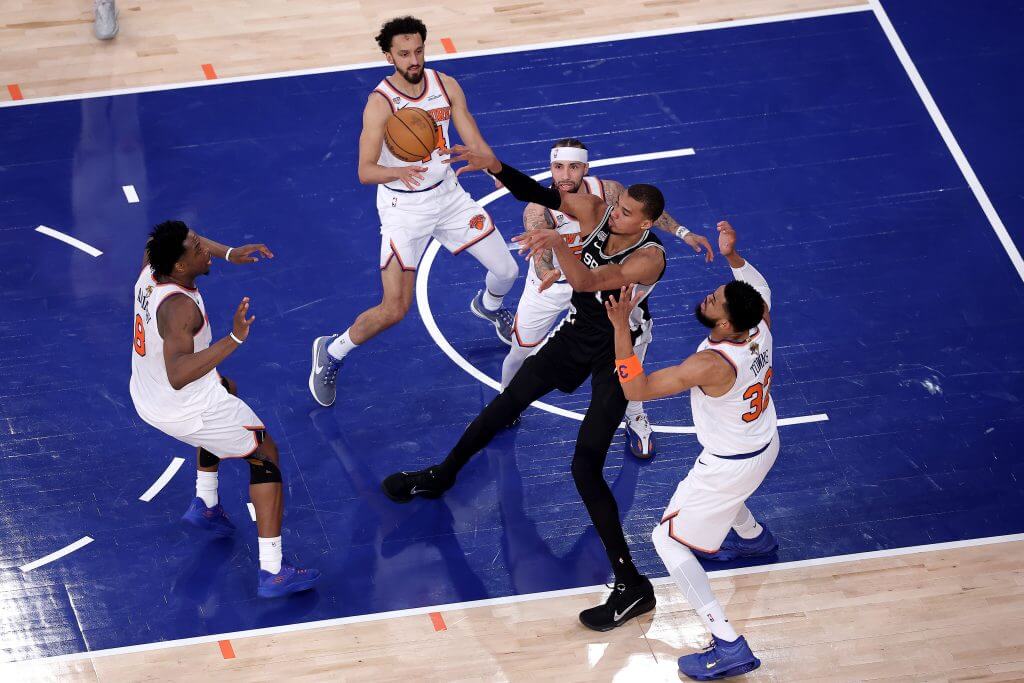
上赛季季后赛最后两轮中,他们经历的得分荒令人费解。尤其是维克托·文班亚马 (Victor Wembanyama),当对手在第四节加强身体对抗、瓦解马刺的战术执行时,他很难创造出好的出手机会。这其中很大一部分责任在他自己身上,他需要提升作为进攻创造者的能力,而这种提升恐怕要到下个季后赛才能得到真正的检验。他需要在武器库中增加更多简单的出手方式,以便在无法赢得卡位战或无法攻击空间时使用。
需要记住的是,作为一名三年级的球员,文班亚马已经远远超出了任何人合理的预期。但马刺需要一套能够为他分担这份重担的体系,而不是仅仅依靠其他某位后卫去强投一记高难度中距离急停跳投。除非福克斯、卡斯尔和/或哈珀能在季后赛中成为真正可靠的外线射手,否则这可能是一场永无止境的艰难战斗。
马刺尚未就轮换安排做出任何最终决定,训练营中应该会有一些良性竞争来解决这个问题。上赛季,他们在赛季中期做出调整,让朱利安·尚帕尼顶替哈里森·巴恩斯进入首发阵容,加上哈珀的巨大进步,改变了球队的整体格局。
人们期待托拜厄斯·哈里斯能改变很多东西——轻松得分,并在防守端顶住对方的大号四号位。他能够填补马刺目前存在的衔接空档:后卫们的抛投、文班亚马的中距离跳投,以及尚帕尼和德文·瓦塞尔的一运急停中投。哈里斯可以穿越防守冲击篮筐,拥有丰富的低位和中位终结手段,还能在运球中做出出色的传球判断。他可以成为解决那些第四节初段得分荒的答案。
马刺很少陷入落后局面,所以他们的目标就是在比赛末段不松开绳子。上个季后赛,他们经历了年轻球队都会遇到的经典困境。也许一次总决赛的刻骨铭心,再加上哈里斯的加盟,足以让他们磨砺出坚持到底的心态。
在新秀赛季跟随格雷格·波波维奇打球时,文班展现出成为一名可靠进攻枢纽的潜质,他能打手递手配合,甚至能打挡拆。让他在三名后卫身边简化职责、扮演进攻终结者的角色是合理的,但在总决赛中,当他不得不独自创造进攻机会时,我们看到了这种打法的局限性。你是否认为球队已有计划重新培养这些技能,尽管过程中必然会遇到阻碍——至少在常规赛期间?—— Thomas G.
计划肯定是有的,但我们先来理清他成长路径的背景。
在现阶段,我不认为应该用总决赛来检验文班亚马的发展计划,因为总决赛的难度远超他在常规赛所面对的任何挑战。整个赛季,他都展现出了你提到的所有技能。看看他在Synergy上的进攻类型数据,他实际上有九个不同类别的回合使用数都达到了至少100次(转换进攻、定点投篮、单打、顺下、背身单打、空切、绕掩护、补篮、挡拆持球人)。
作为对比,尼古拉·约基奇 (Nikola Jokić) 有八类(不过他的空切有97个回合,接近九类)。再看其他场均得分20+的中锋:卡尔-安东尼·唐斯有七类,阿尔佩伦·申京有七类,巴姆·阿德巴约有五类。至少在常规赛中,文班亚马的进攻多样性已经达到了极致。我翻查了往年的数据寻找对比对象,只发现约基奇曾有过九类回合数均达到100次以上的赛季,而且是在此前两个赛季完成的。也就是说,文班亚马的全面性已经足以媲美NBA历史上最伟大的进攻表演之一。
巨大的差距在于他在这些进攻方式上的效率。约基奇的超能力在于他可以在任何时候、从球场任何位置命中投篮。文班亚马正努力成为那种球员,但他还不是。
去年我刚搬到圣安东尼奥时,每当被问到文班亚马应该以谁为模板,我总是说约基奇。他应该能够高举篮球、拆解对方防线,当找不到理想的传球选择时,就自己把球砸向篮筐。那是文班亚马的理想形态。但他刚刚打完第三个赛季,距离那个层次还很远。
为什么在挡拆中担任持球人目前对他来说是低使用率的技术环节,这一点更容易解释。这是全联盟最难掌握的技能,而这套阵容设计也让他最不需要做这件事。但如果马刺想要打造一套真正人人可互换的进攻体系,他就必须能够轻松地融入这些战术。上赛季初我们看到了更多这样的尝试,当时他大量试验持球突破,但随着他的比赛风格越来越偏向转换进攻和空切、在外线的组织和背身单打减少,这方面的内容有所淡化。这反映出三后卫轮换全面铺开、球队整体节奏加快,以及球队意识到必须管理文班亚马的比赛负荷,才能让他在第四节保持高效。
这种收缩在常规赛中并未显现出负面影响,但在季后赛深入阶段暴露无遗。他的控球需要更加扎实,才能更稳定地成为持球组织者。在季后赛中,更大的挑战似乎在于文班亚马运球节奏被打乱,难以双脚踏进禁区。他运球启动时缺乏节奏。这在他的首次季后赛之旅中是意料之中的;事实上,考虑到他的经验水平,他应对得已经相当出色。
文班亚马过去在打挡拆时有过不少亮眼表现——他能在防守中蛇形回撤找到顺下队友,或者绕过防守冲击篮筐制造犯规。随着年龄增长,他会继续打磨这项技能。
今年,我预计赛季初会看到更多手递手配合,因为这能让后卫们以更快的速度攻击防守的缝隙。文班亚马与球“捉迷藏”般的能力可能成为有效武器,但他的急停跳投必须提升才能让这套打法奏效。如果他能做出手递手假动作后衔接急停跳投,那将真正打开马刺的进攻局面。
由生成式 AI 翻译,翻译内容可能不准确或不完整,以原文为准。
查看原文:The Spurs' biggest weakness was their half-court offense. How can they improve it?
The Spurs’ biggest weakness was their half-court offense. How can they improve it?
Earlier this month, I asked for questions about the San Antonio Spurs leading up to the start of training camp in a few weeks. I compiled answers based on some of your questions, which we’ll release in a few articles over the course of the month.
In this edition, we’ll talk about the Spurs’ biggest shortcoming in last season’s playoffs — their half-court offense — and how it could improve this season. Future editions will dissect the roles of the three lead ballhandlers (De’Aaron Fox, Stephon Castle and Dylan Harper), dive deeper into the impact of free-agent signing Tobias Harris and ponder how replacing Sean Sweeney with Billy Donovan may affect Mitch Johnson’s coaching staff.
Questions have been lightly edited for clarity and brevity.
What do you think the Spurs think is their biggest weakness to overcome and put behind them? I don’t think they care or have decided who gets minutes and who starts or doesn’t, but they must have something they looked at from last year and said, “This is our main goal. We must be better here.” What is that? Why? — Dylan M.
I think the Spurs’ roster decisions and points of emphasis this summer serve the bigger goal of improving as a half-court offense.
The droughts they went through in the last two rounds of the playoffs last season were perplexing. Victor Wembanyama, in particular, struggled to create good looks when defenses ramped up the physicality in the fourth quarter and killed the Spurs’ execution. A lot of that is on him to improve as a creator in a way we probably won’t see tested until next postseason. He needs more simple shots in his arsenal to use when he can’t win the position battle or attack space.
It’s important to remember that, for a third-year player, Wembanyama was already way ahead of anyone’s reasonable expectations. But the Spurs need a system that can take that burden off him, beyond one of their other point guards getting to a contested midrange pull-up. That could be a permanent uphill battle unless Fox, Castle and/or Harper can be a legit knockdown deep shooter in the playoffs.
The Spurs haven’t made any firm decisions on how the playing rotation will work, and there should be some good training camp battles to settle things. Last year, they course-corrected halfway through the season by putting Julian Champagnie in the starting lineup over Harrison Barnes, plus Harper took a big leap forward to change the dynamic.
The hope is that Tobias Harris changes a lot of things by scoring with ease and holding up defensively against big fours. He bridges that gap they have between their guards’ floater game, Wembanyama’s mid-post jumpers and the one-dribble midrange pull-ups from Champagnie and Devin Vassell. Harris can attack all the way to the rim through traffic, has an array of low- and mid-post finishes and can make good playmaking reads off the bounce. He can be the solution to a lot of those early fourth-quarter droughts.
The Spurs rarely played from behind, so their goal is to simply not let go of the rope late in games. Last postseason, they experienced the classic conundrum of an inexperienced team. Maybe one NBA Finals heartbreak and a dose of Harris is enough to give them the mindset callouses to hold it together.
In his rookie season under Gregg Popovich, Wemby showed some flashes of being a solid offensive hub, operating in dribble handoffs and even pick-and-rolls. It made sense to streamline his responsibilities with the three guards and make him a play finisher, but during the finals, we saw the limits of this approach when he had to create offense on his own. Do you believe there is a plan in place to develop these skills again despite the natural hurdles that will eventually arise, at least during the regular season? — Thomas G.
There is certainly a plan in place, but let’s first figure out the context of his development path.
I wouldn’t make the NBA Finals a litmus test for Wembanyama’s development program at this point, because it was drastically harder than what he faced during the regular season. Throughout the year, he showed all of the skills you mentioned. If you look at his play-type breakdown on Synergy, he actually has nine different categories with at least 100 possessions used (transition, spot-up, isolation, roll man, post-up, cut, off screen, put-backs, pick-and-roll ballhandler).
For comparison, Nikola Jokić had eight (though he had 97 cuts, so he was close to nine). Looking at other centers averaging 20-plus points a night, you have Karl-Anthony Towns (seven), Alperen Şengün (seven) and Bam Adebayo (five). Wembanyama’s variety, at least in the regular season, is as wide as it gets. Doing some digging to find comps in previous years, I could find only Jokić having nine categories with at least 100 possessions, which he did in the prior two seasons. So, Wembanyama’s versatility is already rivaling that of one of the greatest offensive stretches in NBA history.
The drastic difference is his efficiency on said plays. Jokić’s superpower is that he can hit a shot from anywhere on the court at any time. Wembanyama is trying to become that kind of player, but he isn’t yet.
When I first moved to San Antonio last year and was asked who Wembanyama should model his game after, I always said Jokić. He should be able to play with the ball over his head and pick offenses apart, then throw it up toward the rim when he doesn’t see a pass he likes. That is the idealized version of Wembanyama. But he just finished Year 3, so he is far from that player today.
It’s easier to explain why operating as the ballhandler in ball screens is a low-usage area for him right now. It’s the hardest skill in the league, and this roster design makes it the least necessary for him. But if the Spurs are going to have a truly interchangeable offense, he has to be able to flow into those easily. We saw more of that early last season when he was experimenting a lot with dribble driving, then it drifted a bit as his game became more transition/cut heavy with less orchestrating on the perimeter and posting up. That was a reflection on the three-guard rotation hitting full swing, the team’s overall tempo picking up and the recognition that Wembanyama’s load needs to be managed within games so he can remain effective in the fourth quarter.
The effects of that pull-back didn’t manifest in the regular season, but they showed deep into the playoff run. His handle needs to get tighter for him to be a playmaker with the ball more regularly. In the playoffs, it seemed like the bigger challenge was that Wembanyama’s dribbling cadence to get two feet into the paint was disrupted effectively. He didn’t have a lot of rhythm when he put the ball on the floor. That is to be expected in his first playoff run; in fact, he did an impressive job working around it considering his experience level.
Wembanyama’s had some good moments in the past running pick-and-roll where he can snake back through coverages to hit a roller or drive around defenses to draw a foul. As he gets older, he’ll build out that skill more.
This year, I’d expect to see more dribble handoffs early on because it opens up the guards to hit the pockets in the defense with more speed. Wembanyama’s ability to play hide-and-seek with the ball could be an effective weapon, but his pull-up game has to get better for it to work. If he can fake a dribble handoff into a pull-up shot, he’ll really open up the Spurs’ offense.
By Jared Weiss / The Athletic