By Molly Smith, Staff Writer | San Antonio Express-News (SAEN), 2026-08-14 17:50:52
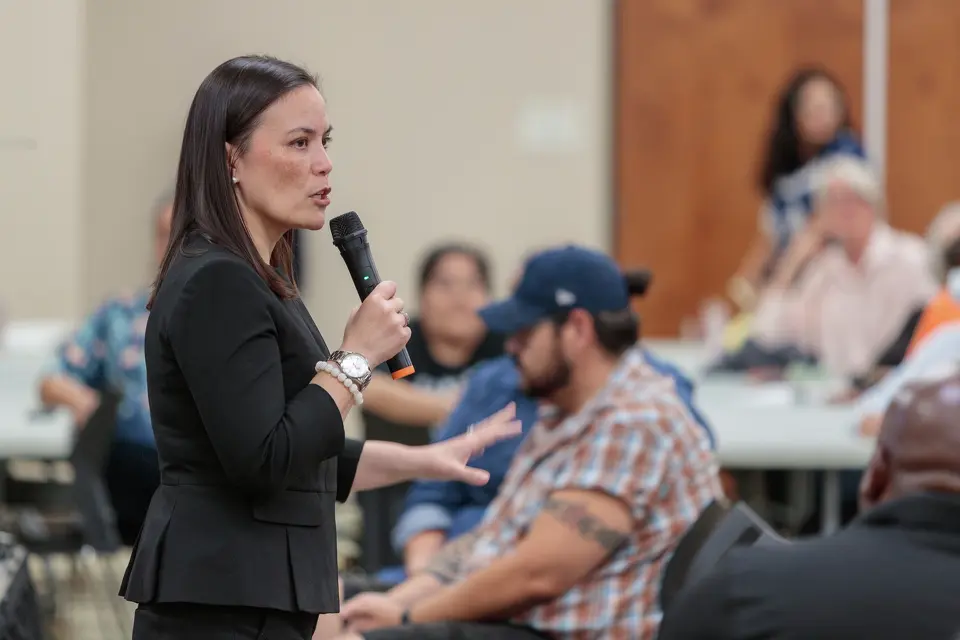
市长吉娜·奥尔蒂斯·琼斯 (Gina Ortiz Jones) 于2026年8月6日在多丽丝·格里芬老年中心举行的关于是否就市政府球馆出资举行投票的聆听会上发言。
在市议会审议市长吉娜·奥尔蒂斯·琼斯提出的、就市政府承诺的马刺球馆出资举行公开投票这一争议性提案的前几天,市经理埃里克·沃尔什 (Erik Walsh) 表示,他正试图纠正他所称的围绕该项目及其将带动的体育娱乐区所流传的“不实信息”。
沃尔什在周五给琼斯和市议会的一份备忘录中表示,他提供“关于最近媒体流传的若干与体育娱乐区某些方面相关的说法和报道的信息与澄清”。
沃尔什没有明说的是,他试图澄清的部分说法正来自琼斯。琼斯一直在动员居民向市议员施压,要求他们支持她提出的在11月3日就市政府对这座13亿美元球馆的4.89亿美元出资进行投票的呼吁。
市议会将在周一上午的特别会议上就此事作出决定。
大多数市议员反对举行公开投票,但琼斯和其他支持11月选举的人士寄希望于公众压力能改变部分议员的立场。
“我们要告诉市议会,一项4.89亿美元的公共资金承诺太庞大、太重要、影响太深远,不能不让选民来决定,”西木广场社区协会主席韦尔玛·佩尼亚 (Velma Peña) 在周五于市政厅前与其他社区领袖共同组织的新闻发布会上表示。
作为其主张的一部分,琼斯强调,自贝克萨县选民去年11月投票批准该县3.11亿美元球馆出资以来,市中心体育娱乐区——更广为人知的名称是“Project Marvel”——的规划已经发生变化。
根据州法律,该县必须获得选民批准,才能提高酒店税和租车税来为其份额提供资金。52%的选民同意了增税。
而市政府计划动用的任何偿债资金来源,都无需寻求选民批准。
“现在的方案和我们在11月讨论的不同,”琼斯在8月6日她组织的“聆听会”上说,该会议旨在听取居民是否希望就市政府的出资进行投票。“已经没有陆桥了,对吧?也不再会有那座千房酒店了。”
她表示,由于“Project Marvel”的规划变化如此之大,就球馆举行公开投票是有必要的。
但沃尔什在备忘录中表示,尽管官员们放弃了在会议中心对面新建第二座会议中心酒店的初步计划,但就市政府对于将阿拉莫穹顶体育场与将在赫米斯费尔前得克萨斯文化研究所地块上建造的球馆连接起来的思路而言,“没有任何改变”。
市政府在2024年获得了近300万美元的联邦拨款,用于研究将东区与市中心重新连接的方案。
“修建陆桥或任何类似的跨I-37重新连接的解决方案,一直都被认为取决于当前社区规划的结果以及能否获得更多资金,”沃尔什写道。
周五下午,琼斯没有立即回应就市经理备忘录置评的请求。
官员们希望该区域包括扩建后的会议中心、翻新后的阿拉莫穹顶体育场,以及由原小约翰·H·伍德联邦法院改造而成的演出场馆。
马刺队表示,他们将推动球馆周边价值14亿美元的开发项目,包括公寓、零售以及餐厅和酒吧。
市政府放弃了在会议中心对面冷冻水厂地块上建酒店的想法,因为圣安东尼奥水务局认定搬迁该工厂将耗资超过3亿美元。
琼斯将这一变化描述为对球馆融资来源之一——得克萨斯州议会2023年为圣安东尼奥设立的“项目融资区”的打击。
“当你考虑州政府对这笔项目的投入时,它依赖于市中心的酒店,”琼斯在8月6日的社区会议上说。“如果那里没有一座千房酒店,那就是一笔缺失的重大投入。”
该税收区允许市政府在30年内收取会议中心三英里范围内州属酒店税收入的增量部分。其基准年为2023年,这意味着任何超过该州当年所征酒店税收入的部分,都将拨给市政府用于会议中心、阿拉莫穹顶体育场或球馆。
得克萨斯州主计长办公室在估算该区域在其生命周期内可为市政府带来高达25亿美元收入时,并未将拟建酒店考虑在内。
同样,沃尔什告诉市长和市议会,市政府在“支撑体育娱乐区现有或预计债务义务的财务预测”中也未将酒店纳入其中。
市政府尚未说明其4.89亿美元球馆出资中有多少将由项目融资区偿还。
西木广场领袖佩尼亚及周五上午新闻发布会上的其他人,都没有提及沃尔什在备忘录中强调的任何要点。
“圣安东尼奥人想要透明度;圣安东尼奥人想要投票,无论钱来自哪个账户,”她说。
位于市西区的希望和平与正义中心主任格拉谢拉·桑切斯 (Graciela Sánchez) 呼吁市议员菲利斯·比亚格兰 (Phyllis Viagran)、伊瓦利斯·梅萨·冈萨雷斯 (Ivalis Meza Gonzalez) 和爱德华·蒙吉亚 (Edward Mungia) 支持公开投票。
他们三人是2025年8月批准球馆融资计划草案的七名市议员中的成员,当时琼斯与市议员杰伦·麦基-罗德里格斯 (Jalen McKee-Rodriguez)、泰丽·卡斯蒂略 (Teri Castillo) 和里克·加尔万 (Ric Galvan) 一同投了反对票。
桑切斯称,她所描述的“支持马刺球馆的最大啦啦队长”比亚格兰“没有代表她的选民”。她指出,根据《圣安东尼奥快报》的分析,比亚格兰所在的东南区有51%的选民对县球馆出资投了反对票。
比亚格兰和梅萨·冈萨雷斯迄今已表示,他们不会在周一的投票中加入琼斯的阵营。蒙吉亚的立场尚不清楚。
“虽然我总体上倾向于支持让选民在重大问题上拥有直接发言权,但我希望获得更多关于将这项措施加入选票的成本和法律影响的信息,”蒙吉亚在7月31日告诉《快报》。
由生成式 AI 翻译,翻译内容可能不准确或不完整,以原文为准。
查看原文:City manager addresses ‘misinformation’ about arena, sports district
City manager addresses ‘misinformation’ about arena, sports district
Mayor Gina Ortiz Jones speaks at a listening session on a potential vote on the city arena contribution at the Doris Griffin Senior Center on Aug. 6, 2026.
Days before the City Council takes up Mayor Gina Ortiz Jones’ controversial proposal to hold a public vote on the city’s pledged Spurs arena contribution, City Manager Erik Walsh said he was attempting to correct what he called “misinformation” about the project and the sports and entertainment district it would anchor.
Walsh told Jones and the council in a memo Friday that he was offering “information and clarification regarding several statements and reports that have recently circulated in the media concerning aspects of the Sports and Entertainment District.”
What Walsh didn’t say was that some of the statements he was seeking to clarify came from Jones. She’s been rallying residents to ramp up pressure on their council members to support her call for a Nov. 3 vote on the city’s $489 million contribution to the $1.3 billion arena.
The City Council will decide the issue at a special meeting Monday morning.
A majority of council members oppose a public vote, but Jones and other proponents of a November election are banking on public pressure to change a few members’ positions.
“We are here to tell City Council that a $489 million commitment of public funds is too big, too important and too generational to decide without the voters,” Westwood Square Neighborhood Association president Velma Peña said during a Friday news conference she and other community leaders organized in front of City Hall.
As part of her pitch, Jones has emphasized how plans for the downtown sports and entertainment district — better known as Project Marvel — have changed since Bexar County voters went to the polls last November to approve the county’s $311 million arena contribution.
The county was required by state law to get voter approval to raise its hotel and rental car taxes to fund its portion. Fifty-two percent of voters OK’d the increase.
The city is not required to seek voter approval for any of the funding sources it plans to tap to repay the bonds it would issue to pay its portion of the arena cost.
“The plan is different than what we were talking about in November,” Jones said at an Aug. 6 “listening session” she organized to hear whether residents want to vote on the city’s payment. “There is not a land bridge anymore, right? There’s no longer going to be this thousand-room hotel.”
She said that because plans for Project Marvel had changed so much, a public vote on the arena was warranted.
But Walsh said in his memo that, while officials scrapped their initial plan to build a second Convention Center hotel, “nothing has changed” in terms of how the city is thinking about connecting the Alamodome to the arena to be built at the former Institute of Texan Cultures site at Hemisfair.
The city received a nearly $3 million federal grant in 2024 to study ways to reconnect the East Side to downtown.
“Construction of a land bridge or any similar solution to reconnect across I-37 has been known to be dependent on the outcome of current community planning and the availability of further funding,” Walsh wrote.
Jones did not immediately respond Friday afternoon to a request for comment on the city manager’s memo.
Officials want the district to include an expanded Convention Center, a renovated Alamodome and the former John H. Wood Jr. Federal Courthouse revamped as a performance venue.
The Spurs have said they will facilitate $1.4 billion worth of development around the arena, such as apartments, retail, and restaurants and bars.
The city nixed the idea of a hotel on the site of the chilled water plant across the Convention Center because the San Antonio Water System determined it would cost more than $300 million to relocate the plant.
Jones has portrayed that change as being a blow to one of the arena’s financing sources: the “project finance zone” that the Texas Legislature created for San Antonio in 2023.
“When you think about the state’s contribution to this, it relies on hotels downtown,” Jones said during her Aug. 6 community session. “If you don’t have a thousand-room hotel there, that’s a big contribution that isn’t there.”
The tax zone allows the city to collect increases in the state’s portion of hotel tax revenue generated within three miles of the Convention Center for a 30-year period. Its base year is 2023, meaning that any money that exceeds the state’s collected revenue for that year will go to the city to spend on the Convention Center, Alamodome or the arena.
The Texas Comptroller’s Office did not factor the proposed hotel into its estimate that the zone could generate as much as $2.5 billion for the city over its lifespan.
Similarly, Walsh told the mayor and council that the city did not factor the hotel into “financial projections supporting the City’s existing or projected debt obligations for the Sports and Entertainment District.”
The city has yet to say how much of its $489 million arena contribution would be repaid by the project finance zone.
Peña, the Westwood Square leader, and others at the Friday morning news conference didn’t mention any of the points that Walsh highlighted in his memo.
“San Antonians want transparency; San Antonio wants to vote no matter what account the money comes from,” she said.
Graciela Sánchez, director of the Esperanza Peace and Justice Center on the city’s West Side, called on council members Phyllis Viagran, Ivalis Meza Gonzalez and Edward Mungia to support a public vote.
They were among seven council members who approved a draft financing plan for the arena in August 2025, which Jones voted against along with council members Jalen McKee-Rodriguez, Teri Castillo and Ric Galvan.
Sánchez said Viagran, who she described as “the biggest cheerleader in favor of the Spurs arena,” is “not representing her constituents.” That’s because 51% of voters from her Southeast Side district voted against the county’s arena contribution, according to a San Antonio Express-News analysis.
Viagran and Meza Gonzalez have thus far said they will not be joining Jones’ side for Monday’s vote. It’s unknown where Mungia stands.
“While I’m generally inclined to support giving voters a direct voice on major issues, I’d like more information on the cost and legal implications of adding this measure to the ballot,” Mungia told the Express-News on July 31.
By Molly Smith, Staff Writer, via San Antonio Express-News