点击查看原文:2026 NBA free agency: Grades for offseason signings, extensions
2026 NBA free agency: Grades for offseason signings, extensions
The NBA offseason is here, and teams across the league have been busy making moves. Free agency officially began at 6 p.m. ET on Tuesday.
I’m grading every free agent signing and the most impactful extensions this offseason, breaking down the ramifications for all teams and players involved.
To determine each grade, I’m looking at multiple factors, including the player’s on-court impact and age, the contract’s financial implications and the context of the team’s short- and long-term outlooks. How risky or certain is the move? And how much does it help or hurt the team’s chance to win a championship, next season or beyond?
Let’s get into the latest moves:
Quick links:
Trade grades | Latest buzz | Trade machine
Depth charts | Offseason guides | Draft
Terms: Four years, $39 million
Grade: B+
ESPN’s Shams Charania reported that “several contenders” were hoping to sign Dean Wade before the Philadelphia 76ers won the bidding war, and it makes sense that the 6-foot-9 forward would have drawn so much interest.
Earlier this offseason, I listed him as one of my underrated free agents whom teams should target because his size, defense and versatility make him a suitable role player for a contender.
How does a player who has never averaged more than 6.0 points per game in any season, and who has a career 11% usage rate, command $39 million on the open market? By guarding the best perimeter player on every opponent, as Wade did in Cleveland, and by making 37% of his 3-pointers.
Conveniently, Philadelphia has been searching for that exact sort of player for years. The 76ers have plenty of guards and centers but a dearth of wing connectors between them. Other than Paul George – a big swing on a maximum contract at forward – they’ve cycled through various options who haven’t quite panned out.
And in lineups with George, Joel Embiid, Tyrese Maxey and rising star VJ Edgecombe, a low-usage player who doesn’t need shots to contribute should slot right in.
Philadelphia doesn’t get a full “A” grade here because a four-year contract is a bit rich for a player who will celebrate his 30th birthday in November and already has an extensive injury history. Wade has played between 44 and 59 games in each of the past five seasons – which is a concern, given Philadelphia’s rough injury track record.
But at less than $10 million per season, Wade will never put undue strain on the 76ers’ cap sheet, unlike his other oft-injured teammates. So, it’s difficult to imagine them ever looking back on this deal with much regret.
Terms: Two years, $13 million (player option in second year)
Grade: A
Luke Kennard signed a one-year, $11 million contract as a free agent last offseason, but he’s taking a pay cut next season despite leading the NBA in 3-point percentage (48%) and briefly turning into a playoff hero with the Los Angeles Lakers.
That can’t be construed as anything other than a stellar deal for the Phoenix Suns, who needed more shooting after trading Grayson Allen and Royce O’Neale, and now add the most accurate 3-point marksman in the NBA.
A player option in the second year of this deal is a win for Kennard, who can reenter the market next summer if he has another strong season in 2026-27. But it’s surprising that he couldn’t land a higher per-year commitment now.
In previous seasons, one of the greatest drawbacks to Kennard’s game was his difficulty staying on the court in the playoffs. But he stepped up in that scenario this spring with both Luka Doncic and Austin Reaves injured, as he scored 50 points on 65% shooting (80% on 3s) in the Lakers’ first two wins against the Houston Rockets. He couldn’t sustain that hot streak through the rest of the postseason, but his overall playoff numbers – 11.5 points per game, 47% on 3-pointers, with notably more aggression than usual – were more than satisfactory.
Kennard is now 30 years old, and he always has been a target on defense. But he was solid in Atlanta last season before the trade deadline, and he was solid in Los Angeles after. He should be just as solid again for Phoenix next season.
Terms: Two years, $18 million
Grade: A-
The bloom has come off of Keon Ellis’ rose somewhat, as the young player with strong advanced stats and a promising 3-and-D projection took a step back in 2025-26.
The previous season, Ellis averaged 1.5 steals per game and made 43% of his 3-pointers. But as his jumper regressed (36% on 3s last season), he lost some playing time in Sacramento. And after a midseason trade, he barely figured into Cleveland’s postseason rotation despite the Cavaliers’ dire need for perimeter defense; Ellis picked up six playoff DNPs and averaged only 7.4 minutes per game when he did play.
With official measurements of 6-foot-4 and 175 pounds, Ellis is too slight to guard some of the NBA’s best playmakers, which limits his upside as a true defensive stopper. For comparison, ace point-of-attack defenders such as Kris Dunn and Cason Wallace are similar in height but 20 to 30 pounds heavier.
That uneven trajectory makes Ellis a smart investment for Brooklyn, however. He is 26 years old but still has fewer than 5,000 NBA minutes under his belt, so he can continue to develop without needing to contribute to a contender right away. And on the Nets’ side, they could use some defensive help on a depth chart full of youngsters. Regardless of Ellis’ shortcomings, he’s still a far superior defensive option to any other guard on the roster.
Terms: One year, $6.5 million
Grade: B+
When I ranked the top under-the-radar free agents in this year’s class earlier this offseason, Tim Hardaway Jr. was my last cut from the piece. He delivered an impressive bounce-back season after signing for the minimum with the Denver Nuggets, averaging 13.5 points per game and making 41% of his 3-pointers.
Hardaway posted career bests in both 3-point and 2-point percentages while playing next to Nikola Jokic, and he finished third in Sixth Man of the Year voting – which is a convenient coincidence for the Miami Heat, given that Hardaway will be replacing the man who finished second in that vote, Jaime Jaquez Jr.
After shipping out Jaquez and three other players (plus picks) in the Giannis Antetokounmpo blockbuster, and with it also appearing as if signing free agent Norman Powell will be out of Miami’s price range, the Heat had two glaring needs: shooting and depth, especially in the backcourt. Hardaway won’t solve those problems by himself, but he checks both boxes.
Miami clearly recognized the value he’d bring, so it scooped Hardaway up within the first hour of the market opening June 30. Hardaway will be a reliable option to convert kickout passes from Antetokounmpo, and he is almost always available (70-plus games in six of the past seven seasons, including 80 in 2025-26).
Hardaway won’t add much playmaking, and he’ll likely be the weakest defender in various permutations of Erik Spoelstra’s lineups. But the Heat know what they’re getting out of the veteran shooter, and that’s enough for their short-term needs.
June 30: Dieng returns to Bucks on three-year deal
Terms: Three years, $17.5 million
Grade: B-
Ousmane Dieng is the exact sort of player the Milwaukee Bucks should be targeting this offseason: a 23-year-old former lottery pick with upside that hasn’t yet manifested in the NBA.
Dieng was the New York Knicks’ No. 11 pick in the 2022 draft before the Oklahoma City Thunder traded three future conditional first-round picks to acquire him. He never fully found his footing there. His single-season high in games played for the Thunder was 39, and he played just 32 total playoff minutes in 2024-25 for the champions.
On the merits, he’s probably worth only a minimum contract at this point, and the Thunder’s decision to trade him suggests that one of the NBA’s smartest teams isn’t convinced he’ll ever make good on his draft promise.
But Dieng is a skilled forward with an improving jump shot (34% on 3s last season), and he played the best basketball of his career when given an opportunity in Milwaukee last season, after bouncing from Oklahoma City to Charlotte to Chicago to Milwaukee in a dizzying series of trades.
He averaged 11 points and 3.6 assists in 26.8 minutes per game with the Bucks, and though his efficiency still leaves a lot to be desired, his youth gives him plenty of room to grow. Taking a flier to retain him is smart business for a team embarking on a new rebuilding path.
Terms: Three years, $44 million
Grade: B
Williams’ career peaked in the 2021-22 season, both in quantity and quality of play. For a Boston Celtics team that surged to the Finals, the center nicknamed “Time Lord” averaged career highs in minutes, points and rebounds while ranking second in the league with 2.2 blocks per game. He finished seventh in Defensive Player of the Year voting – but was arguably an even more valuable defender than the winner, teammate Marcus Smart, due to his extraordinary rim protection and help defense.
Perhaps most importantly, Williams played 61 games that season. And the fact that’s still a career high helps explain why his career has gone sideways since.
Injuries limited Williams to just 35 games in 2022-23, and he played even less after arriving in Portland the following year, in the trade that sent Jrue Holiday to Boston. Williams played six games in 2023-24 and only 20 more in 2024-25, meaning he’d appeared in 61 games combined across three seasons.
So even though he bounced back to play 59 games last season, availability remains his clearest knock. He played 1,008 regular-season minutes last season, and Portland would likely be thrilled if he averages that amount over the duration of his new deal.
But in that limited playing time, Williams remains a positive player because of his defensive prowess. He showed as much in Portland’s first-round loss against San Antonio, when he gave the Spurs’ slashers a lot of trouble as they attacked the rim.
Overall last season, Williams allowed opponents to shoot just 53% at the basket, per NBA Advanced Stats, which was in the same range as Isaiah Hartenstein (53%), Victor Wembanyama (54%) and Rudy Gobert (54%). With Williams and Donovan Clingan (55%) protecting the paint, Portland will have a superb defensive spine.
One ripple effect of this signing is that it raises questions about the Trail Blazers’ view on 2025 first-rounder Yang Hansen, as it seems unlikely that any of the three centers can play together. Clingan and Hansen never shared the court last season, per databallr, while Williams did so with the others for 48 total minutes, to disastrous results. Perhaps that calculus will change if Clingan’s 3-point shot develops further, and he and Williams can play together much as Williams did with Al Horford in Boston.
Terms: Two years, $22 million
Grade: B-
This deal is somewhat of an overpay in a vacuum, given Nurkic’s unspectacular value at this point of his career, but the Jazz can afford it. And Nurkic clearly ingratiated himself to Utah by stuffing the stat sheet last season, when he averaged a double-double in only 26 minutes per game and contributed a career-high 4.8 assists per contest.
He appeared in 41 games and didn’t play after the All-Star break, after undergoing nose surgery to address a deviated septum.
Nurkic occupies a sort of middle ground for the Jazz, at least until they resolve Walker Kessler’s restricted free agency. If Kessler leaves, then they’ll probably want to add another center who can play ahead of Nurkic, as the 31-year-old is no longer a starting-caliber center for a contender, which Utah hopes to be this season.
(Jaren Jackson Jr. would also be an option to slide up to center in that scenario, with Lauri Markkanen playing power forward. But Jackson has operated much more smoothly next to another true big man throughout his career.)
If Kessler stays in Utah, though – which should almost always be the expectation with a restricted free agent – then Nurkic can function as a perfectly qualified backup center. And if his lack of footspeed and defensive versatility mean he gets played off the court in the postseason, well, the Jazz would surely be happy to be a good enough team to have that problem.
Terms: Two years, $40 million
Grade: B-
This is a low-floor, high-ceiling play for a veteran team that’s angling to become one of the lowest-floor, highest-ceiling squads in the league.
Porzingis’ floor is tied entirely to his availability. The 30-year-old center is still an effective player if he’s healthy, but that’s a mighty large “if” at this point: He played just 42 games for the Boston Celtics in 2024-25 and 32 combined games for the Atlanta Hawks and Warriors last season, because of an illness that Boston’s doctors reportedly diagnosed as postural orthostatic tachycardia syndrome (POTS).
He also never played more than 29 minutes in a game with Golden State and averaged a career-low 24 minutes per game over the whole season, as the Hawks and Warriors sought to manage his stamina.
But Porzingis averaged 25 points per 36 minutes when he was able to stay in games, right in line with his other recent averages. And his decline in efficiency (58% true shooting, his first time below 62% in four years) was likely tied to his inability to develop a rhythm, with so many long absences throughout the year.
Those stats suggest Porzingis’ high ceiling as a stretch big who can also protect the rim in Golden State, which also re-signed Al Horford this summer, two years after Horford and Porzingis teamed up to help Boston win a championship. Playing Porzingis only 24 minutes per game could be workable if Warriors coach Steve Kerr also has Horford and Draymond Green to round out his big man rotation – and even more so if Anthony Davis is involved, as well.
The broader importance of Porzingis’ new contract is what it means for the Warriors’ pursuit of even brighter stars than him. This deal likely restricts Golden State from using the full non-taxpayer midlevel exception, according to ESPN’s Bobby Marks, which complicates the Warriors’ scheme to add both Davis and LeBron James this summer.
It’s still possible that Golden State could pull off that superstar teamup, such as by shedding money elsewhere – Moses Moody would be a prime candidate to be moved in that scenario, as he’s owed $12.5 million next season after tearing his left patellar tendon in March – or getting James to sign for an even smaller contract than the midlevel. It remains to be seen how Porzingis’ new deal affects the rest of Golden State’s offseason plans.
But for now, committing up to $20 million per year – only $3 million is guaranteed for the second season, according to ESPN’s Anthony Slater – is a questionable move for a team that hopes to finish the offseason with a crowded cap sheet. There’s a world in which Porzingis, Horford, Green and Davis all take turns missing games and form a sort of super-center Voltron when they’re available; there’s also a world in which the Warriors miss out on Davis and end up paying Porzingis about $1 million per game because he plays so infrequently.
Terms: Three years, $45 million
Grade: A
Champagnie has only one standout NBA skill, but it’s fortunately one of the most valuable skills to have – especially so on a team led by Victor Wembanyama, De’Aaron Fox, Stephon Castle and Dylan Harper, who are all much better on 2-point shots than on 3s.
Champagnie made 38% of his 3-pointers in the regular season and 40% in the playoffs, and he and Devin Vassell are the only meaningfully above-average shooters in San Antonio’s rotation. Last season, 74% of Champagnie’s shot attempts were 3-pointers, the 10th-highest mark among qualified players.
That ability to space the floor around the Spurs’ stars is crucial, so it made sense that San Antonio improved as a team after Champagnie replaced Harrison Barnes as a starter.
The Spurs were good before that point, which came on New Year’s Eve in 2025; they’d reached the NBA Cup final and gone 23-9 (a 59-win pace) with a plus-5.7 net rating. But they leaped to another level afterward, going a league-best 39-11 (a 64-win pace) with a plus-10.1 net rating with Champagnie as a permanent fixture in the starting lineup.
Before this new deal, Champagnie had a $3 million team option for next season, and he would have become an unrestricted free agent thereafter. So this is a win-win, as it gives him a significant raise in 2026-27 and ties him to San Antonio for an additional two years at a below-market rate. Knockdown shooters who can play credible defense tend to cost a lot more to sign than $15 million per year.
San Antonio also structured this contract shrewdly, to take advantage of the team’s broader cap outlook. Champagnie’s salary will be the highest in Year 1 of the new deal and then descend slightly in Years 2 and 3, when the rest of the team around him will get more expensive.
High-priced extensions for Wembanyama and Castle will likely begin in 2027-28 and 2028-29, respectively, so reducing Champagnie’s payments in those seasons will help balance out the Spurs’ cap sheet over the next few years.
Terms: Three years, $27 million
Grade: D
Huerter has a reputation as a knockdown shooter, but he hasn’t lived up to it over the past few seasons.
Since making 40% of his 3s in 2022-23 – when he and Domantas Sabonis enjoyed a delightful handoff chemistry as the Sacramento Kings led the NBA in offensive rating – Huerter’s shooting accuracy has declined precipitously. He made 36% of his 3-pointers in 2023-24, 34% in 2024-25 and just 31% last season (31.4% with the Chicago Bulls before the trade deadline, 29.4% in Detroit afterward).
Perhaps the torn labrum in his left shoulder that ended his 2023-24 season in March has played a contributing role in that change. But whatever the cause, it’s not ideal for a player whose value is so dependent on his shot – more than half of his attempts have been 3s in every season in his career, and he leans much more toward the “3” than the “D” in the “3-and-D” formulation – to lose it so drastically.
That decline makes Detroit’s decision to retain Huerter on a multiyear deal somewhat odd. So, too, does the way the Pistons used him after acquiring him in February: He scored six total points in 42 minutes in the first four games of Detroit’s playoff run, then didn’t play again until a scoreless, shotless three-minute stint in a game against Cleveland.
That lack of playing time made it seem as if the Pistons didn’t value the 27-year-old wing. But they rewarded him with an average of $9 million over three years nonetheless.
The Pistons need more shooting – that’s why their trade for Isaiah Joe graded so well – but they already had Huerter last postseason, and he didn’t do anything to solve that issue. Maybe they think he will do better with a full season in their system, rather than as a midseason addition, but there’s not much recent evidence that he’s worth this sort of investment.
Detroit’s offseason is far from complete, but at least for now, one wonders whether there was a better use of this cap room and roster spot.
Terms: Four years, $24 million
Grade: B+
With five different teams before the Knicks, the story was the same: Shamet would play well as a floor spacer in the regular season only to lose his coach’s trust as rotations shrank in the playoffs. He has averaged 8.4 points per game in the regular season in his career, versus just 4.9 in the playoffs.
But Shamet finally found his ideal situation in New York, where he served as a sort of sixth man during the Knicks’ title run. On nights when starter Josh Hart struggled to shoot – and opposing defenses’ plans to play off Hart allowed them to gum up the works elsewhere in New York’s offense – coach Mike Brown could insert Shamet to form a five-out lineup.
That group was untouchable: The Knicks’ five-man unit with Shamet in Hart’s place among the starters outscored its opponents by 54 points in 34 minutes in the postseason for a whopping plus-67.2 net rating. And Shamet himself made 47.5% of his 3-point attempts in the postseason.
Those specific numbers are unlikely to last beyond the Knicks’ magical playoff journey. Shamet is a very good shooter, but he’s only at 39% on 3s for his career, and his on/off ratings have a mixed track record.
But with Shamet’s shooting ability, improved defense and perfect fit on the champions, he should be worth more than $6 million per year. The Knicks are likely trading off extra length – this contract will take him through his age-32 season – in exchange for a lower annual salary, which will help the team meet its owner-mandated goal of staying under the second apron threshold next season.
Signing Shamet, however, means the Knicks will lose fellow free agent Mitchell Robinson this summer unless they’re actually willing to go into the second apron.
It’s not as if the Knicks chose Shamet over Robinson, necessarily: The backup center might command a sufficiently high salary that the Knicks couldn’t have afforded to keep him and stay under the second apron even without Shamet also on the books. But that’s an unfortunate tradeoff regardless, as the Knicks’ bench leans small with Shamet, Jose Alvarado and Miles McBride leading the way, and they won’t be able to find a Robinson replacement who’s nearly as valuable.
Terms: Three years, $64 million
Grade: C
Wiggins’ extension is reportedly coming in two parts. First, he’s opting into his $30.2 million player option for 2026-27. Then he’s adding two years and $34 million afterward, with another player option in the final year.
That’s a little rich for someone who will be approaching his mid-30s by that point and is only a roughly average player. It’s not a disastrous addition by any stretch of the imagination, though, because even an average forward who can make 3-pointers – Wiggins shot a career-high 41% from distance last season – and engage as a solid defender retains value in the modern NBA.
In the short term, the first year of Wiggins’ new pact is more problematic, because rather than spread out the $64 million total more evenly across three seasons – or even backload the contract to make the 2026-27 payment as small as possible – Wiggins will earn the most money next season. And that happens to be right when the Heat are facing a cap crunch, as they’re hard-capped by the first apron after the Giannis Antetokounmpo blockbuster.
Taking the full $30.2 million next season is Wiggins’ prerogative – that’s the whole point of a player option – but restructuring his new deal differently could have helped Miami retain free agent guard Norman Powell.
Now, though, the Heat are unlikely to be able to afford to keep Powell, which will remove a key source of 3-point shooting and shot creation from their lineup. They will likely have to make due with minimum signings and under-the-radar fliers as the offseason continues and they fill out the rest of their roster.
That financial rigidity is one reason I gave the Heat a B- grade for the Antetokounmpo deal – because even with the addition of the two-time MVP, Miami didn’t seem like an immediate title contender, which should be the goal for any team that adds a player with his current skill, age and contract. This latest Wiggins update only reinforces that perception.
Terms: Two years, $20 million
Grade: A-
Sharpe has quietly emerged as one of the NBA’s best backup centers, even as the Nets have declined around him. He has never reached 20 minutes per game in a season, but he has made the most of his time on the court.
Last season, Brooklyn had a minus-4.3 net rating with Sharpe on the floor, versus minus-12.3 without him, which was the best swing on the team. In 2024-25, he had the second-best swing among Nets rotation players, behind only Dorian Finney-Smith (before his trade to the Lakers). And in 2023-24, Sharpe had the Nets’ best on/off differential, too.
Sharpe is a solid finisher around the rim, an active defender – even if his rim protection numbers are lacking for a center – and an excellent offensive rebounder. He’s the active leader (among players with at least 1,000 minutes) in career offensive rebounding rate, ahead of a bunch of bigger, better-known centers:
Active Leaders in Career Offensive Rebounding Rate
| Player |
ORB% |
| Day’Ron Sharpe |
18.5 |
| Donovan Clingan |
17.6 |
| Zach Edey |
17.3 |
| Mitchell Robinson |
17.2 |
| Andre Drummond |
16.8 |
Sharpe should have the opportunity to step into a starting role for the Nets next season, after they agreed to trade Nic Claxton for Julius Randle. Perhaps he’ll get some more of the recognition he deserves while doing the dirty work next to Randle and Michael Porter Jr.
To reach this new deal, the Nets declined Sharpe’s $6.25 million team option for next season and extended him for two years and $20 million instead – which is still a bargain, given his subtle value. The only reason the Nets get an A-minus instead of a full A is because they signed the 24-year-old Sharpe for only two years at this figure, instead of locking him down for additional years through more of his upcoming prime.
Terms: Three years, $75 million
Grade: A
Step by step, the Thunder keep getting closer to slipping under the second apron threshold.
First, GM Sam Presti traded Isaiah Joe and Aaron Wiggins – who will make just over $20 million combined next season – for a combined four second-round picks. But Joe and Wiggins were deep bench players who ranked 10th and 12th, respectively, on the team in playoff minutes last season. The Thunder can afford to let them go without losing much championship equity.
Hartenstein is a different story. He’s a nailed-down starter for the Thunder, and his value goes far beyond what the surface stats say, to the point that a $25 million annual salary seems like a bargain.
The now-28-year-old center averaged just 9.2 points and 9.4 rebounds last season. But both estimated plus-minus and DARKO think he’s a top-25 player in the league, in terms of per-possession impact, and xRAPM’s review is only slightly less glowing, placing Hartenstein just outside the top 30.
Or, consider that Hartenstein has a low block rate (just 0.8 blocks per game last season) for a center. But he is still one of the best rim protectors in the league: Last season, opponents shot just 52.7% against Hartenstein at the rim, which ranked ninth among players with at least 150 shots defended.
Hartenstein’s teams have had a better defensive rating with him on the court in every season of his career, per Cleaning the Glass – even in Oklahoma City, where almost every one of his teammates is an elite defender. With the Thunder still reluctant to play Chet Holmgren as a full-time center, Hartenstein is a necessary member of their rotation.
And if anything, Hartenstein has become even more valuable to the Thunder over the past year, because now they’re staring down more potential playoff matchups against Victor Wembanyama and the San Antonio Spurs. On offense, Hartenstein offers a different wrinkle from any other Thunder player against the Spurs,as a threat to grab offensive rebounds and score on lobs and floaters.
And on defense, the Thunder primarily defended Wembanyama with wings in the regular season, but they switched tactics after Game 1 of the conference finals, when the Spurs center torched that coverage en route to 41 points. From then on, Hartenstein – who’d played just 12 minutes in Game 1 – became the primary defender on Wembanyama.
Given both Hartenstein’s overall value and his specific value against the Thunder’s greatest rival, there was no way the team could part ways with him this offseason, even though they held a $28.5 million team option and could have dropped under the second apron entirely by letting him go.
Oklahoma City turned that $28.5 million option for one year into a $25 million average over three years, with a “unique mutual option that allows both parties to rework the agreement again in 2028 before the final season,” according to ESPN’s Shams Charania.
The new deal both keeps a key player in Oklahoma City and saves the Thunder some money while they’re at it. And while the details of that mutual option remain to be seen, it seems as if the two parties are preserving their chance to renegotiate another extension in a similar scenario two years from now.
Maybe at that point, the Thunder will be ready to reconsider Hartenstein’s fit on their roster (and in their cap sheet) once No. 12 pick Aday Mara develops into the sort of big, physical center who can take on Wembanyama. But for now, they made the easy decision to lock down a crucial championship contributor for the next couple years.
Terms: Three years, $14-plus million
Grade: A
Every dollar counts for the NBA champs this summer. That’s because owner James Dolan doesn’t want to go into the second apron to keep his full championship roster together, saying last week, “We’re willing to stretch, but there’s certain things in the NBA that you’d have to be suicidal to do. One of them is the second apron.”
With that (self-imposed) limitation in mind, the Knicks must be breathing a sigh of relief that they were able to retain Alvarado for this price. The backup point guard likely could have earned more money in 2026-27 if he’d declined his $4.5 million player option and reached the open market, but he evidently decided to give New York a hometown discount and accept a smaller payment next season in exchange for a greater long-term guarantee.
Expect more players with options to pursue this sort of salary structure as the offseason continues, as teams within range of the apron thresholds balance their 2026-27 commitments with their multi-year cap sheets.
Andrew Wiggins could pull off this maneuver with the Miami Heat, for instance, because the Heat have limited space to fill out a roster around new star Giannis Antetokounmpo. The Cleveland Cavaliers could dip under the second apron if James Harden does the same. And the Oklahoma City Thunder could opt for this strategy with the team options it holds for Isaiah Hartenstein and Luguentz Dort.
But back to Alvarado: The feisty guard seemed like a perfect fit in New York after being traded back home at the deadline, and he managed to exceed those lofty expectations. The Knicks had a plus-24.5 net rating in the playoffs with Alvarado on the floor, which was the best mark on the team. They were also plus-12.5 in the regular season with Alvarado on the court, which led all of New York’s rotation players.
New York’s five starters are all signed for next season, but the bench is in greater flux, with the likes of Mitchell Robinson, Landry Shamet and Jordan Clarkson all reaching free agency. Alvarado could have done so as well, but the Knicks got a sensible deal done early, so one key item from their offseason checklist is complete.
Terms: Three years, $38 million
Grade: B+
When the Phoenix Suns recently re-signed two of Mark Williams’ teammates, I wrote in my analysis, “In a vacuum, the Suns did well to re-sign both [Collin] Gillespie and [Jordan] Goodwin for reasonable rates.” But in context, I asked, “Is Phoenix content to run it back while also accepting the penalties that come with exceeding the luxury tax and first apron?”
The answer is apparently yes, because all of that analysis applies just as well to Williams’ new deal. Again, in a vacuum, three years and $38 million is more than a reasonable contract for Williams, a solid starting center who averaged 11.7 points per game while playing a career-high 60 games last season.
But in practice, the Suns might have completed their most important offseason transactions while pushing above the luxury tax line, above the first apron and close to the second apron, all to bring back a roster that won 45 games before losing in a first-round sweep last season.
For Williams alone, however, it’s hard to argue against Phoenix’s decision to offer this contract. The 24-year-old center has durability concerns, as he’d never played more than 44 games in a season before 2025-26, and he infamously failed a physical with the Los Angeles Lakers to scuttle a completed deal at the 2025 deadline.
Nor is he a particularly impactful defender, despite his size. Williams has allowed opponents to shoot around 65% at the rim throughout his career, which ranks among the worst marks for NBA big men.
But Williams has a good touch on offense – he has shot better than 60% from the field in every season – and the Suns would have a massive hole at center if he departed: Oso Ighodaro is a fine role player, but he’s not up to the rigors of starting 82 games at center, and 2025 lottery pick Khaman Maluach is still an extremely raw prospect.
In an ideal world, Maluach will be the Suns’ center of the future. But Williams can help hold down the fort as Maluach develops, and he signed for a relative bargain given the current salary scale for starting centers.
More broadly, the Suns have work to do if they want to avoid paying so much for a middling team, and the likes of Jalen Green and Grayson Allen could be trade candidates if that’s the goal. But Phoenix deserves credit for not letting the broader financial picture get in the way of re-signing Gillespie, Goodwin and Williams to three sensible deals.
Terms: Three years, $74 million
Grade: B
A spot in the Charlotte Hornets’ starting lineup opened up on Thursday morning, as they traded franchise player LaMelo Ball to the Minnesota Timberwolves. But it closed two hours later, as the Hornets re-signed Coby White, a hometown kid whom they first acquired at the 2025-26 trade deadline.
It will be interesting to see how coach Charles Lee structures his offense with Ball gone. White is more of a combo guard than a pure point, so Lee could opt for a point guard by committee approach in which White, Kon Knueppel, Brandon Miller and reserves Tre Mann, Sion James and No. 18 pick Christian Anderson Jr. all get reps.
Barring further upgrades in the backcourt, Charlotte’s offense will likely fare worse without Ball in 2026-27, regardless.
White is a lot like his former teammate in Chicago, Ayo Dosunmu, who agreed to a big new free agent contract of his own (five years, $112 million) this week. The two 26-year-old guards were born just a month apart, and they both have a lot of strengths but no true standout skills.
White is a good shooter, a good passer and a good floor runner in transition, but he’s not a top-tier player in any of those categories. He’s probably best known for his shooting, but while he’s at 37% in his career on 3-pointers on high volume, he doesn’t have much more of a ceiling from distance: He has been within 1.5% of his career mark – in either direction – in every season.
Comparing White’s contract to Dosunmu’s is instructive because Dosunmu received more years, but White received more dollars per year. The two deals thus look relatively balanced.
So why does White’s contract receive a B grade, when Dosunmu’s received a B-minus? Because Dosunmu’s new salary put additional pressure on the Timberwolves’ more strained cap sheet, while the Hornets have more than $50 million to work with below the luxury tax, even after giving White a sizable raise.
Terms: Two years, $14 million
Grade: B+
Al Horford got off to a very slow start in Golden State last season, to the point that it seemed as if the veteran big man might be done as an NBA rotation player. Amid various absences, he averaged just 5.6 points per game on 45% true shooting before Christmas.
But he soon rediscovered his typical form and averaged 9.3 PPG on 59% true shooting from Christmas through the end of the season – right in line with his 8.8 PPG and 60% true shooting from his final two seasons in Boston. He was also one of Golden State’s best performers in the play-in round.
So don’t close the book on Horford’s career just yet. He is 40 years old now, and he might need plenty of rest throughout the regular season – he hasn’t played 70 games in a season since 2017-18 and appeared in only 45 last year – but he can still play 20 productive minutes per game, supplying savvy defense, offensive spacing and positional flexibility.
It’s not easy for the Warriors to find role players who belong in their read-and-react system, but with his unselfish play and basketball intellect, Horford is a strong fit.
Horford is replacing his $6 million option for 2026-27 with a new two-year contract worth just a bit more than that per year. At some point, he’ll inevitably slow down for good. But this is a low-dollar, low-risk deal for Golden State, and Horford seems to have enough left in the tank to make it worth the Warriors’ while.
Terms: Four years, $185 million (with a player option in Year 4)
Grade: B+
It might seem impossible, given the intense media attention the Los Angeles Lakers receive, but Austin Reaves might be underrated.
Because he plays on a team with Luka Doncic and LeBron James, Reaves doesn’t collect the counting stats he would if he were a different team’s lead option. But look at Reaves’ statistics in 2025-26 in 669 minutes without Doncic, per databallr, and how extraordinary they are.
In fact, they’re extremely similar to Shai Gilgeous-Alexander’s stats:
2025-26 Stat Comparison
|
Shai Gilgeous-Alexander |
Austin Reaves without Luka Doncic |
| Points |
33.5 |
33.1 |
| Assists |
7.1 |
7.5 |
| Rebounds |
4.6 |
4.8 |
| Free Throw Attempts |
9.7 |
11.7 |
| True Shooting |
66.5% |
65.9% |
| Usage |
33.4% |
34.5% |
|
|
|
| — |
— |
— |
| Counting stats are per 75 possessions |
|
|
That’s not to say that Reaves is as good as Gilgeous-Alexander, of course. He’s more prone to turnovers, he’s a much worse defender, and he isn’t as durable. But he doesn’t need to equal the back-to-back MVP to be worth a whole lot of money, so the former undrafted player is cashing in during his first foray into unrestricted free agency.
After Reaves signed a team-friendly bargain during his last contract negotiation – a four-year, $53.8 million pact when he was a restricted free agent in 2023, with the final year a player option – he didn’t give the Lakers a home-team discount this time around. But after playing like a superstar for large stretches last season, and now at 28 years old, Reaves earned this expensive new deal. The Lakers couldn’t afford to lose him.
Building a championship team around two similar players in Doncic and Reaves won’t be easy, however. There is some unfortunate overlap in the two stars’ skill sets. Reaves’ usage rate dropped from 34.5% without Doncic to just 21.4% with Doncic, for instance, suggesting the Lakers aren’t maximizing his offensive potential when he’s playing off the ball. Both players can be targeted on defense. And now they’ll make more than half of the cap, combined, over the course of their contracts.
But constructing a top-tier contender around two players who are either highly paid or stylistically similar isn’t impossible. The Celtics are perennial contenders despite max deals for Jayson Tatum and Jaylen Brown, and Doncic himself reached the Finals in Dallas while playing next to another offensively oriented guard in Kyrie Irving.
That Mavericks team had enough high-quality complementary players to provide balance for Doncic and Irving, and that’s where the remaining uncertainty lies for the Lakers: Can they build the same support structure?
Beyond Doncic and Reaves, the Lakers’ only players who are signed for next season without any options are Jarred Vanderbilt, Jake LaRavia, Dalton Knecht, Bronny James and Adou Thiero. To say they have an unfinished roster is an understatement; their roster-building around their star guards has barely begun.
So in a vacuum, Reaves’ new contract agreement – he won’t actually sign it until the Lakers finish the rest of their offseason spending, because of his relatively low cap hold in the meantime – is logical, because he is still climbing the ranks of the NBA’s best scorers. But this deal is only the team’s first step this summer.
Signing max players to max contracts is the easy part. Now the Lakers need to round out a winner with limited remaining financial resources.
Terms: Five years, $112 million (with a player option in Year 5)
Grade: B-
The Minnesota Timberwolves didn’t waste any time making use of the cap space they freed up by salary-dumping Julius Randle. On the same night they agreed to trade Randle to Brooklyn, they also agreed to re-sign Ayo Dosunmu, whom they’d initially acquired at the February trade deadline, to a nine-figure deal.
The new contract means a massive windfall for Dosunmu, a former second-round pick who had earned less than $25 million in his career until now. He clearly aced his audition with his new team, with a strong close to the regular season and an eye-opening performance in the playoffs.
It’s fair to come to two overlapping conclusions about Dosunmu’s new deal: First, the Timberwolves needed to re-sign him, and second, they probably overpaid for the privilege.
The first part is easy: With Donte DiVincenzo sidelined by a torn Achilles and Minnesota’s perimeter depth essentially barren behind Anthony Edwards and Jaden McDaniels, the Timberwolves were eager to bring back a positive contributor. Dosunmu turned in his best season in 2025-26, and his energy and shooting (44% on 3s last season, 38% in his career) fit especially well after his midseason trade.
He’ll either start next to Edwards in a dynamic backcourt, or be the Timberwolves’ new sixth man – with Naz Reid entering the starting lineup to replace Randle – if they acquire another guard with their extra financial wiggle room. At 26 years old, Dosunmu’s new deal will take him through the rest of his prime, and the team is counting on further development after his career year.
It’s unclear whether Dosunmu’s ceiling warrants a nine-figure deal with a player option, however. He’s a solid all-around player who doesn’t have an obvious carrying skill: a fine passer, but overqualified as a lead creator; a useful defender, but with strangely muted steal rates (his career high is 0.9 per game); a knockdown shooter, but on relatively low volume.
Dosunmu has never rated well by advanced stats because he had a negative on/off differential in every season of his career until this past season.
Much has been made of Dosunmu’s postseason breakout, highlighted by a 43-point outburst in a Game 4 win over the Nuggets. But while he averaged 21.8 PPG on 61% shooting against Denver, he fell to 9.4 PPG on 36% shooting as Minnesota was eliminated by San Antonio.
To be fair, he was hampered by calf tightness, but it’s also possible the Timberwolves are reading too deeply into a couple of hot games against a weak Denver defense that had done more preparation to stop the injured Edwards and DiVincenzo than Dosunmu.
Terms: Four years, $212 million (with a player option in Year 4)
Grade: D
When the Wizards traded for Trae Young in January, it seemed like an opportunistic buy-low move for a franchise devoid of star power, as they didn’t have to surrender any picks to add the four-time All-Star.
But now we’ve learned the true price of Washington’s acquisition, and it didn’t turn out to be a buy-low endeavor at all. Young’s new contract isn’t the maximum that the Wizards could have given him – that four-year deal would’ve been worth $222 million – but it will still pay him an average of $53 million over four seasons and make him one of the 20 highest-paid players in the NBA.
If Young was ever at that level in terms of his performance – he’s made one All-NBA third team in his career – he’s not anymore, as he prepares to enter his age-28 season following a marked decline on the court.
While Young remains an offensive engine who has averaged double-digit assists in each of his past three full seasons, he has also lost some of what made him so special on that end in his early 20s.
Young’s penchant for highlight-worthy deep 3-pointers hides the fact that he has shot 34% or worse from distance in three of the past four seasons. Over that span, he ranks 49th out of 56 players with at least 1,500 attempts in 3-point percentage. The only point guard below him on that list is De’Aaron Fox, who faces major questions due to his own four-year contract that kicks in next year.
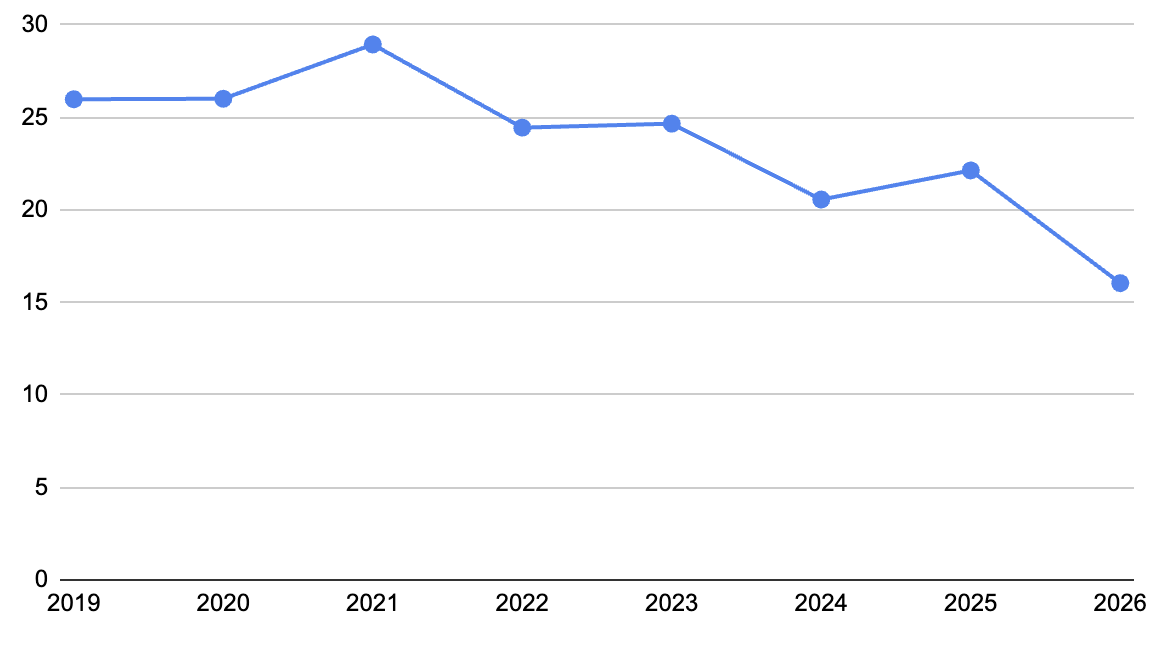
Even more worrying, some of Young’s burst has disappeared, which raises broader concerns about a decline in athleticism. In the 2020-21 season, which ended in Atlanta’s surprising trip to the conference finals, Young averaged 29 drives per 100 possessions, per GeniusIQ, which ranked third behind Shai Gilgeous-Alexander and Luka Doncic.
But over the past three seasons, Young is down to 21 drives per 100 possessions, a drop of more than a quarter. He ranks 14th in drive frequency in that span (minimum 1,000 total drives), which is still good, but nowhere near the elite level anymore.
Trae Young’s Drives Per 100 Possessions
And if Young isn’t maximizing his offensive impact, then it’s unclear how much he can help a contender because his contributions on the other end are so meager.
The advanced stat xRAPM ranks Young in the 97th percentile for offensive impact, but below the first percentile in defensive impact. Estimated plus-minus, similarly, has Young in the 97th percentile on offense and the fourth percentile on defense.
In every season of his career (until this last, injury-shortened one), Young’s teams have been much better with him on offense, and in almost every season, they’ve been much worse with him on defense, according to Cleaning the Glass’ on/off data.
A player with that profile still has value to the right team in the right context. And Washington fits in some respects, as a franchise lacking a clear lead creator, with lots of present-day cap flexibility and young players on rookie contracts. Young will certainly raise the Wizards’ floor as they seek to climb out of the NBA’s basement after losing 67, 64 and 65 games in the past three seasons.
But soon enough, some of those young players will start demanding contract extensions, and now they’ll receive their raises at the same time that the Wizards are paying upward of $50 million per season to a small guard with huge flaws on the wrong side of the aging curve.
Under the NBA’s current financial regime, the worst mistake a team can make is committing superstar money to a good but not great player who’s a rung below that level. The Wizards would have been OK if they had re-signed Young to fewer dollars or fewer years, ideally both. But they didn’t pick either option.
June 21: CJ McCollum returning to Hawks on one-year deal
Terms: One year, $21 million
Grade: A
McCollum played an unexpectedly important role in Atlanta last season, as the Hawks surged after the All-Star break. And in retrospect, he might have been the most valuable player in the playoffs because he accomplished something that nobody else in the entire NBA could: With game-winning buckets in the final minute of consecutive games, he managed to beat the Knicks multiple times this postseason.
That wasn’t the expectation when McCollum came to Atlanta in the Trae Young trade, where he was seemingly included primarily to help match Young’s salary. Any on-court contributions would have been a bonus.
But McCollum meshed well with Atlanta’s untraditional positional alignment. The Hawks’ five-man lineup of McCollum, Dyson Daniels, Nickeil Alexander-Walker, Jalen Johnson and Onyeka Okongwu had a plus-21.4 net rating, per Cleaning the Glass, which ranked second among all lineups with at least 500 possessions. In a larger sample, the trio of McCollum, Alexander-Walker and Johnson – the veteran guard alongside the Hawks’ two best players – had a plus-14.5 net rating, per NBA Advanced Stats.
Next season, the Hawks will continue using those effective lineups, and McCollum’s ability to play both on- and off-ball – which he has successfully balanced throughout his entire career, starting when he was Damian Lillard’s sidekick with the Portland Trail Blazers – makes him an asset in Atlanta. He can run the offense himself, take a backseat to Johnson (the Hawks’ assist leader after Young’s departure) and help mentor a young point guard, if Atlanta goes that route with the No. 8 pick in this week’s draft.
And while McCollum is well past his peak and will be 35 years old at the start of next season, his extension qualifies for one of my favorite sports aphorisms: There’s almost no such thing as a bad one-year deal.
After making $30.7 million last season, McCollum’s salary will drop to $21 million in 2026-27. That number maintains the Hawks’ offseason flexibility, as ESPN’s Bobby Marks wrote in his offseason guide that “Atlanta is in as good a financial shape as any playoff team.” And it includes almost no downside, because the Hawks aren’t committing to pay McCollum into his late 30s, when his gradual (thus far) decline should grow more pronounced.
June 20 & 21: Suns agree to deals to bring back two guards
G Collin Gillespie
Terms: Four years, $48 million
Grade: A-
G Jordan Goodwin
Terms: Three years, $19 million
Grade: B+
When I ranked the most underrated free agents of this class, Gillespie topped the list. He enjoyed a breakout 2025-26 season, averaging 12.7 points per game and sinking 40% of his 3-pointers. His 46% mark on catch-and-shoot 3s ranked third among 121 players with at least 200 attempts (behind Luke Kennard and Jamal Murray). And he rates well by advanced stats.
For Gillespie, who went undrafted out of college and played three consecutive seasons on a two-way deal before 2025-26, a $48 million pact represents life-changing money.
For Phoenix, Gillespie fills a much-needed role as a ball handler next to Devin Booker, who led the Suns with 6.0 assists per game but isn’t the sort of playmaker who should dominate the ball on every possession. A four-year deal will cover the rest of Gillespie’s prime (he celebrates his 27th birthday this week) and tie him to Phoenix at a fair price.
Goodwin is also a 27-year-old point guard, but he’s a much more unorthodox player for the position than Gillespie: He’s not a remarkable scorer or creator (though his improved 3-point percentage, up to 37% last season, is notable), but he’s a strong defender and – most remarkably – an incredible offensive rebounder.
One of the most incredible statistics of last season is that the 6-foot-3 Goodwin ranked 15th among qualified players with a 9.4% offensive rebounding rate. All 14 players ahead of him were centers.
In a vacuum, the Suns did well to re-sign both Gillespie and Goodwin for reasonable rates.
The potential complication is how these deals affect the rest of the Suns’ offseason plans, with starting center Mark Williams also due for a new contract as he enters restricted free agency. They entered the offseason just $18 million shy of the luxury tax line and $26 million shy of the first apron.
And although the Suns greatly exceeded expectations last regular season, winning 45 games with a feel-good group and landing the West’s No. 8 seed, they were uncompetitive in a first-round sweep against Oklahoma City and don’t have any clear pathways to greater contention. Is Phoenix content to run it back while also accepting the penalties that come with exceeding the luxury tax and first apron?