By John Hollinger | The Athletic, 2026-06-10 10:40:15
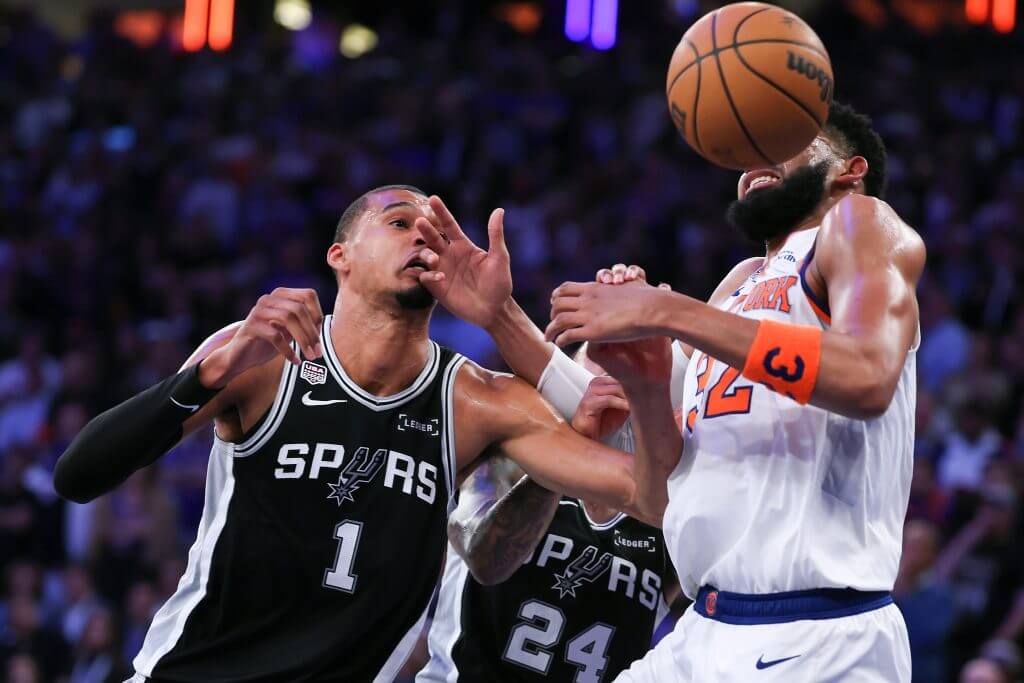
纽约——女士们先生们,这才是真正的系列赛。
实至名归。尼克斯和马刺已经连续打了三场惊心动魄、你来我往的大战,且每场比赛在最后一分钟内都曾战至仅差一个球权。三场比赛的总比分是尼克斯321比马刺314,总共只有区区7分之差。此时此刻,如果大比分不是2-1,那将完全无法体现两队之间微乎其微的实力差距,更不用说抹杀了我们在这三场比赛中所看到的极高竞技水准。
需要明确的是,纽约依然占据优势:尼克斯距离夺冠所需的四场胜利已经半程过半,而且还手握两个主场。如果你在系列赛开始前的“先验认知”是两队势均力敌,并将每场比赛都视为抛硬币,那么仅凭纽约目前2-1的领先优势,就足以让他们拥有70%的系列赛胜率。
此外,尼克斯神奇的连胜终有结束的一天,但这并不意味着他们突然失去了打出高光攻势的能力。即便是在这场比赛中,他们也在第二节狂轰42分,其中包括在最后三分钟打出一波14-3的狂潮,一度让我的同行们开始琢磨周六是不是可以去高尔夫球场消遣了。
然而,我们至少还要在圣安东尼奥再战一场,而且如果三天后我们又回到纽约,谁也不会感到意外。马刺虽然落后,但他们依然有机会扮演搅局者的角色。
所以,不妨让我们来聊聊为什么这轮系列赛如此焦灼,顺便对这两支球队以及他们在巅峰状态下所展现出的极高竞技水准表达由衷的赞赏。(即便在这样一个并非时刻完美的夜晚,两队也都有各自的失误:尼克斯反常地在外线出现了几次小学生级别的失误,而马刺则多次送出无谓的犯规。)
从大局来看,周一最大的不同在于圣安东尼奥的进攻终于回暖,尤其是马刺没有在转换进攻中因为糟糕的决策而自乱阵脚。在这三场比赛中,圣安东尼奥的推反击频率逐渐降低,但效率却稳步提升。根据Primestats.net的数据,第一场比赛中他们出手过于急躁,结果灾难性地搞砸了转换(转换进攻占比32.0%,每回合仅得0.98分);第二场比赛的转化率同样惨不忍睹(转换进攻占比23.5%,每回合仅得0.83分);而到了第三场,他们则展现出了更具针对性且更高效的转换进攻(转换进攻占比仅为12.9%,但每回合得分高达1.58分)。
马刺还在罚球线上取得了压倒性的优势,这也是赛后迈克·布朗 (Mike Brown) 的抱怨之后的热门话题,但这种指责站不住脚。首先,没有任何规则或潜在保证规定两队的罚球次数必须均等。常规赛中,尼克斯的罚球率排在联盟第24位,而马刺在避免送对手上罚球线方面高居联盟第一。既然如此,你觉得结果会怎样呢?
我在这里还要指出,“罚球”和“犯规”并不是一回事。在第三场比赛中,圣安东尼奥被吹罚了21次犯规,而尼克斯则是23次;事实上,纽约在每场比赛中都被吹了整整23次犯规,而马刺三场被吹罚的次数分别是20次、21次和23次。
没错,第三场上半场维克托·文班亚马 (Victor Wembanyama) 对杰伦·布伦森 (Jalen Brunson) 的一次极其明显的犯规确实被漏判了。但除此之外呢?大家都散了吧,没什么好大惊小怪的。马刺很可能在每场比赛中都在罚球数上占优,因为这两支球队整个赛季的球风就是如此,就像尼克斯很可能在控制失误上做得更好、中距离出手更多一样。这些只是两队根深蒂固的风格使然,绝非什么偏袒纽约这种超级大市场的阴谋诡计。
相反,让我们把焦点转回那些精彩的部分。这两支球队都极具观众缘,不仅打法赏心悦目,球员和教练组成员也都很讨人喜欢、个性十足(当然,也许有一个显而易见的例外)。
此外,风格决定比赛,而这轮对决堪称引人入胜。在那些最令人难忘的瞬间,尼克斯和马刺都逼出了最强的彼此。本周早些时候,我曾引用过一个例子,那是周五第二场比赛中的一幕:尼克斯的“多点分球”总是比马刺的防守快一步,直到最后在24秒进攻时间仅剩0.2秒时,由米卡尔·布里奇斯 (Mikal Bridges) 在底角投中了一个大空位三分。在纽约主要依靠防守取胜的那场比赛中,这堪称一次行云流水的团队进攻撕裂顶级防守并创造出轻松出手机会的绝佳范例。
然而,周一的比赛却给我们提供了几个鲜明的反例。比如在上半场,尼克斯又打出了一次类似于第二场那样的“四次分球”配合,但这一次马刺的防守跟进得要好得多,逼得OG·阿奴诺比 (OG Anunoby) 只能在底角顶着防守强投一个“接锅球”——而整晚状态神勇、打得像疯了一样的阿奴诺比,居然奇迹般地把球投进了。
不过,从圣安东尼奥的角度来看,好戏还在后头。下半场,马刺用另一次防守回合再次证明了,为什么这支队伍能在常规赛防守效率高居联盟第三,并在季后赛中高居第二。
第四节还剩4分08秒时,落后8分的尼克斯在暂停回来后立即通过一次针对布伦森的无球掩护,让兰德里·沙梅特 (Landry Shamet) 顺下,瞬间打乱了马刺的防守阵型。在进攻时间还剩13秒时,沙梅特双脚已经踏入油漆区,而马刺的五名防守球员全都被吸引到了球场的同一侧。
按理说,圣安东尼奥此时应该彻底交代了,尤其是面对尼克斯这样一支擅长在面对轮转防守时送出致命传球的进攻球队。令人惊叹的是,马刺在防守端步步紧跟,纽约自始至终没有得到任何空位机会,而文班亚马则在7秒后,在篮下结结实实地封盖了沙梅特。
这绝对是双方顶尖水准的博弈:尼克斯在电光石火间寻找防守漏洞并做出正确的战术选择,而马刺则像疯了一样疯狂补位,试图堵住大坝上的每一个新缺口,直到最后由文班亚马用一次篮下封盖一锤定音。
让我们再看一遍这个回合,除了文班之外,还要注意其他人的防守细节:
- 达龙·福克斯 (De’Aaron Fox) 一个人防了四名球员,并且在最关键的防守中段,他飞身扑出油漆区,拼尽全力封堵了卡尔-安东尼·唐斯 (Karl-Anthony Towns) 的空位三分出手。
- 迪伦·哈珀 (Dylan Harper) 提前换防了针对布伦森的下掩护,破坏了后者的出手空间,随后又以闪电般的速度飞身扑防,掐死了布伦森的另一次潜在三分机会。
- 当沙梅特传球给阿奴诺比,后者眼看就要获得大空位轻松出手的机会时,德文·瓦塞尔 (Devin Vassell) 飞速扑向底角,逼迫阿奴诺比只能将球传给唐斯。
- 斯蒂芬·卡斯尔 (Stephon Castle) 在回合开始时绕前防守布伦森,随后换防到乔什·哈特 (Josh Hart) 身上,并挤过掩护紧紧贴住他;在唐斯用投篮假动作骗过福克斯后,卡斯尔果断放弃哈特去协防延误唐斯,最后又迅速回位抢下了防守篮板。
- 至于文班亚马,在完成封盖之前,他果断放掉了底角的阿奴诺比,去封堵来自球场另一侧的威胁。
最后,注意一个没有发生的情况:文班亚马并没有飞身扑出油漆区去防守弧顶的投手,这使他能够在球传到底角时,依然有能力盯防沙梅特。这是战术设计使然。
“到了这个时候,”福克斯说道,“当你和一支球队交手了这么多次,你已经对他们的套路了如指掌。他们也同样了解我们。他们让我们陷入了轮转防守……对手都想把维克拉出油漆区。大家都知道这不是什么秘密。我们已经变得非常擅长围绕他进行轮转,而他在扑防投手、将对手逼离三分线的同时保持防守身位方面也做得越来越好。
“所以,面对像兰德里这样投篮极其精准的投手,他成功把对方逼离了三分线。我们则在他身边疯狂补位。他(沙梅特)是想顶着维克强投,还是不投?他选择尝试顶着维克出手,结果被盖了。如果他把球传出去,我们就会进行‘X型轮转’。[“X型轮转”是一种防守技术,即距离球最近的防守球员扑向第一次传球,这通常需要一名油漆区防守球员通过交叉跑位进行第二次轮转,去防守下一名投手。] 我们围绕维克进行‘X型轮转’,疯狂补位。我觉得我们就是用这种方式把他们防得挺好的。”
疯狂的是,即便这次进攻没有转化为得分,尼克斯在这个回合的进攻配合也同样堪称精彩。
再看一遍:尼克斯接受了后场对布伦森的绕前防守,并让他去设立掩护,以便将防守较弱的球员换防到他面前。接着,布伦森跑向沙梅特在底角设立的内切掩护——这是暂停后设计的一个不寻常的变招,本可能让马刺的后卫猝不及防,但哈珀洞察了这一切,并提前上前封堵传球路线。
沙梅特立刻注意到了哈珀的举动,顺势拆开顺下,如果面对的是普通身材的护筐球员,这本可以是一次轻松的反跑上篮。即便如此,沙梅特还是做出了正确的选择,将球分给外线的阿奴诺比,后者又迅速传给弧顶的唐斯。马刺硬是凭借两次不可思议的轮转防守,才阻止了他们两人投出大空位三分。
唯一可以挑剔的,或许是沙梅特最后的投传选择,他本可以传给底角的哈特,让马刺的防守在多一两次传导球中继续疲于奔命。
“那是今晚最精彩的回合之一,”马刺主教练米奇·约翰逊 (Mitch Johnson) 说道。
“从多次努力、预判队友意图的角度来看,这是一个非常棒的防守回合。当然,维克托也在那里,用他最擅长的方式在篮下完成了收尾。”
而这个回合,正是我们在前三场比赛中频繁看到的双方精彩表现的缩影——这不仅是个人天赋的闪耀,更是任何篮球级别都罕见的团队协作与默契配合。
准备好爆米花,尽情享受这轮对决吧。通常,一轮能被历史铭记的“伟大”系列赛需要具备三个要素:整体极高的竞技水准、单场比赛在最后一分钟(或几分钟)决出胜负,以及一轮至少打满六场的势均力敌的系列赛。我们已经达成了前两个条件,并且似乎正顺利朝着第三个条件迈进。在总决赛(大致)过半之际,这轮系列赛完全有机会成为载入史册的传世经典。
由生成式 AI 翻译,译文内容可能不准确或不完整,以原文为准。
点击查看原文:One scrambling NBA Finals defensive stand shows why Spurs-Knicks might be a classic
One scrambling NBA Finals defensive stand shows why Spurs-Knicks might be a classic
NEW YORK – Ladies and gentlemen, we have a series.
Deservedly. The Knicks and Spurs have played three straight thrilling, back-and-forth games that became one-possession contests at some point in the final minute. The aggregate score is Knicks 321, Spurs 314, a mere seven-point difference across three games. Anything other than 2-1 at this point would be a gross misrepresentation of the difference in quality between these two sides, not to mention throwing some shade at the overall level of play we’ve seen in the three games so far.
To be clear, New York still has the advantage: The Knicks are halfway to four and still have two home games left. If your “prior” entering the series was that the two teams were evenly matched and you treated each game as a coin flip, the mere fact of New York’s 2-1 edge would give it a 70 percent chance of winning the series.
Also, the inevitable fact that the Knicks’ magical win streak would come to an end doesn’t mean they suddenly lost the ability to conjure up brilliant stretches of basketball; even in this game, they had a 42-point eruption in the second quarter that included a 14-3 avalanche in the final three minutes, briefly leaving my colleagues to ponder the possibility of spending Saturday at the golf course.
Instead, we’ll play at least one more game in San Antonio, and nobody will be shocked if we end up back here in New York three days after that. The Spurs are behind, but they still have a chance to be party poopers.
So, instead, let’s talk about why we have a series, and maybe show a little appreciation for these two teams and the phenomenally high level of play they’ve achieved in their best moments. (Even on a night that didn’t always include those best moments, both teams had their lapses: the Knicks uncharacteristically made several grade-school-level turnovers on the perimeter, while the Spurs committed multiple senseless fouls.)
The big-picture difference on Monday was that San Antonio’s offense finally showed up, and, in particular, that the Spurs didn’t combust with atrocious decisions in transition. San Antonio has run less often and more effectively in each game, with disastrously itchy trigger fingers in Game 1 (32.0 percent of possessions, 0.98 points per possession, according to Primestats.net) and brutal conversion rates in Game 2 (23.5 percent of possessions and 0.83 ppp) giving way to more targeted and effective transitions (just 12.9 percent of possessions, but 1.58 ppp).
The Spurs also won the free-throw battle decisively, a hot topic after Mike Brown’s complaints following the game, but an unconvincing allegation. First of all, there is no rule or implied guarantee that the two teams will shoot the same amount of foul shots. The Knicks were 24th in the NBA in free-throw rate in the regular season, and the Spurs ranked No. 1 among teams at avoiding sending opponents to the line; what did you think would happen?
I’ll also note here that “free throws” and “fouls” aren’t the same thing. San Antonio was called for 21 fouls against 23 for the Knicks in Game 3; New York has been called for exactly 23 every single game, and the Spurs for 20, 21 and 23.
Yes, one particularly egregious foul by Victor Wembanyama on Jalen Brunson in the first half of Game 3 was very obviously missed. Otherwise? Move along everyone – there is nothing to see here. The Spurs are likely to win the free-throw battle every game, just because that’s how these teams played all season, much as the Knicks are likely to win the turnover battle and shoot more from midrange. These are just underlying stylistic facts of how the teams play, not some nefarious plot to favor a big and important market such as New York.
Instead, let’s circle back to the good stuff. Both these teams are incredibly easy to root for, with attractive playing styles and likable, interesting players and staff (with perhaps one glaring exception).
Moreover, styles make fights, and this one is compelling. At the most memorable moments, the Knicks and Spurs have brought out the best in each other. Earlier this week, I cited an example from Friday’s Game 2 where the Knicks’ “sprays” stayed one step ahead of the Spurs defense until finally they landed a wide-open corner 3 for Mikal Bridges with two-tenths of a second on the shot clock. In a game New York otherwise won with its defense, it was an example of beautiful connected offense breaking down an elite defense to generate an easy shot.
Well, Monday gave us a few glaring counter-examples. The Knicks, for instance, had another “four-spray” sequence in the first half similar to the one in Game 2, except the Spurs tracked it much better and forced a contested “grenade” in the corner from OG Anunoby that he – in the process of playing out of his freaking mind all night – somehow converted.
However, from San Antonio’s side, it gets better. After halftime, the Spurs came back with another sequence that underscored how this squad had the league’s third-best defense in the regular season and second-best in the playoffs.
With 4:08 left, the Knicks came out of a timeout trailing by eight points and got the Spurs off balance almost immediately with an off-ball screen for Brunson that turned into a slip for Landry Shamet. With 13 seconds left on the shot clock, Shamet had two feet in the paint and all five Spurs players were on one side of the court.
By all rights, San Antonio should have been absolutely cooked here, especially against an offensive team like the Knicks that can reliably make the next pass in the sequence against the rotating defense. Amazingly, the Spurs stayed with them every step of the way, New York never got an open shot, and Wembanyama ended up stuffing Shamet at the rim seven seconds later.
This is absolutely elite stuff all around, a whirlwind of the Knicks finding the net opening and making the right play, and the Spurs scrambling like mad to plug each new hole in the dike before finally Wembanyama seals it with a block at the rim.
Watch it again, and look beyond Wemby:
- De’Aaron Fox guarded four players and, in perhaps the most key part in the middle, flew out of the paint and sold out to take away an open Karl-Anthony Towns 3-point attempt.
- Dylan Harper pre-switched a pindown for Brunson to take his look away, and then scrambled into a lightning-quick close-out to take away another potential 3 for Brunson.
- Devin Vassell flew out to the corner when it looked like Anunoby would have a wide-open fungo on the pass from Shamet, forcing his next pass out to Towns.
- Stephon Castle denied Brunson at the start of the play, switched onto Josh Hart and fought over a screen to stay with him, left him to stunt toward Towns after he shot-faked Fox, and got back in the play for the defensive board.
- And Wembanyama, before the block, left Anunoby in the corner to close off a threat from the opposite side of the court.
Finally, note what didn’t happen: Wembanyama didn’t come flying out of the paint to close out on a shooter at the top of the key, leaving him able to track Shamet when the ball came to him in the corner. That’s by design.
“At this point,” Fox said, “when you’ve played a team so many times, you know what they’re going to do. They know what you’re going to do. They got us in rotations and … teams want to get Vic out of the paint. You know that’s not a secret. We have gotten good about rotating around him, and he’s gotten better at closing out to shooters, getting guys off the line while trying to stay in front of them.
“So, with someone like Landry, who obviously … shoots the leather off the ball, he got him off the line. We’re scrambling around him. Does he want to finish over him or not? He elected to try to finish over him, he blocked the shot. If he passed the ball out, we’re ‘x’-ing. [“X” is a defensive technique where the closest defender to the ball jumps to the first pass, usually necessitating a paint defender to make an “x” by crossing his path to make the second rotation to the next shooter.] We’re ‘x’-ing around Vic. We’re scrambling. And that’s the way that we, I think we’ve guarded them pretty well.”
What’s wild is that this play was also great offense by the Knicks, even if it didn’t get a result.
Watch it again: The Knicks accepted the ball denial in the backcourt on Brunson and had him set a screen so they could switch a weaker defender onto him. Then Brunson ran into a corner pin-in from Shamet – an unusual wrinkle out of the timeout that might have caught the Spurs off guard, but Harper was on top of it and jumped the pass early.
Shamet noticed Harper’s move right away and slipped the screen, cutting for what might have been a backdoor layup against a normal-sized rim protection. Even then, Shamet makes the right kickout to Anunoby, who hits Towns at the top of the key. It took two incredible rotations to prevent either one of them from launching a wide-open 3.
About the only thing you could criticize was Shamet’s final shoot-pass decision, when he might have hit Hart in the corner and put the Spurs in the blender for another pass or two.
“That was one of the plays of the night,” Spurs coach Mitch Johnson said.
“It was a really good possession in terms of multiple efforts, anticipating what your teammate was going to do. And then Victor was there, obviously, doing what he does best to clean it up at the rim.”
And that play is a microcosm of the brilliance we’ve seen from both sides through so much of these first three games — not just scintillating individual talent, but a level of teamwork and coordination rarely seen at any level of basketball.
Get yer popcorn and enjoy it for as long as it lasts. Usually we require three elements for history to remember a “great” series: A high standard of play overall, individual games decided in the final minute(s) and a close series that goes at least six games. We’ve already checked the first two boxes and seem well on our way to the third. Halfway through (roughly), these NBA Finals have a chance to be an all-time classic.
By John Hollinger, via The Athletic