By Fred Katz | The Athletic, 2026-06-10 10:00:43
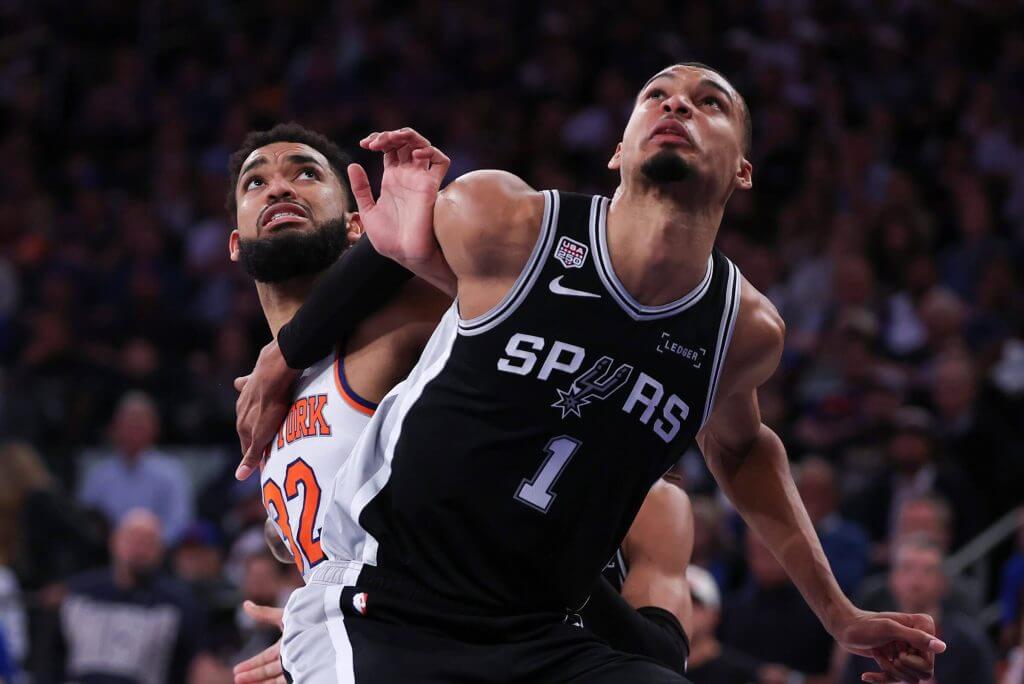
纽约——纽约尼克斯一直到最后一个回合,都在强行给他们的得分手喂球。
伴随着仅存的一线生机,这支已经一个半月未尝败绩的球队准备发边线球。乔什·哈特 (Josh Hart) 站在右侧边线,此时尼克斯落后圣安东尼奥马刺4分。总决赛第三场只剩下最后几秒。纽约需要奇迹降临,但奇迹并未发生。
球队的头号球星杰伦·布伦森 (Jalen Brunson) 在球场的另一侧开始跑位,准备切入禁区接球,从而完成一次快速出手。尼克斯浪费不起时间,但布伦森根本无法摆脱防守。马刺后卫斯蒂芬·卡斯尔 (Stephon Castle) 像牛皮糖一样紧紧贴在他身上——正是这个人在西部决赛中让两届MVP谢伊·吉尔杰斯-亚历山大 (Shai Gilgeous-Alexander) 吃尽了苦头。
布伦森冲进禁区。卡斯尔仿佛粘在了对手身上。布伦森伸出一只手臂,试图摆脱。布伦森的手和卡斯尔的胸口之间甚至连一丝缝隙都没有。卡斯尔挡在他面前,封锁了通往三分线外的路线。
当OG·阿奴诺比 (OG Anunoby) 向相反方向切入时——这一跑位本可以阻挡那些防守不如卡斯尔的球员——布伦森被迫偏离了路线。卡斯尔改变了尼克斯的战术版图,并引发了一场地震。
布伦森没有接球机会。阿奴诺比背对着球。哈特无法将球传给尼克斯的队长,他将目光投向球场上方,转头看向在右侧翼三分线外背身要球的米卡尔·布里奇斯 (Mikal Bridges)。布里奇斯接球,转身,仓促出手了一记偏出的三分球。
就在人们以为尼克斯再也不会输球的时候,他们输了——这是他们45天来的首次失利。虽然布里奇斯在比赛结束前的打铁很难说是失利的主因,但这次进攻却典型地暴露了纽约这支全联盟最聪明、最无私的球队之一所罕见的问题。
周一,当马刺将系列赛大比分追至1-2时,尼克斯死死盯着特定的目标。如果第一选择被掐死,他们就找不到可行的替代方案。一个以“阅读并反应(read-and-react)”哲学为核心、充满活力的半场进攻,无法像往常那样频繁地发起攻击。
“我们的进攻陷入了今年我所见过的最停滞的状态,”主教练迈克·布朗 (Mike Brown) 说道。
布朗做出这一评估的部分原因是失误。尼克斯出现了13次失误,其中不乏无迫使失误。一旦传球过高或过偏,圣安东尼奥马刺就会迅速反击轻松得分。
如果尼克斯不能尽早落位,他们就无法创造出那么多转换三分球的机会,而且他们将不得不面对圣安东尼奥已经落好位的防守——那是全联盟最密不透风的防线之一。他们无法在两名马刺球员试图纠正混乱局面(比如大防小或小防大的错位)的空档中溜过去。在第三场比赛中,那些在五秒钟内一个尼克斯球员传给另一个,另一个又迅速传给下一个,下一个再找到另一个的“乒乓球式”流畅传导球并不多见。球队最终仅送出18次助攻,这是他们本赛季(包括常规赛和季后赛共99场比赛)的第二低纪录。
这看起来一点也不像周一之前豪取13连胜(季后赛历史上第二长连胜纪录)的那支尼克斯。当然,马刺的防守对此起到了关键作用。
尤其是卡斯尔,他在不同的对位中不断纠缠。有时,这位身高6英尺6英寸的后卫负责防守布伦森;有时,他去对位哈特。他甚至还与中锋卡尔-安东尼·唐斯 (Karl-Anthony Towns) 展开了对决。周一,唐斯在面对卡斯尔或凯尔登·约翰逊 (Keldon Johnson) 这样体型较小的防守者时,表现得比尼克斯连胜开始以来都要挣扎——而尼克斯此前的连胜在很大程度上正是得益于唐斯一场接一场地接管比赛。
在第二节的某段时间里,尼克斯试图将球吊给被体型较小的约翰逊防守的唐斯。尼克斯虽然拥有身高优势,但约翰逊硬是将这位7英尺高的大个子顶出了禁区。这与唐斯在神奇的G2中面对马刺小个防守时的表现截然相反,当时他在内线彻底摧毁了马刺,尤其是在上半场。
“我们做完第一次掩护后,基本上就只是站在那里看着,”布朗说道。
想要打出流畅的进攻并不容易。
唐斯未能惩罚身材较矮的对手,这意味着马刺没有那么大的压力去让维克托·文班亚马 (Victor Wembanyama) 防守他,这使得这个星球上最伟大的禁区守护者得以在篮筐周围自由游走。他不仅切断了突破路线,还封锁了空切区域。
这让人想起了东部决赛的第一场。当时克利夫兰骑士让他们的中锋贾勒特·阿伦 (Jarrett Allen) 去防守三分不稳定的哈特,从而让阿伦可以肆无忌惮地收缩禁区。纽约的无球跑动随之消失,尼克斯一度落后多达22分,直到他们换上另一名射手兰德里·沙梅特 (Landry Shamet) 拉开空间,才发起了一场历史性的逆转。
“(我们)有太多人在看球,大家都站在那里,”布里奇斯在谈到周一的失利时说道。“我们必须保持移动。我认为他们在防守后卫方面做得很好。而且文班一直镇守在低位,有时会让我们产生混乱。我认为如果我们保持移动,情况会有所好转。”
周一,尼克斯丢掉了在总决赛前两场比赛中行之有效的战术。
在圣安东尼奥的前两场比赛中,大部分时间都非常流畅的球权转移变得滞涩。空切也不够犀利。他们眼中的目标变成了他们想要把球传给的队友,而不是防守的漏洞或球场的空档区域。
在G1和G2中,尼克斯锁定了一个看似反直觉的目标:文班亚马。他们让这位年度最佳防守球员频繁陷入挡拆,这把他拉离了篮筐,并迫使他进行更多的跑动,这可能是他在那两场比赛第四节大口喘气的原因。但他们在G3中放弃了这一战术。
根据Second Spectrum的数据,在G1和G2中防守了48次挡拆后,文班亚马在G3中仅防守了14次。
文班亚马减少了对尼克斯中锋的贴防,而尼克斯也减少了与他的纠缠。在这14次挡拆中,哈特仅做了一次掩护。其余的都是在这位身高7英尺4英寸的中锋防守唐斯或米切尔·罗宾逊 (Mitchell Robinson) 时发生的。
圣安东尼奥改变了防守对位,而尼克斯则偏离了行之有效的战术。到了G4,他们必须找回自己的战术风骨。
“那些细节,对细节的专注,那些我们引以为傲的东西,我们今天都没有做到,”布伦森说道。“所以,无论我们得到了什么样的投篮机会,细节都能决定一场比赛的成败。”
由生成式 AI 翻译,译文内容可能不准确或不完整,以原文为准。
点击查看原文:In Game 3 loss, 'stagnant' Knicks got away from what worked in their first 2 victories
In Game 3 loss, ‘stagnant’ Knicks got away from what worked in their first 2 victories
NEW YORK — The New York Knicks force-fed their scorers all the way down to the last possession.
With only the slightest sliver of a chance at victory, a team that hadn’t lost a game in a month and a half readied to inbound the basketball. Josh Hart stood on the right sideline, the Knicks down 4 points to the San Antonio Spurs. Only a few seconds remained in Game 3 of the NBA Finals. New York required a miracle to poof into existence. It did not.
The team’s top dog, Jalen Brunson, began the play on the opposite side of the court, ready to cut through the paint and receive a pass, which could lead to a quick shot. The Knicks could not afford to waste time, but Brunson could not free himself. Draped all over him was Spurs guard Stephon Castle, the same man who ruined the Western Conference finals for two-time MVP Shai Gilgeous-Alexander.
Brunson sprinted into the lane. Castle acted as if he were glued to his opponent. Brunson extended an arm, trying to shimmy away. Daylight did not even show between Brunson’s hand and Castle’s chest. Castle stood in his way, blocking the route toward the 3-point arc.
As OG Anunoby cut in the opposite direction, a move that could have impeded the path of a worse defender than Castle, Brunson veered off course. Castle had shifted the Knicks’ geography — and he had caused an earthquake.
Brunson wasn’t open. Anunoby’s back was to the play. Hart could not get the Knicks’ captain the basketball and panned his eyes upcourt, turning his head to Mikal Bridges, who was posting up outside the arc on the right wing. Bridges fielded a pass, spun around and heaved an errant 3-pointer.
Just when it seemed the Knicks would never lose again, they did — for the first time in 45 days. Though Bridges’ clank to conclude the evening was hardly the reason for the defeat, the possession was exemplary of a rare issue for New York, one of the league’s cleverest and most unselfish squads.
The Knicks locked in on specific targets Monday, when the Spurs shrank their series lead to 2-1. If the first option was cut off, they could not find a viable alternative. A dynamic half-court attack, one that thrives with a read-and-react philosophy, could not strike nearly as often as it normally does.
“We were about as stagnant as I’ve seen us all year,” head coach Mike Brown said.
Part of the reason for Brown’s evaluation was the turnovers. The Knicks coughed up the ball 13 times, sometimes unforced. If a pass sailed too high or too wide, San Antonio would dart the other way for a bucket.
If the Knicks can’t get into their sets early, then they won’t create as many transition 3-pointers, and they will go up against a San Antonio defense, one of the league’s stingiest, that is already set. They can’t slide behind two Spurs trying to correct a frantic moment that forced a big guy to guard a smaller one or vice versa. Those ping-pong possessions when one Knick dishes to another who pops the ball to another who finds one more all in a span of five seconds weren’t so prominent in Game 3. The team settled for 18 assists, its second-lowest total out of 99 regular-season and playoff games.
These did not look like the Knicks who entered Monday victors of 13 consecutive games, the second-longest winning streak in playoff history. Of course, the Spurs had something to do with that.
Castle, in particular, jostled through various matchups. At times, the 6-foot-6 guard manned Brunson. At others, he took Hart. He squared off with center Karl-Anthony Towns, who struggled more against tinier defenders Monday — such as Castle or Keldon Johnson — than Towns has since the beginning of the Knicks’ heater, which sparked in large part because Towns took over game after game.
During one stretch of the second quarter, the Knicks tried to lob the ball into Towns, who was being guarded by the smaller Johnson. The Knicks had a size advantage, but Johnson pushed the 7-footer out beyond the paint. It was the opposite of what Towns showed when the Spurs manned him with smalls during his miraculous Game 2, when he annihilated San Antonio down low, especially in the first half.
“We’d get the first screen, and then we literally just stood and watched,” Brown said.
It wasn’t so easy to flow freely.
Towns failing to punish shorter opponents meant the Spurs weren’t as pressured to put Victor Wembanyama on him, which allowed the planet’s greatest protector of the paint to roam around the rim. He didn’t just cut off driving lanes; he also blocked areas to cut.
It was reminiscent of Game 1 of the Eastern Conference finals. The Cleveland Cavaliers placed their center, Jarrett Allen, on Hart, an inconsistent 3-point shooter, which allowed Allen to sag into the paint. New York’s movement dissipated. The Knicks went down 22 points before inserting an extra shooter, Landry Shamet, who spread the court and sparked a historic comeback.
“(It was) too much ball watching, standing around,” Bridges said of Monday’s loss. “We just got to keep moving. I think they do a great job defensively with the guards. Then Wemby staying low, it can draw confusion sometimes. I think if we keep moving, it’s going to help us.”
Monday, the Knicks got away from what worked over the first two games of the finals.
Ball movement, which was pristine much of the first two games in San Antonio, tightened. Cutting wasn’t as sharp. The targets they identified were teammates to whom they wanted to get the ball, not opponents or areas of the court.
During Games 1 and 2, the Knicks zeroed in on a counterintuitive mark: Wembanyama. They placed the Defensive Player of the Year in pick-and-rolls aplenty, which pulled him away from the hoop and made him run more, possibly contributing to his heavy breathing during those fourth quarters. But they got away from that move in Game 3.
After guarding 48 pick-and-rolls over Games 1 and 2, Wembanyama defended only 14 in Game 3, according to Second Spectrum.
Wembanyama attached himself to the Knicks’ centers less, and the Knicks detached themselves from him. Of those 14 pick-and-rolls, Hart was the screener on only one of them. The rest came with the 7-foot-4 center manning Towns or Mitchell Robinson.
San Antonio changed its alignment, and the Knicks steered away from what was working. Come Game 4, they must return to their identity.
“The little things, the attention to detail, the stuff that we pride ourselves on, we didn’t do it,” Brunson said. “So, regardless of whatever shots we were getting, the little things could make or break a game.”
By Fred Katz, via The Athletic