By Law Murray | The Athletic, 2026-06-10 11:00:37
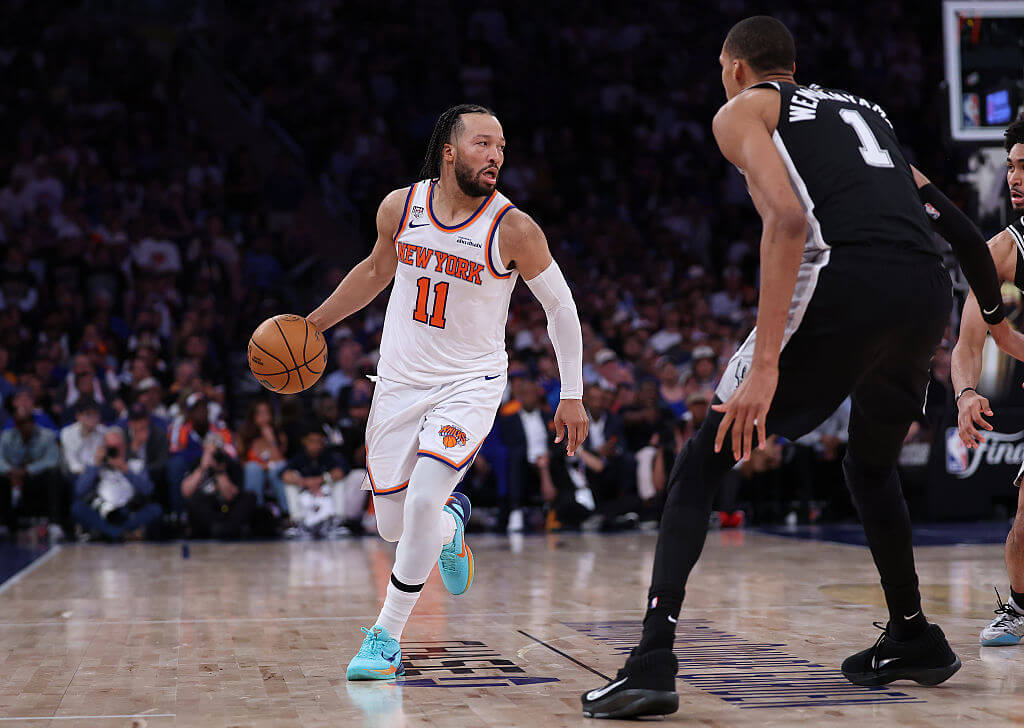
在2026年NBA总决赛第三场还剩30多秒时,纽约尼克斯后卫杰伦·布伦森 (Jalen Brunson) 抢下篮板并推进到前场。圣安东尼奥马刺以111-105领先,因此布伦森必须有所作为。
他持球突破圣安东尼奥马刺的新秀迪伦·哈珀 (Dylan Harper),将其逼至三分线以内,随后完成一记后撤步三分命中,将尼克斯的落后分差缩小了一半。这是布伦森在第三场比赛中得到的最后分数,也是他的最后一次出手。
布伦森全场25投11中,砍下全队最高的32分,并送出5次助攻。但这一次,与第一场和第二场不同,尼克斯未能完成逆转。马刺在最后五次进攻中三次得分,守住了第四节的领先优势,并以111-105赢下比赛。
随着系列赛将在周三迎来第四场对决,纽约有一个显而易见的问题亟待解决:他们该如何阻止在布伦森在场时持续输分的局面?
总决赛三场战罢,尼克斯大比分2-1领先,且总得分以321-314领先马刺。然而,在布伦森上场的阶段,纽约反而净输13分。考虑到布伦森作为球队核心组织者和进攻创造者的角色,且他的出场时间高居全队之首(根据NBA.com的数据,超过110分钟),这一数据显得尤为扎眼。
不过,这并不意味着布伦森在这轮系列赛中没有贡献。在第一场比赛中,他在还剩1分50秒时命中一记二次进攻三分,抹平了圣安东尼奥的最后一次领先,随后在最后一分钟利用维克托·文班亚马 (Victor Wembanyama) 的一次致命失误得分。在第二场比赛中,布伦森在还剩39.3秒时打进扳平比分的一球,随后再次抓住文班亚马的失误造成犯规,两罚中一帮助球队反超,完成了全场的最后一次领先交替。
但从系列赛的整体趋势来看,在布伦森掌控进攻时,纽约屡屡陷入落后。在第一场到第三场比赛中,马刺在首节分别建立起10分、10分和12分的领先优势。第一场比赛中,在布伦森首节上场的时间里,尼克斯净输10分。而在第二场和第三场中,布伦森打满首节12分钟,纽约分别以25-34和22-33落后。在这些首节比赛中,布伦森在35分钟的出场时间里仅得16分,投篮共计22投仅5中(命中率22.7%),同时送出4次助攻,并伴有4次失误。
与此同时,尼克斯在首节每百回合仅能得到88.0分,而在此前对阵东部球队的12场季后赛中,这一数据高达130.9分。在常规赛期间,纽约的首节进攻效率高居联盟第五(每百回合120.2分),这也是他们单节进攻火力最猛的时段。
面对年度最佳防守球员文班亚马镇守的禁区,布伦森也很难攻到篮下。相反,在面对斯蒂芬·卡斯尔 (Stephon Castle)、朱利安·尚帕尼 (Julian Champagnie)、德文·瓦塞尔 (Devin Vassell) 和哈珀等身材更高大的防守者时,他不得不选择在三分线内进行中距离尝试。而在面对全联盟限制对手罚球率最出色的马刺防守时,想要博得罚球也绝非易事。
正如尼克斯在开局阶段因布伦森长时间持球而陷入挣扎一样,每当布伦森首次下场休息时,他们也总能同样稳定地蚕食马刺的领先优势。在第一场布伦森首次休息期间,尼克斯将10分的落后分差缩小到3分。在第二场他首次休息时,尼克斯将9分的分差追至3分。而在第三场他首次休息时,尼克斯将11分的分差缩小到4分。这三个时间段加起来虽然只有15分钟,但正是尼克斯重新咬住比分的关键时刻。在这几段累计时间里,马刺全队投篮仅有22投6中。
卡尔-安东尼·唐斯 (Karl-Anthony Towns) 是这些逆转局面的核心人物。在这轮系列赛中,在唐斯不在场的37分30秒里,纽约净输了24分。
总决赛期间,纽约在布伦森在场时的最佳表现出现在第一场第三节中段,当时圣安东尼奥以65-51领先。从那时起,布伦森13投7中砍下19分,在比赛最后的18.5分钟里,当布伦森在场时,尼克斯净胜马刺24分。但即便是在那次反扑高潮中,布伦森也并非独自扛起整个进攻重任。唐斯、乔什·哈特 (Josh Hart) 和迈尔斯·麦克布莱德 (Miles McBride) 都提升了自己的组织表现,纽约通过多点开花创造了进攻机会。
自那之后,这种平衡就变得难以寻觅。在第二场比赛中,尼克斯险些成为被逆转的一方,圣安东尼奥在第四节打出一波21-5的狂潮,期间尼克斯在连续六次进攻中遭遇了长达207秒的得分荒。在这六次进攻的最后三次中,布伦森连续投篮不中,其中包括连续两次三分打铁。即使是在纽约全场表现最好的阶段——一波26分的分差逆转、将12分的落后转化为14分的领先——当唐斯在场时,尼克斯也净胜了马刺29分。
之所以提及这些,是因为尼克斯在第三场中未能像前两场那样抹平分差。不过,第四节的问题并不在布伦森身上,而是在于纽约的配角阵容。在最后一节中,除布伦森和阿奴诺比 (Anunoby) 之外的其他球员,在16次出手里投丢了15球,唯一的进球来自米切尔·罗宾逊 (Mitchell Robinson) 补篮打进布伦森投丢的球。
更大的问题在于布伦森在第三节的灾难级表现,这让尼克斯陷入了无法自拔的泥潭。他单节7投仅2中,包括该节最后四次出手全部打铁,送出3次失误,仅打进一球且没有助攻,还领到了三次犯规,全部送给马刺罚球机会。纽约在半场结束时还握有7分领先,但当布伦森在第三节还剩4分29秒因犯规麻烦被换下时,尼克斯已经落后3分——在他上场的这段时间里,分差发生了10分的变化。此后,纽约再也未能取得领先。
对尼克斯来说,好消息是他们目前大比分2-1领先,并且接下来还有一个主场。但展望未来,令人担忧的是,纽约在总决赛的大部分时间里都在努力“熬过”布伦森在场的阶段,而不是在这些时间里赢分。这在第一场和第二场奏效了,但在第三场却没能灵验。
如果纽约想要在第四场中走得更轻松一些,他们可能需要一个效率更高的布伦森——一个在面对全联盟最强悍防守之一时,无需大包大揽掌控球权也能影响比赛的布伦森。
由生成式 AI 翻译,译文内容可能不准确或不完整,以原文为准。
点击查看原文:The Knicks keep losing the Jalen Brunson minutes. How long can they survive it?
The Knicks keep losing the Jalen Brunson minutes. How long can they survive it?
With just over 30 seconds left in Game 3 of the 2026 NBA Finals, New York Knicks guard Jalen Brunson grabbed a rebound and advanced into the frontcourt. The San Antonio Spurs led 111-105, so Brunson had to make something happen.
He drove at San Antonio Spurs rookie Dylan Harper enough to send him inside the 3-point line, then stepped back and nailed a 3-pointer to cut New York’s deficit in half. Those were Brunson’s final points and last shot attempt of Game 3.
Brunson finished with a team-high 32 points on 11-of-25 shooting from the field to go with five assists. But this time, unlike Games 1 and 2, the Knicks never completed the comeback. The Spurs scored on three of their final five possessions, holding onto their fourth-quarter lead and earning a 111-105 victory.
As the series shifts to Game 4 on Wednesday, New York has a glaring issue to resolve: How can they stop losing the Brunson minutes?
Through three games of the NBA Finals, the Knicks are up 2-1 and outscoring the Spurs 321-314 overall. Yet, New York has been outscored by 13 points with Brunson on the floor, a notable stat given Brunson’s role as the primary playmaker and shot creator while playing the most minutes among all Knicks (over 110, per NBA.com).
That doesn’t mean Brunson hasn’t delivered in the series, though. In Game 1, he erased San Antonio’s final lead with a second-chance 3-pointer with 1:50 remaining, then scored after a costly Victor Wembanyama turnover in the final minute. In Game 2, Brunson hit a game-tying basket with 39.3 seconds left before capitalizing on another Wembanyama miscue, drawing the foul that led to the go-ahead free throw and the game’s final lead change.
But the larger trend of the series is that New York has repeatedly fallen behind with Brunson directing the offense. The Spurs built first-quarter leads of 10, 10 and 12 points in Games 1 through 3, respectively. In Game 1, the Knicks were outscored by 10 points in Brunson’s opening-quarter minutes. In Games 2 and 3, with Brunson playing all 12 minutes of the first quarter, New York was outscored 34-25 and 33-22. During those first quarters, Brunson has scored just 16 points in 35 minutes while missing 17-of-22 shots (22.7 percent) from the field with four assists and four turnovers.
The Knicks, meanwhile, have managed only 88.0 points per 100 possessions in first quarters compared to 130.9 points per 100 possessions in 12 playoff games against the Eastern Conference. During the regular season, New York ranked fifth in first-quarter offensive efficiency (120.2 points per 100 possessions), its highest output in any period.
Brunson has also struggled to reach the rim when it’s protected by Wembanyama, the Defensive Player of the Year. Brunson has instead settled for attempts inside the 3-point line against bigger defenders such as Stephon Castle, Julian Champagnie, Devin Vassell and Harper. Free throws aren’t a given against a Spurs defense that allowed the NBA’s lowest free-throw attempt rate.
As consistently as the Knicks have struggled to begin games with Brunson pounding the rock, they have eaten up Spurs deficits just as consistently during Brunson’s first trips to the bench. During Brunson’s first rest in Game 1, the Knicks turned a 10-point deficit into a 3-point game. During his first rest in Game 2, the Knicks shaved a nine-point deficit to three. In Brunson’s first rest in Game 3, the Knicks cut an 11-point deficit to four. Those three stretches account for just 15 minutes of basketball, but they are when the Knicks have gotten back into games. The Spurs made just 6 of 22 from the field during those collective spans.
Karl-Anthony Towns has been at the center of those turnarounds. In the 37:30 Towns has been off the floor in the series, New York has been outscored by 24 points.
New York’s best stretch with Brunson of the finals came after San Antonio took a 65-51 lead midway through the third quarter of Game 1. From that point on, Brunson scored 19 points on 7-of-13 shooting, and the Knicks outscored the Spurs by 24 points over the final 18.5 minutes of that game with Brunson on the floor. But even during that surge, Brunson wasn’t carrying the entire offensive burden. Towns, Josh Hart and Miles McBride each bumped up their playmaking as New York generated offense from multiple sources.
That balance has been harder to find since. In Game 2, the Knicks looked close to being on the other side of a blown lead, as San Antonio ripped a 21-5 fourth-quarter run featuring 207 seconds of scoreless basketball by the Knicks over six possessions. The last three of those possessions featured misses by Brunson, including back-to-back missed 3s. Even during New York’s biggest positive stretch of the game, a 26-point swing that turned a 12-point deficit into a 14-point lead, the Knicks outscored the Spurs by 29 points with Towns on the floor.
This is only relevant because the Knicks failed to erase a deficit in Game 3 the way they did in Games 1 and 2. Brunson wasn’t the problem in the fourth quarter, though. New York’s supporting cast was. Players not named Brunson or Anunoby missed 15 of their 16 shots in the final period, with the lone basket coming on a Mitchell Robinson putback of a Brunson miss.
The bigger issue was Brunson’s disastrous third quarter, which put the Knicks in a hole they couldn’t escape. He missed 5-of-7 shots, including his final four attempts of the period, committed three turnovers while recording just a single basket and no assists, and picked up three fouls that all resulted in Spurs free throws. New York entered halftime with a seven-point lead but trailed by three when Brunson went to the bench with 4:29 remaining in the third because of foul trouble — a 10-point swing during his minutes. New York never led again.
The good news for the Knicks is that they own a 2-1 series lead and have another home game ahead. The concern moving forward should be that New York has spent much of the finals trying to survive Brunson’s minutes rather than winning them. That worked in Games 1 and 2. Not so much in Game 3.
If New York wants a more comfortable path to a Game 4 victory, it will likely need a more efficient version of Brunson, one who can impact the game without dominating the ball against one of the NBA’s toughest defenses.
By Law Murray, via The Athletic