By Baxter Holmes, 2026-05-24 19:00:00
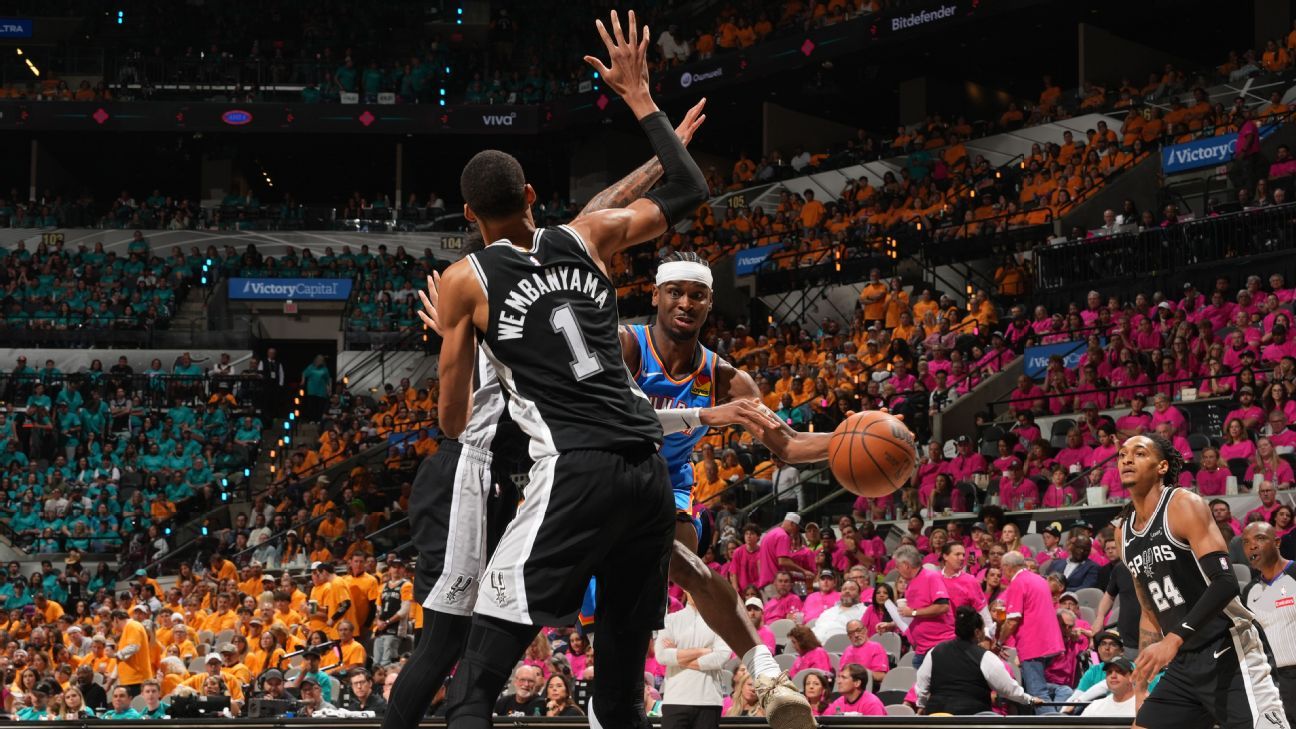
在左侧低位,距离篮筐仅一步之遥的地方,谢伊·吉尔杰斯-亚历山大 (Shai Gilgeous-Alexander) 发现了一个转瞬即逝、极其罕见的机会,这看起来就像是圣安东尼奥马刺队坚如磐石的防守中出现的一个漏洞——整晚,马刺都用凶悍的包夹对他围追堵截:
一个绝对的空位机会。
在西部决赛第一场第四节还剩8分30秒时,这位俄克拉荷马雷霆队的后卫悄悄溜到了防守墙后面,眼看就要拿下他今晚最轻松的得分。
然而,奇怪的事情发生了。
吉尔杰斯-亚历山大开始起跳投篮,而身高7英尺4英寸(约2.24米)、拥有令人难以置信的8英尺(约2.44米)翼展的马刺当家中锋维克托·文班亚马 (Victor Wembanyama) 则站在几英尺外。他站在篮筐下,似乎已经放弃了,因为此时要上去封盖已经太迟了,甚至连上前干扰都来不及。
尽管如此,他还是举起了他那长得有些夸张的手臂,眼睛紧盯着飞向篮筐的皮球。
球勉强擦到篮筐侧面,文班亚马轻松收下篮板。吉尔杰斯-亚历山大试图从文班亚马手中抢球,而文班亚马则看着这位比自己矮了将近一英尺(约30厘米)的球员,报以一笑。
在马刺以122-115双加时艰难取胜的比赛中,这个回合只是一个微不足道的插曲,尤其是考虑到文班亚马那惊为天人的数据:41分和24个篮板。在技术统计表上,这不过是一次投篮不中和一个篮板。
但这个回合本身,只是整场比赛中无数个缩影之一。当文班亚马在场时,他的存在本身就会引发一种无形的影响,全联盟的数据分析人员告诉ESPN,他们很难准确地量化这种影响。
这些分析人员表示,这很可能代表了文班亚马最大、最具统治力的特质。
“自从我进入NBA以来,我认为这是我们一直在讨论的话题,”一位西部联盟的数据分析人员告诉ESPN。
“你该如何衡量恐惧?”
在NBA全部30个球馆球场上方的钢架悬吊平台上,20个高科技摄像头在每场比赛中以每秒60次的频率追踪每位球员身体上的29个点,在每个赛季提供数十亿个数据点。
这些球员追踪数据随后被输入先进的人工智能和机器学习算法中,生成远超传统技术统计表的数据。
如今,分析人员表示,他们比以往任何时候都能推断出更多比赛的细节,尤其是在进攻端。但他们表示,防守端的影响力仍然是一个相对的谜团,战术配合上的细微差别可能会模糊准确的衡量。
“在防守端,你可能做对了一切,但对方却在你头上投进了一个不可思议的球,”这位西部联盟的分析人员说。“你也可能做错了一切,而对方却投丢了一个非常轻松的球。但你如何确定谁对此负有最大责任?”
一位东部联盟的分析人员表示,一名防守球员可能会有很高的“被一步过率”(blow-by rate),这意味着他防守的球员往往会“一步过”他突入油漆区。但也许这个数据只是防守战术的产物,该战术旨在将投手逼离三分线,并将他们引向内线负责盖帽的中锋。
在20世纪50年代效力于旧金山大学期间,比尔·拉塞尔 (Bill Russell) 成为第一位将盖帽作为防守武器的球员。
起初,拉塞尔在训练中疯狂盖帽队友,以至于有些队友根本不再往内线突破。接着,他对对手也如法炮制,对手在被盖了几次后,也开始躲着他。(拉塞尔在他的第一场大学校队比赛中就送出了13次盖帽,这至今仍是旧金山大学的单场纪录。)
“那种挫败感是惊人的,”已故的前旧金山大学前锋迈克·普雷索 (Mike Preaseau) 曾告诉ESPN。“他们不明白自己遭遇了什么。”
在随后的几十年里,这一趋势一直在延续——伟大的盖帽手不仅能扇飞投篮,还能威慑对手,让他们甚至不敢出手。
“在心理上,你必须试着让进攻球员怀疑自己正在做的事情,”拉塞尔曾说。“‘这行得通吗?我能投进这一球吗?’你必须制造疑虑。”
从那以后,这种心理优势一直存在。
这种威慑力在文班亚马身上可以说体现得淋漓尽致。他连续第三个赛季领跑联盟盖帽榜,并在本赛季以年仅22岁的年纪,成为了联盟历史上第一位全票当选的年度最佳防守球员。
“你们常说有些球员能改变对手的投篮。而他则是直接让对手连篮都不敢投,”马刺队后卫达龙·福克斯 (De’Aaron Fox) 在4月下旬表示。“他们看到他在里面,就会把球运出来或者传出去。他改变了你防守的整个态势,也改变了对方球队的进攻态势。”
如今,在自己的首次季后赛之旅中,文班亚马创下了单场12次盖帽的NBA季后赛纪录,并在球队对阵明尼苏达森林狼队的第二轮系列赛中,干扰了无数次其他的投篮。
“在防守端,伙计,他太不可思议了,”森林狼队后卫安东尼·爱德华兹 (Anthony Edwards) 在谈到文班亚马时说。“他改变了篮筐下的每一次投篮,每次盖帽后他都会冲向篮筐,不管是不是干扰球,他都会上去挑战。这太难对付了。”
各支球队有一些方法来评估文班亚马最危险、但却无形的那项技能。
他们会研究对手在面对马刺时尝试了多少次上篮——以及当文班亚马在场时,这个数字缩减了多少。(在常规赛文班亚马在场时,对手每100回合平均仅尝试25.7次上篮,比排名榜首的雷霆还要少3次。)
他们还会观察对手面对马刺时的平均投篮距离——尤其是当文班亚马在场时,这个距离是如何增加的。(本赛季圣安东尼奥对手的平均出手距离为14.9英尺,在NBA中排名第22远。但当文班亚马在场时,这一平均距离增加到了15.8英尺,高居联盟第一。)
球队还可以计算高阶数据分析的最新成果,例如联盟的预期投篮命中率(根据出手位置来确定投篮命中的概率)以及防守压力评分(衡量防守球员给进攻球员施加的压力大小)。
这些数据都清楚地说明了同一个事实:文班亚马在多大程度上将对手的进攻压缩到了他所期望的程度。然而,尽管球队可以通过各种方式量化文班亚马的影响力,但仍有更多影响无法用数据体现——至少在目前,这些只能通过肉眼来观察。
“大家都喜欢指出那些球员突破到油漆区然后又把球运出来的视频,”这位东部联盟的分析人员说。“我认为不仅如此。我觉得关键在于他们一开始是否选择突破。”
“他们脑子里有一个选择菜单:‘在这个回合里我能做什么’——而突向篮筐根本不在这个菜单上。”
换句话说,多位分析人员表示,几乎不可能去统计那些被文班亚马扼杀在摇篮之中的进攻回合。
“他最擅长的事情,”这位东部联盟的分析人员在谈到文班亚马时说,“很难用数据量化。”
文班亚马在半场防守中传播恐惧的史无前例的能力,使他成为一个独一无二的防守存在,这也是各路联盟观察家都注意到的事情。
当然,他并不是第一个在NBA打球的巨人。他甚至不是最高的。乔治·穆雷桑 (Gheorghe Mureșan) 和马努特·波尔 (Manute Bol) 的身高都是7英尺7英寸(约2.31米),比他还要高3英寸。
塔科·法尔 (Tacko Fall)、姚明 (Yao Ming) 和肖恩·布拉德利 (Shawn Bradley) 的身高都是7英尺6英寸(约2.29米)。
还有另外四名球员比文班亚马高一英寸,另有五名球员和他一样高。
“那些人都是极其顶尖的护筐手,”一位数据分析人员说,“但是……他的威慑力延伸到了整个球场,因为他比那些人中的任何一个都要灵活、敏捷得多。”
名人堂后卫德维恩·韦德 (Dwyane Wade) 对此表示赞同,他本赛季曾为亚马逊Prime解说过文班亚马的一些比赛。
“大多数人如果拥有身高或臂展,就没有横向移动的敏捷性或速度,”韦德告诉ESPN。“如果他们兼具了这些,又可能不够聪明,容易盲目起跳。而他拥有这一切。他还有耐心。他会等到球出手后再起跳。他无所不能。”
不妨去问问前NBA主教练汤姆·锡伯杜 (Tom Thibodeau),他被认为是联盟历史上最伟大的防守大师之一。
“如今的许多进攻都建立在冲击篮筐的基础上,然后在篮下做出判断,是直接突到底上篮,还是把球分到外线投三分,”锡伯杜告诉ESPN。
“而他甚至能阻止你进去。作为一名防守者,如果你能让进攻方对你的动作做出反应,你就占据了优势。他一个人就是一套防守体系。……他总是让你猜不透。他要扑过来了吗?还是不来?你总是在观察他。”
或者去问问前NBA主教练迈克·德安东尼 (Mike D’Antoni),他被认为是联盟历史上最伟大的进攻大师之一。
“如果你只是采用传统打法,试图冲击篮筐,”德安东尼告诉ESPN,“你毫无机会。”
德安东尼表示,文班亚马带来的最大问题或许在于,当他防守挡拆时,他可以留在防守人后面,利用自己的身高和臂展,依然能对进攻球员的动作产生影响。
“我们总是教导球员要延误防守,但他不需要这样做,”德安东尼说。“他可以退在后面,但无论如何都能干扰到投篮。他是唯一能做到这一点的球员。这是教不出来的,你也无法绕过他。”
“这就是为什么他将在接下来的10年里一直成为MVP的热门人选。”
解说文班亚马的一些比赛,让韦德更加欣赏他的表现。
“我们谈论迈克尔·乔丹 (Michael Jordan) 和勒布朗·詹姆斯 (LeBron James) 以及所有那些家伙——我们总是在谈论他们的成就,”韦德说。“而对于文班,我们现在就可以断言,我们看到了一个在所有方面都极其出色的球员。他没有弱点。这太不可思议了。所以,是的,在防守端,他就像在进攻端一样具有统治力。他在攻防两端都拥有绝对的统治力。”
至于我们无法量化的那部分统治力?
“我们从未见过这样的场景:那些想要冲击篮筐、想要得分、想要投篮的球员,看着文班并试图单挑他,却发现往左突不过去,往右也突不过去,甚至无法在他头顶出手,”韦德说。
“他们只能去别处寻找机会。”
由生成式 AI 翻译,译文内容可能不准确或不完整,以原文为准。
点击查看原文:Why Victor Wembanyama's most dominant skill remains a mystery
Why Victor Wembanyama’s most dominant skill remains a mystery
ON THE LEFT block, just a short skip from the rim, Shai Gilgeous-Alexander found something fleeting, something rare, something that appeared to be a glitch in the San Antonio Spurs’ vise grip defense that had hounded him all night with ferocious double-teams:
A wide-open look.
With 8:30 remaining in the fourth quarter of Game 1 of the Western Conference finals, the Oklahoma City Thunder guard had snuck behind the defensive wall and seemed primed to score his easiest points of the night.
Then something strange happened.
Gilgeous-Alexander began his shooting motion, while Spurs’ star center Victor Wembanyama – who stands 7-foot-4 inches tall and possesses a mind-boggling 8-foot wingspan – stood a few feet away, beneath the rim, resigned to the fact that it was too late to try to block the shot, much less even contest it.
Still, he raised one of his cartoonishly long arms, his eyes tracking the ball toward the basket.
The ball barely grazed the side of the rim, and Wembanyama devoured the rebound. Gilgeous-Alexander tried to wrestle the ball from Wembanyama, who laughed in return at a player who is nearly a foot shorter.
In the Spurs’ nail-biting 122-115 double-overtime win, the play amounted to a forgettable footnote, especially given Wembanyama’s otherworldly stat line: 41 points and 24 rebounds. In the box score, it would register as nothing more than a missed shot and a rebound.
But the play itself marked one of numerous instances that take place throughout the course of a game when Wembanyama’s mere presence evokes something analytics staffers across the league told ESPN that they struggle to accurately quantify.
It represents what might well be Wembanyama’s greatest and most dominant trait, these analytics staffers say.
“As long as I’ve been in the NBA, I think it’s something that we’ve always talked about,” one Western Conference analytics staffer told ESPN.
“How do you measure fear?”
IN THE CATWALKS above the court in all 30 arenas across the NBA, 20 high-tech cameras track 29 points on every player’s body 60 times per second throughout every game, providing billions of data points throughout every season.
That player tracking data is then fed into advanced artificial intelligence and machine learning algorithms to generate statistics that go far beyond the typical box score.
Today, analytics staffers say they’re able to deduce more than ever about the intricacies of the game, especially on offense. But they say defensive impact remains a comparative mystery, where schematic nuances can cloud accurate measurement.
“On defense, you could do everything right and the guy could make an impossible shot on you,” the Western Conference analytics staffer said. “You could do everything wrong and the guy could miss a very easy shot. But how do you determine who was most responsible for that?”
A defensive player could have a high blow-by rate, one Eastern Conference analytics staffer said, meaning players he is guarding tend to “blow by” him toward the lane. But perhaps that rate is a product of a defensive scheme designed to run shooters off the 3-point line and funnel them toward a shot-blocking center in the paint.
While starring for the University of San Francisco in the 1950s, Bill Russell became the first player to utilize the blocked shot as a defensive weapon.
First, Russell blocked his teammates’ shots in practice to the point that some stopped driving through the lane at all. Then he did the same to opponents, who, after getting their shots blocked a few times, began avoiding him too. (And Russell blocked 13 in his first varsity game, still a USF single-game record.)
“The frustration was amazing,” the late Mike Preaseau, a former USF forward, once told ESPN. “They didn’t understand what was happening to them.”
That same trend would continue through the decades – with great shot blockers not only swatting shots but deterring them from ever being taken.
“Psychologically, you have to try to make the offensive player question what he’s doing,” Russell once said. “‘Will this work? Can I make this shot?’ You have to create doubts.”
That psychological edge has held ever since.
THIS ELEMENT OF intimidation has arguably never been more pronounced than with Wembanyama, who led the league in blocks for a third straight season and this campaign, at just 22, became the first unanimous Defensive Player of the Year in league history.
“You talk about guys that change shots. He literally negates guys even shooting the ball,” Spurs guard De’Aaron Fox said in late April. “They’ll see him in there and dribble the ball out or kick out. He changes the whole dynamic of your defense, and he changes the dynamic of other teams’ offense.”
Now in his first postseason, Wembanyama set an NBA playoff record with 12 blocks in a single playoff game and impacted countless other shots during his team’s second-round series against the Minnesota Timberwolves.
“Defensively, man, he’s incredible,” Wolves guard Anthony Edwards said of Wembanyama. “He changes every shot at the rim, he goes to the rim every time after every block, whether it’s goaltending or not, he’s going to go up and challenge it. It’s tough.”
There are ways teams account for Wembanyama’s most dangerous – but invisible – skill.
They examine how many layups opponents attempt against the Spurs – and how that number shrinks when Wembemyama is on the floor. (When Wembanyama was on the court in the regular season, teams averaged 25.7 layups attempted per 100 possessions, three fewer than top-ranked Oklahoma City.)
They also look at the average distance opponents attempt their shots from against the Spurs – and especially how that distance increases when Wembemyama is playing. (The average field-goal-attempt distance from San Antonio’s opponents this season came 14.9 feet away from the basket, 22nd farthest in the NBA. But when Wembanyama was on the floor, that average grew to 15.8 feet, which ranked No. 1.)
Teams also can calculate more recent developments in advanced analytics, such as the league’s expected field goal percentage (which helps determine the odds of a shot going in based on its location) and its defensive pressure score (which measures the amount of pressure a defensive player applies on an offensive player).
Those numbers all clearly tell the same story: at just how much Wembemyama squeezes offenses to his will. Still, for all the ways that teams can quantify Wembanyama’s impact, there are even more that remain a mystery – where, at least for now, only the eye can see them.
“Everyone likes pointing out the videos where guys drive into the paint and then just dribble it out,” the Eastern Conference analytics staffer said. "I think it’s even more than that. I think it’s whether they drive in the first place.
“They’ve got a menu in their head of, 'This is what I can do in this possession – and driving to the rim is just not on the menu.”
In other words, multiple analytics staffers say, it’s nearly impossible to account for plays Wembanyama prevented from ever happening.
“What he does best,” the Eastern Conference analytics staffer said of Wembanyama, “is hard to quantify.”
WEMBANYAMA’S UNPRECEDENTED ABILITY to spread fear across the half court is what makes him a singular defensive presence, and it’s something that league observers of all stripes notice.
He is not, of course, the first giant to play in the NBA. He isn’t even the tallest. Gheorghe Mureșan and Manute Bol were each 7-foot-7, three inches taller.
Tacko Fall, Yao Ming and Shawn Bradley were all 7-foot-6.
Four other players were an inch taller than Wembanyama, and five others were just as tall.
“Those guys were all elite, elite rim protectors,” one analytics staffer said, “but … his deterrence expands all over the court because he’s way more mobile and fluid than any of those guys.”
Hall of Fame guard Dwyane Wade, who has called some of Wembanyama’s games for Amazon Prime this season, agrees.
“Most guys, if they have the height or the length, they don’t have the agility or the quickness to move side to side,” Wade told ESPN. “Then, if they do, they’re not smart enough to not just jump. He has all those things. He also has the patience. He allows for the ball to be released before he jumps. He does it all.”
Just ask former NBA coach Tom Thibodeau, who is considered one of the greatest defensive minds in the history of the game.
“So much of today’s offense is predicated upon attacking the rim and then making your read at the rim, whether you can get all the way there and lay it in or spray it out for the 3,” Thibodeau told ESPN.
“And he deters you from even going in there. As a defender, if you can get the offense to react to you, you have the advantage. And he’s a defense unto himself. … He’s got you guessing all the time. Is he coming? Is he not coming? You’re always looking.”
Or ask ex-NBA coach Mike D’Antoni, who is considered one of the greatest offensive minds in the history of the game.
“If you’re just going to play traditionally and try to get to the rim,” D’Antoni told ESPN, “you’ve got no chance.”
D’Antoni says arguably the biggest problem that Wembanyama poses is that when he’s guarding a pick-and-roll, he can remain behind the play and use his height and length to still impact what the offensive player might do.
“We always teach to be up with the screen, but he doesn’t have to be there,” D’Antoni said. "He can be back and impact the shot anyway. He’s the only guy who can do that. You can’t teach that, and you can’t get around that.
“That’s why he’s going to be MVP for the next 10 years.”
Calling some of Wembanyama’s games has led Wade to appreciate his play even more.
“We talk about [Michael] Jordan and LeBron [James] and all them guys – we always talk about their accomplishments,” Wade said. “We could stop right now with Wemby and say we saw someone who’s actually really good at everything. He has no weaknesses. It is incredible. And so, yes, on the defensive end of the floor, he’s just as dominant as he is on the offensive end of the floor. He has total dominance on both sides of the floor.”
As for the part of his dominance we can’t quantify?
“We’ve never seen guys that want to attack the basket, that want to score, that want to shoot, look at Wemby and try to size him up and they can’t beat him left, they can’t beat him right, they can’t go over top,” Wade said.
“They just go somewhere else.”
By Baxter Holmes, via ESPN