By Ben Golliver, 2026-07-20 19:00:00
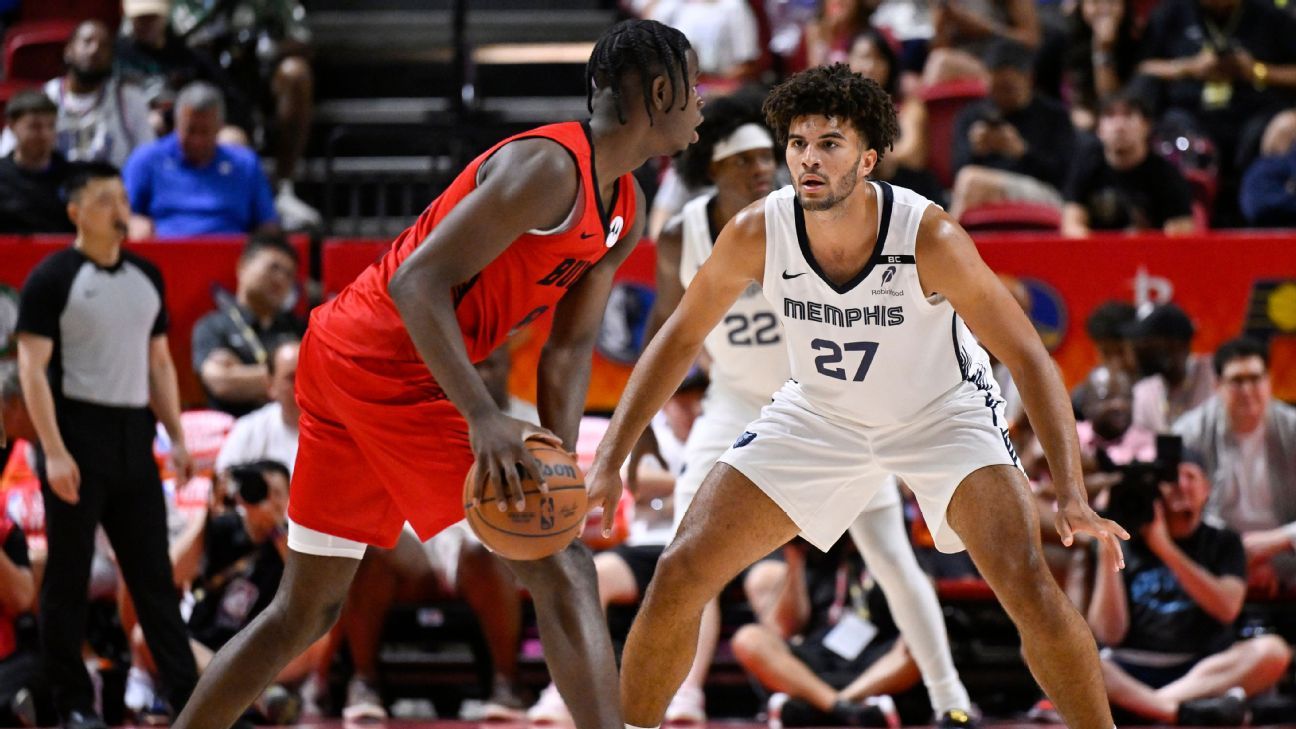
拉斯维加斯夏季联赛让NBA世界第一次有机会充分观察今年这批备受瞩目的乐透秀在面对职业级别对抗时的表现。
前四顺位新秀——AJ·迪班萨 (AJ Dybantsa)、达林·彼得森 (Darryn Peterson)、卡梅隆·布泽尔 (Cameron Boozer) 和卡莱布·威尔逊 (Caleb Wilson)——都有属于他们的高光时刻。迪班萨在揭幕战率领华盛顿奇才正面击败了彼得森所在的犹他爵士,不过尽管频繁遭遇双人包夹,彼得森依然找到了展现其得分天赋的方法。与此同时,布泽尔带领孟菲斯灰熊杀入了锦标赛的冠军赛**,**而飞翔的威尔逊则让芝加哥公牛球迷们整整兴奋了一周。
2026届的顶尖新秀们在吸引眼球方面面临着激烈竞争:一批2025年的乐透秀重返罪恶之城,开始了他们的第二次夏季联赛征程;而今年的11号秀亚克塞尔·伦德博格 (Yaxel Lendeborg) 则在周日率领金州勇士夺得夏季联赛冠军。
如今,夏季联赛已正式落下帷幕,让我们为今年的佼佼者们颁发各项之最奖项。注:球员需至少出战两场比赛才有资格入选,而那些全程参与的球员会获得额外的加分。
跳转至各奖项:
最有价值球员 | 最具活力新秀
最引人关注新秀 | 最不稳定新秀
最令人失望新秀 | 最佳次轮新秀
最佳二年级生 | 进步最快二年级生
最佳次轮二年级生 | 最佳落选秀
夏季联赛MVP:卡梅隆·布泽尔,孟菲斯灰熊
布泽尔面前没有迪班萨那么多的球迷,没有像彼得森那样吸引那么多防守注意力,也没有创作出像威尔逊那么多的YouTube高光集锦,但这位杜克出品的球员通过他最擅长的方式脱颖而出:持续稳定地产出并赢得胜利。
当迪班萨的奇才、彼得森的爵士和威尔逊的公牛在拉斯维加斯合计仅取得6胜9负的战绩时,布泽尔带领灰熊(4胜2负)杀入了夏季联赛的冠军赛。这位身高6尺9寸、身体强壮的锋线球员平滑地适应了职业级别的对抗:在六场比赛中,他场均贡献18.5分、8.0个篮板和3.7次助攻。按每分钟产出计算,这些数据与他在杜克大学那个惊艳的大一赛季相比并不逊色。
布泽尔在内线得分的效率会根据对位球员的体型而变化:面对小个防守者时,他能熟练地利用错位优势,但当试图在长人林中作业时,则会遇到更大的困难。正因为他是一名技术如此精湛、球商如此之高的球员,布泽尔在受阻时大多能找到正确的临场调整方法,并在外线灵活跑位。
年轻且正在重建的灰熊在布泽尔身边配备了NBA级别的球员——塞德里克·考沃德 (Cedric Coward)、奥利维尔-马克森斯·普罗斯珀 (Olivier-Maxence Prosper)、泰勒·亨德里克斯 (Taylor Hendricks) 和贾文·斯莫尔 (Javon Small)——而他在个人得分与转移球之间取得了很好的平衡。布泽尔在他这个年纪拥有一种不可思议的阅读防守的能力,他能从侧翼送出横跨球场的大范围横传球,也能在肘区找到底线位置的队友。
“有很多东西我们可以带进常规赛,”布泽尔说。“[我们的特点是]速度制胜并且比对手更努力。我认为我们拥有一套能够在今年上场竞争的阵容。”
怀疑者可能会认为布泽尔比同届的其他顶尖新秀“更乏味”或“运动能力较差”,但他的可靠性、控制力和篮球智商都是重要的资产。同样重要的,还有他对团队成功一心一意的专注。
“我们输了,”布泽尔在周日拒绝任何个人赞誉时说道。“除非你赢了[冠军],否则你拿不到MVP。”
最具活力新秀:卡莱布·威尔逊,芝加哥公牛
没有哪个球员在拉斯维加斯引发了更多的热议,威尔逊在北卡罗来纳大学的大一赛季因右手拇指受伤而提前结束后,他在这次赛事中倾注了全部心血。
20岁的威尔逊表现得就像一名被迫压抑了五个月能量和竞争欲望的运动员。在完成那些怪兽级别的双手暴扣的间隙,他会在篮下封盖投篮,在转换进攻中快速推进,在行进间送出横跨40英尺的击地妙传,并展示了他改进后的三分投射。虽然身高6尺9寸的威尔逊看似天生适合大前锋位置,但他也有可能足够快速和全能,能够同时胜任超大号侧翼的角色。
威尔逊比赛中最令人瞠目结舌的方面是他的弹跳能力:他比对手起跳更快、腾空更高、滞空更久。难怪前少年天才、名人堂成员凯文·加内特上周四会坐在场边观看威尔逊的比赛。
在迪班萨和彼得森提前结束他们的夏季联赛征程时,威尔逊在四次出场中场均砍下23.5分、7.3个篮板、1.3次抢断和2.5次盖帽。他的竞争精神在收官战中展露无遗:他与湖人队拼抢到鲜血染红军服,并且与一名防守者激烈争吵,以至于双方最终不得不被分开。
威尔逊这种狂热的能量也存在缺点。他经常在试图运球穿过人群时出现失误,而他的一些全场奔袭也导致了糟糕的决策。他需要增强力量,以成为一名更可靠的禁区得分手,而他高风险、高回报的打法还需要几年的打磨。
尽管如此,在内华达沙漠度过仅仅一周后,威尔逊看起来已经是自德里克·罗斯之后最令人兴奋的公牛球员了。
最引人关注新秀:达林·彼得森,犹他爵士
彼得森在堪萨斯大学的大一赛季让每个人都希望本能看到更多:他的高光时刻精彩绝伦,并引发了与科比·布莱恩特的比较,但由于伤病缺席和上场时间限制,他的整体表现并不完整。这基本上也是彼得森在夏季联赛结束后留给人们的印象。
这位榜眼秀在三场比赛中场均贡献20.7分和4.0次助攻,他展现了自己娴熟的运球创造空间和多样化的得分能力。即便如此,他依然未能打消关于他比赛中的一些最大疑问。
尽管在选秀前过程中将自己描述为一名控球后卫,彼得森的失误数却高于助攻数,并且在应对双人包夹和陷阱防守时有时显得迷茫。如果他能轻松得分,这或许还不至于太令人担忧,但彼得森的跳投手感不佳,最终交出了31%/23%/76%的三项命中率。
虽然这位身高6尺5寸的后卫具备成为常年全明星的身体条件和沉稳举止,但他并没有真正地席卷拉斯维加斯。等待他取得突破的过程仍在继续。
最不稳定新秀:小米雷斯·约翰逊 (Morez Johnson Jr.),达拉斯独行侠
约翰逊的首秀堪称惊艳:对阵金州勇士砍下27分、8个篮板、3次助攻、3次抢断和2次盖帽。正如数据显示,这位9号秀在攻防两端都如同一记重锤。在这场充斥着篮筐上方精彩镜头的出色表现的锦上添花之笔是,这位身高6尺9寸的锋线甚至拉到外线命中了一记三分球。这正是达拉斯想要看到的一切:身体对抗、能量、多功能性以及进攻端的空间拉伸能力。
不幸的是,在独行侠下一场输给湖人的比赛中,约翰逊看起来完全像是另一个人。他在28分钟内犯规七次,在禁区内的反应看起来慢了一拍,最终仅得到10分和5个篮板,而独行侠在他上场的28分钟里净负对手22分。
对于约翰逊来说,真相肯定介于两者之间。一旦他在达拉斯与库珀·弗拉格 (Cooper Flagg) 和凯里·欧文并肩作战,他将转变为一个进攻端的辅助角色。如果他能持续稳定地打出对阵勇士时的那种能量,约翰逊就能帮助独行侠赢下比赛,仅仅靠消耗对手的体力。
最令人失望新秀:阿代·马拉 (Aday Mara),俄克拉荷马城雷霆
考虑到夏季联赛的比赛相对缺乏组织性,且由大量出手得分的后卫主导,马拉在他的上场时间里没有留下太多印记,有时甚至在跟上比赛节奏方面都很挣扎,这并不令人意外。
这位身高7尺3寸的中锋带着极其出色的传球技巧进入NBA,他在拉斯维加斯的最佳时刻,就是他快速将球传给空切球员,让他们在禁区内获得高命中率投篮机会的场面。除此之外,马拉发现自己的得分机会难以创造,而且对于拥有他这样身高和臂展的球员来说,他在攻防两端的篮下统治力都不够好。
俄克拉荷马城是唯一一支在拉斯维加斯未尝胜绩的球队,而11号秀马拉在三场比赛中场均仅得到8.7分和7.7个篮板。先别反应过度:在密歇根大学被NBA水准的队友围绕时,马拉表现出色,而且他即将加入的是联盟中阵容天赋最高的雷霆队。
最佳次轮新秀:米利克·托马斯 (Meleek Thomas),克利夫兰骑士
来自阿肯色大学的34号秀托马斯享受了长达一周的火热手感。这位身高6尺3寸的后卫在四场比赛中,以50%/44%/100%的三项命中率场均砍下27.3分,领跑夏季联赛得分榜。在一场充斥着优质得分手的竞争中,托马斯独占鳌头,他的场均得分比任何其他至少出战三场比赛的球员高出近4分。
当然,这得益于托马斯在拉斯维加斯享有无限开火权,并且他的场均20.5次出手为锦标赛最高。他的最佳表现是对阵迈阿密热火时砍下35分,那场比赛他命中6记三分球,并且持球进攻看起来非常流畅。
无论骑士能否在自由球员市场签下勒布朗·詹姆斯,他们都将很乐意将托马斯的得分爆发力添加到一个上赛季替补得分排名联盟第25位的阵容中。
最佳二年级生:叶戈尔·德明 (Egor Demin),布鲁克林篮网
天哪,德明的转变可谓是天翻地覆,上赛季他还是那支重建中的篮网队里一个畏手畏脚、表现基本无效的新秀。这位俄罗斯后卫上赛季未能充分利用他6尺8寸的身高优势,总是待在三分线外,很少冲击篮下得分。
20岁的德明在这个夏天看起来完全变了一个人,并且是一名更加全面的球员:他更频繁地持球突破进攻,在人群中完成终结,并且作为进攻组织者做出了良好、果断的决策。篮网迫切需要他们近年选中的一些新秀成长为能改变局面的球员,而德明在三场拉斯维加斯表演赛中场均贡献21.0分和4.3次助攻,朝着这个方向迈出了坚实的一步。
进步最快二年级生:卡曼·马鲁阿奇 (Khaman Maluach),菲尼克斯太阳
在2025-26赛季,马鲁阿奇的上场时间在去年选秀的前十顺位新秀中是最少的,这使得夏季联赛成为一个关键机会,让他可以提醒菲尼克斯的教练们他的能力所在。这位身高7尺1寸的南苏丹中锋抓住了他的机会,在四次出场中场均贡献19.5分、12.8个篮板和2.0次盖帽,同时看起来像是拉斯维加斯最好的中锋。
这位杜克大学出品的球员在处理他所有的防守职责时显得得心应手:在篮下封盖、在禁区挑战突破者,以及有时扩防到外线进行空间防守。领跑夏季联赛篮板榜的马鲁阿奇,也展现了自己作为多维进攻武器的能力。除了持续稳定的禁区得分外,他还经常出手底角三分,并在整个锦标赛中外线总计20投8中(命中率40%)。
总而言之,马鲁阿奇为自己在下赛季获得更重要的角色提供了强有力的理由。
最佳次轮二年级生:查兹·拉尼尔 (Chaz Lanier),底特律活塞
眨眼之间,你可能就错过了拉尼尔的新秀赛季:他在发展联盟的上场时间比在活塞队还多,并且在季后赛中几乎没上过场。对于有志争冠球队里的次轮秀来说,生活往往就是如此。
24岁的拉尼尔无意在拉斯维加斯保持低调。这位身高6尺3寸的后卫在四次出场中场均得到17.4分,并且在场均9次出手的情况下,三分命中率高达51.1%。在他表现最出色的一场比赛中,拉尼尔在一场大胜纽约尼克斯的比赛第一节就拿下了全场最高24分中的17分。
活塞上赛季的三分出手次数排名联盟第29位,因此拉尼尔在拉斯维加斯展现的高产量、高效率投篮应该会引起他们的注意。值得注意的是,他在夏季联赛中投进的三分球数(23个)比他整个新秀赛季(19个)还要多。当然,所有关于小样本量的免责声明都适用。
最佳落选秀:亚瑟·卡卢马 (Arthur Kaluma),洛杉矶湖人
卡卢马打出精彩夏季联赛表现的时机再好不过了:在詹姆斯和八村塁离队后,湖人队正在重建他们的前场,他们正在寻找身高、身体对抗和攻防兼备的贡献者。
这位24岁的锋线上赛季效力于湖人队的发展联盟附属球队,他以身高6尺7寸的良好体型和强硬的外线防守者声誉而闻名。但是,在结束了四年大学生涯后于2025年落选的卡卢马,对于一支打入锦标赛半决赛的湖人队来说,在进攻端却是一个意外的惊喜。
卡卢马在五场比赛中场均得到18.6分,场均出手超过五次三分球,命中率达到50%,其中对阵独行侠时砍下34分的表现尤为突出。所有这些意料之外的得分并没有影响他的防守活力,因为在一场大胜公牛的比赛中,他以纠缠威尔逊为乐。
湖人队也对2025年次轮秀阿杜·蒂耶罗在拉斯维加斯的表现感到满意,而且他们据报道对签下乔纳森·库明加感兴趣。当围绕卢卡·东契奇建队时,运动型锋线是一个如此令人垂涎的位置,也许卡卢马这个出色的夏天会为他赢得一份双向合同。
由生成式 AI 翻译,译文内容可能不准确或不完整,以原文为准。
查看原文:NBA summer league superlatives: Which players impressed?
NBA summer league superlatives: Which players impressed?
Las Vegas summer league offered the NBA world its first extended look at how this year’s premier lottery class would fare against professional competition.
The top four picks – AJ Dybantsa, Darryn Peterson, Cameron Boozer and Caleb Wilson – all had their moments. Dybantsa led the Washington Wizards to a head-to-head victory over Peterson’s Utah Jazz on opening night, though Peterson still found a way to show off his scoring savvy despite facing regular double-teams. Meanwhile, Boozer led the Memphis Grizzlies to the tournament’s championship game**,** and the high-flying Wilson thrilled Chicago Bulls fans all week long.
The top tier of the 2026 class had plenty of competition for attention: a handful of 2025 lottery picks were back for a second run through Sin City, and Yaxel Lendeborg, this year’s 11th pick, led the Golden State Warriors to the summer league title on Sunday.
Now that summer league is officially in the books, let’s hand out superlatives to this year’s standouts. Note: Players needed to appear in at least two games to be included, and those who stuck around for the entire event earned extra credit.
Jump to a superlative:
Most Valuable Player | Most Electric Rookie
Most Intriguing Rookie | Most Inconsistent Rookie
Most Disappointing Rookie | Best Second-Round Rookie
Best Sophomore | Most Improved Sophomore
Best Second-Round Sophomore | Best Undrafted Player
Summer league MVP: Cameron Boozer, Memphis Grizzlies
Boozer didn’t play in front of as many fans as Dybantsa, draw as much defensive attention as Peterson or author as many YouTube highlights as Wilson, but the Duke product stood out by doing what he does best: produce consistently and win.
While Dybantsa’s Wizards, Peterson’s Jazz and Wilson’s Bulls combined for a 6-9 record in Las Vegas, Boozer led the Grizzlies (4-2) to the summer league’s championship game. The sturdy 6-foot-9 forward made a smooth adjustment to the professional level of competition: He averaged 18.5 points, 8.0 rebounds, and 3.7 assists per game in six games. On a per-minute basis, those numbers weren’t far off his production during his sensational freshman season at Duke.
Boozer’s effectiveness as an interior scorer vacillated depending on the size of his matchup: He expertly exploited mismatches against smaller defenders but found tougher sledding when he tried to operate in the trees. Because he’s such a polished and intelligent player, Boozer mostly found the right in-game adjustments when stymied and moved well around the perimeter.
The young and rebuilding Grizzlies flanked Boozer with NBA players – Cedric Coward, Olivier-Maxence Prosper, Taylor Hendricks and Javon Small – and he struck a nice balance between scoring and moving the ball. Boozer has an uncanny ability to read defenses at his age, finding teammates with cross-court skip passes from the wing and baseline looks from the elbow.
“There’s a lot we can take into the regular season,” Boozer said. “[Our identity is] speed kills and outworking the opponent. I think we have a roster that can go out and compete this year.”
Skeptics might view Boozer as “more boring” or “less athletic” than the other top names in his class, but his reliability, control and intelligence are all major assets. Ditto for his single-minded focus on team success.
“We lost,” Boozer said Sunday, rejecting any individual acclaim. “You can’t win MVP unless you win [the championship].”
Most electric rookie: Caleb Wilson, Chicago Bulls
No player generated more buzz in Las Vegas than Wilson, who poured his heart into the event after his one-and-done season at the University of North Carolina was cut short by a right thumb injury.
Wilson, 20, performed like an athlete forced to bottle up his energy and competitive juices for the past five months. In between monster two-handed slams, he blocked shots at the rim, pushed the ball in transition, threaded 40-foot bounce passes on the run and showed off his improved three-point shot. While the 6-foot-9 Wilson seems like a natural fit at power forward, it’s possible that he’s quick and versatile enough to also function as an oversize wing.
The most eye-popping aspect of Wilson’s game is his leaping ability: He gets off the ground faster, skies higher and levitates longer than his opponents. No wonder Kevin Garnett, the former teenage sensation turned Hall of Famer, sat courtside last Thursday to get a look at Wilson.
While Dybantsa and Peterson cut short their summer league runs, Wilson compiled averages of 23.5 points, 7.3 rebounds, 1.3 steals and 2.5 blocks per game in four appearances. His competitive pride came through in his finale: He scrapped with the Lakers until blood covered his jersey, and he jawed with a defender so aggressively that the two parties eventually had to be separated.
There were downsides to Wilson’s frenetic energy. He regularly committed turnovers while trying to dribble in traffic, and some of his end-to-end forays led to poor decisions. He needs to add strength to become a more reliable inside-the-arc scorer, and his high-risk, high-reward play style needs a few years of refining.
Still, Wilson looks like the most exciting Bulls player since Derrick Rose after just one week in the Nevada desert.
Most intriguing rookie: Darryn Peterson, Utah Jazz
Peterson’s freshman season at Kansas left everyone wishing they had been able to see more: His best moments were splendid and prompted comparisons to Kobe Bryant, but his body of work was incomplete because of injury absences and minutes limits. That’s basically the same story for Peterson coming out of summer league.
The second pick averaged 20.7 points and 4.0 assists in his three appearances, and he gave glimpses of his well-honed ability to create space off the dribble and score in a variety of ways. Even so, he was unable to put to bed some of the biggest questions about his game.
Despite describing himself as a point guard in the predraft process, Peterson registered more turnovers than assists and looked confused at times while navigating double-teams and traps. That wouldn’t have been overly concerning if he was scoring with ease, but Peterson struggled to find the touch on his jumper and finished with 31/23/76 shooting splits.
While the 6-foot-5 guard has the physical tools and level-headed demeanor to become a perennial All-Star, he didn’t really take Las Vegas by storm. The wait for his breakthrough continues.
Most inconsistent rookie: Morez Johnson Jr., Dallas Mavericks
Johnson’s debut was a sight to behold: 27 points, eight rebounds, three assists, three steals and two blocks against the Golden State Warriors. As that line suggests, the No. 9 pick was a wrecking ball on both sides of the court. To top off an excellent showing filled with above-the-rim highlights on both ends, the 6-foot-9 forward even stepped out to hit a 3-pointer. This was everything Dallas could have wanted to see: physicality, energy, versatility and a stretch element on offense.
Unfortunately, Johnson looked like a completely different player in the Mavericks’ next game, a loss to the Lakers. He committed seven fouls in 28 minutes, looked a step slow to react to the action in the paint and finished with just 10 points and five rebounds as the Mavericks were outscored by 22 points in his 28 minutes.
The truth is surely somewhere in the middle for Johnson, who will shift into a complementary offensive role once he’s playing alongside Cooper Flagg and Kyrie Irving in Dallas. If he can consistently bring the type of energy he showed against Golden State, Johnson can help the Mavericks win games simply by exhausting the opposition.
Most disappointing rookie: Aday Mara, Oklahoma City Thunder
Given that summer league play is relatively unstructured and dominated by bucket-getting guards, it’s no surprise that Mara didn’t leave much of a mark during his minutes and sometimes struggled to keep up with the pace of play.
The 7-foot-3 center enters the NBA as a very skilled passer, and his best moments in Las Vegas involved him whipping the ball to cutters for high-percentage looks in the paint. Otherwise, Mara found his own scoring opportunities hard to come by, and he didn’t command the basket area that well on either end for a player with his size and length.
Oklahoma City was the only team to go winless in Las Vegas, and Mara, the No. 11 pick, averaged just 8.7 points and 7.7 rebounds in his three appearances. Don’t overreact yet: Mara excelled when surrounded by NBA-caliber players at the University of Michigan, and he is set to join the league’s most talented roster in Oklahoma City.
Best second-round rookie: Meleek Thomas, Cleveland Cavaliers
Thomas, the No. 34 pick out of Arkansas, enjoyed a weeklong heater. The 6-foot-3 guard led summer league by averaging 27.3 points per game on 50/44/100 shooting splits in four games. In a competition stacked with quality bucket-getters, Thomas stood alone by averaging nearly four points per game more than anyone else who played at least three games.
Of course, it helped that Thomas enjoyed the greenest light in Las Vegas and averaged a tournament-high 20.5 shots per game. His top performance was a 35-point explosion against the Miami Heat in which he hit six 3-pointers and looked very fluid on the ball.
Whether or not the Cavaliers land LeBron James in free agency, they will gladly add Thomas’ pop to a bench that ranked 25th in scoring last season.
Best sophomore: Egor Demin, Brooklyn Nets
Boy, has the switch flipped for Demin, who was a timid and largely ineffective rookie for the rebuilding Nets. The Russian guard failed to make the most of his 6-foot-8 size last season, hanging out behind the 3-point line and rarely scoring at the rim.
Demin, 20, looked like a completely different and much more complete player this summer: He attacked off the dribble with greater regularity, finished in traffic and made good, assertive decisions as a playmaker. The Nets desperately need some of their recent draft picks to emerge as difference-makers, and Demin took a nice step in that direction by averaging 21.0 points and 4.3 assists in three Las Vegas exhibitions.
Most improved sophomore: Khaman Maluach, Phoenix Suns
Maluach logged the fewest minutes among last year’s top 10 picks during the 2025-26 season, setting up summer league as a pivotal chance to remind Phoenix’s coaches what he can do. The 7-foot-1 South Sudanese center seized his opportunity, averaging 19.5 points, 12.8 rebounds, and 2.0 blocks per game in four appearanceswhile looking like the best center in Las Vegas.
The Duke product was very comfortable handling all of his defensive responsibilities: blocking shots at the rim, challenging drivers in the paint and stepping out at times to defend in space. Maluach, who led summer league in rebounding, also served as a multidimensional offensive weapon. In addition to a steady stream of paint scoring, he regularly launched corner 3-pointers and finished 8-20 (40%) from beyond the arc for the tournament.
Put it all together, and Maluach made a strong case for a larger role next season.
Best second-round sophomore: Chaz Lanier, Detroit Pistons
Blink and you missed Lanier’s rookie season: He played more minutes in the G League than he did for the Pistons, and he barely saw the court in the playoffs. That’s often how life goes for second-round picks on aspiring contenders.
Lanier, 24, had no intention of laying low in Las Vegas. The 6-foot-3 guard averaged 17.4 points and shot 51.1% from deep in nine attempts per game in his four appearances. In his best effort, Lanier scored 17 of his game-high 24 points in the first quarter of a runaway win over the New York Knicks.
The Pistons ranked 29th in 3-point attempts last season, so Lanier’s high-volume, high-efficiency shooting in Las Vegas should get their attention. Remarkably, he made more 3-pointers during summer league (23) than he did in his entire rookie season (19). All small sample size disclaimers do apply.
Best undrafted player: Arthur Kaluma, Los Angeles Lakers
Kaluma’s timing for a stellar summer league couldn’t be any better: The Lakers are looking for size, physicality and two-way contributors as they rebuild their frontcourt following the departures of James and Rui Hachimura.
The 24-year-old forward spent last season with the Lakers’ G League affiliate, earning a reputation as a physical perimeter defender with good size at 6-foot-7. But Kaluma, who went undrafted in 2025 after a four-year college career, has been a pleasant surprise on the offensive end for a Lakers team that reached the tournament’s semifinals.
Kaluma averaged 18.6 points and shot 50% on more than five three-point attempts per game in his five appearances, highlighted by a 34-point outburst against the Mavericks. All that unexpected scoring didn’t impact his defensive energy, as he took pleasure in hounding Wilson in a blowout win over the Bulls.
The Lakers have also been pleased with 2025 second-round pick Adou Thiero’s play in Las Vegas, and they’re reportedly interested in signing Jonathan Kuminga. With athletic forwards being such a coveted position when building around Luka Doncic, perhaps Kaluma’s big summer will earn him a two-way contract.
By Ben Golliver, via ESPN