By Marcus Thompson II | The Athletic, 2026-06-08 09:05:13
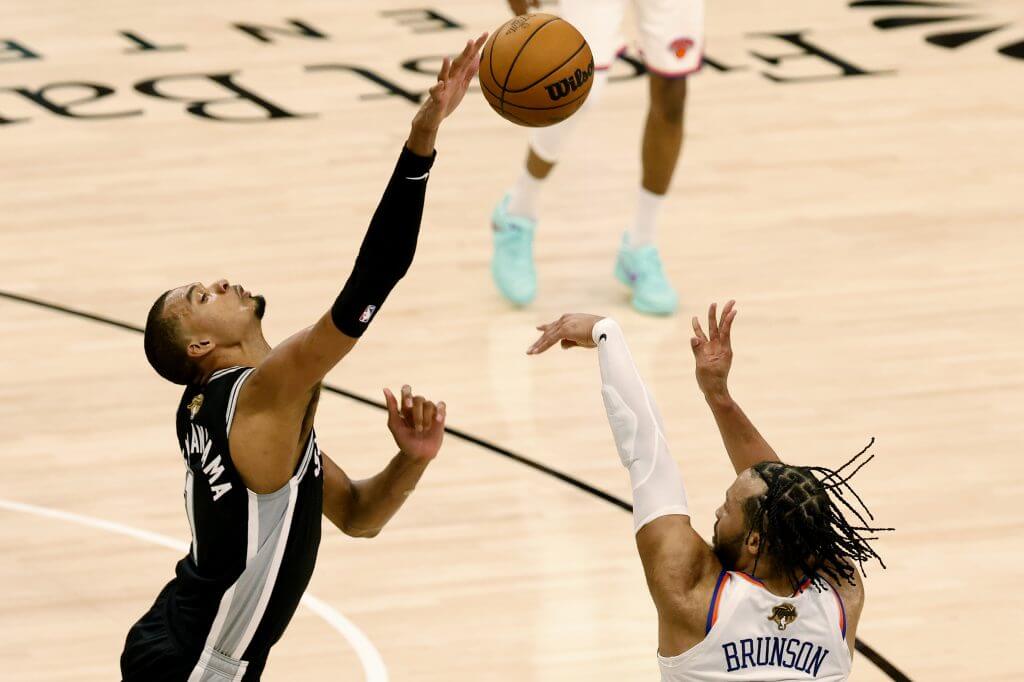
圣安东尼奥——这可能是本届总决赛中最不可思议的一球——对杰伦·布伦森 (Jalen Brunson) 稍显抱歉——但这无疑生动地展现了尼克斯是如何应对这位新科年度最佳防守球员的。
在第一场比赛第三节的最后几秒,尼克斯让米切尔·罗宾逊 (Mitchell Robinson) 在左侧低位牵制维克托·文班亚马 (Victor Wembanyama),而乔什·哈特 (Josh Hart) 则驻守在右侧。经过两次传导,哈特接球并获得了直通篮下的通道——这迫使文班亚马不得不放弃罗宾逊,上前护框。
但哈特根本没打算在文班头上强投。哈特的意图始终是压缩防守,他在油漆区内运了两步球,为迈尔斯·麦克布莱德 (Miles McBride) 移动到底角争取时间。哈特的传球精准地找到了麦克布莱德。这位被称为“Deuce”的后卫接球时,惯性正带着他向底线冲去。麦克布莱德在底角稳稳站定,利用他跳投时的弹跳高度和极高的出手点,顶着扑防过来的马刺控卫达龙·福克斯 (De’Aaron Fox) 投出了这记三分。
麦克布莱德的三分球在高高砸中篮板后,空心入网。
底角三分打板进球,就像在很久没穿的外套口袋里摸出了一张20美元的钞票。在街头球场上,人们会说麦克布莱德今天真是得到了上天的眷顾。
但这生动地展现了这支尼克斯队的一项关键优势。他们对底角的统治,就像《火线》(The Wire)里的马洛(Marlo)统治街区一样。而这一回合的关键,在于谁没有去干扰这次投篮。
维克托·文班亚马。
因为有他的存在,本届总决赛中最珍贵的“黄金地带”,莫过于球场四个角落那四块面积各为42平方英尺的区域。这仅占NBA球场总面积的3.6%左右,却可能决定本轮系列赛的归属。
纽约目前以2-0大比分领先圣安东尼奥,这在很大程度上得益于他们对这片区域的极致利用。尼克斯在底角投出了惊人的53.6%的三分命中率,以此来对抗马刺那支极擅长保护油漆区的防守。
马刺拥有全联盟最顶级的防守之一,因为文班亚马用他那在NBA历史上都屈指可数的超长臂展(8英尺)巡视着油漆区。在外线,马刺还拥有运动能力出色、防守侵略性强的后卫,在终极护框神器的撑腰下,他们对三分线的防守同样出色。对于任何进攻球队来说,马刺都是一道难以破解的难题。
尼克斯在进入总决赛前,季后赛场均内线得分高达53.3分,高居季后赛首位。考虑到纽约在常规赛期间的内线得分仅排在联盟第23位(场均47.8分),这一转变尤为引人注目。
但在面对马刺时,这一数字大幅下滑至44.0分。这就是“文班效应”。在今年季后赛中,圣安东尼奥场均仅让对手在内线拿到41.2分。
“他的臂展无与伦比,而且防守智商极高,”米卡尔·布里奇斯 (Mikal Bridges) 说道,“这绝对会给我们制造麻烦。他能拿到最佳防守球员是有原因的。”
但尼克斯用他们的底角三分弥补了这一劣势。当他们想把文班亚马拉出油漆区时,他们可以找唐斯,或者让唐斯与布伦森打挡拆。但尼克斯其实并不介意文班亚马留在内线,因为他们可以在22英尺外惩罚对手。他们通过突破和传导球让马刺的防守动起来,并乐于用来自底角——球场上距离最近的三分点——的致命一击来完成这次进攻执行。
俄克拉荷马雷霆在西部决赛中也采用了同样的策略。雷霆场均内线得分仅为38分,他们放弃了内线进攻,转而创造空位三分机会。雷霆利用谢伊·吉尔杰斯-亚历山大 (Shai Gilgeous-Alexander) 的突破来撕扯防守,随后他会将球传给拉开到底角的队友。尽管缺少了全明星球员杰伦·威廉姆斯 (Jalen Williams),但雷霆依然保障了足够的进攻火力,因为亚历克斯·卡鲁索 (Alex Caruso) 和凯森·华莱士 (Cason Wallace) 用底角三分惩罚了马刺——两人合计31投18中。不过,雷霆在第四场比赛后手感降温,在最后三场比赛中三分球仅有32投11中,而前四场他们投进了23个。
尼克斯采用了类似的战术:压缩内线,无限轰炸底角。而在底角投射方面,没有人比尼克斯做得更好。
根据NBA官方数据,纽约以409记底角三分命中数领跑全联盟,是仅有的五支至少投进350记底角三分的球队之一。全联盟只有不到一半的球队(12支)达到了300记。而在总决赛中,尼克斯在底角的手感更是热得发烫。
OG·阿奴诺比 (OG Anunoby) 和布里奇斯在常规赛的底角三分命中数一直稳居联盟前列,分别排名第一和第三。尼克斯还拥有最近三分手感热到逆天的兰德里·沙梅特 (Landry Shamet) 以及麦克布莱德作为常规的底角埋伏射手。阿奴诺比和沙梅特包办了尼克斯15记底角三分中的10记。
“首先,”阿奴诺比解释道,“(这源于)大量的练习。投了无数个球。这能拉开空间。我们站在底角可以把空间彻底带开,这是进攻端一个极好的安全阀。”
他们让圣安东尼奥的防守陷入了进退两难的境地。
当然,纽约人并没有发明底角三分。这在NBA长期以来都是一项极具价值的得分手段。今年季后赛,马刺场均出手近11次底角三分(10.8次),甚至比纽约(10.1次)还要多。但尼克斯的命中率高得惊人,足以摧毁任何防守。
迈克·布朗 (Mike Brown) 执教的球队在进入本轮系列赛时,底角三分命中率高达41.8%——仅次于湖人(46.3%)和明尼苏达(44.4%),而后两支球队都没能闯过第二轮。而马刺在进入总决赛时,底角三分命中率仅为32%,在季后赛16支球队中排名第14。
两场比赛打完?尼克斯底角三分28投15中——第一场进了8个,第二场进了7个。相比之下,纽约在横扫克利夫兰的四场比赛中总共才投进20个,进入总决赛前场均仅有4.0个。
如果数据还不足以说明纽约是如何利用底角惩罚马刺的,那么看看文班亚马就知道了。他为了兼顾保护油漆区和扑防投手,简直在场上转得团团转。很多时候,他根本无法扑防到位,只能专注于卡位。
在第一场比赛中,布伦森在右侧底角投进那记关键的准绝杀三分时,文班亚马被卡在唐斯身后,迫使斯蒂芬·卡斯尔 (Stephon Castle) 不得不从油漆区中央一路飞奔过去伸手干扰。但他根本无能为力。
“这很难,”尼克斯控卫何塞·阿尔瓦拉多 (Jose Alvarado) 说道,“这就是为什么我们努力突入内线,然后把球分到外线。这是一项艰巨的任务。”
在面对尼克斯时,球场空间被拉得无限宽。即使对文班亚马来说,要覆盖的防守面积也太大了。圣安东尼奥那些运动能力出色的后卫虽然能补防到位,但他们往往没有足够的臂展去干扰尼克斯的投手。
当然,如果文班亚马真的补防到了底角——正如他此前经常做的那样,利用他96英寸的惊人臂展去改变投篮轨迹,尼克斯似乎也完全可以接受。
因为扑防到底角不仅会消耗文班亚马的体力——这在赛季的这个阶段可是稀缺资源——同时还会暴露出突破通道。
在第二场比赛第四节的中段,马刺让福克斯去防守卡尔-安东尼·唐斯 (Karl-Anthony Towns),从而让文班亚马可以留在中路协防。尼克斯一直利用唐斯——历史上投射能力最强的大个子之一——来将文班亚马引出油漆区,从而让对手的篮下容易受到空切和突破的冲击。因此,通过用小个子防守唐斯,文班亚马可以扮演自由安全卫的角色进行协防,而不是被死死钉在唐斯身边。
但当时站在左侧底角的唐斯,越过文班亚马送出了一记横跨球场的长传,找到了右侧底角的阿奴诺比。由于底角三分的巨大威胁——而阿奴诺比可以说是全联盟最擅长此道的球员——文班亚马不得不拼命扑向右侧底角进行防守。他成功阻止了这次底角三分出手,但阿奴诺比顺势利用文班亚马过猛的扑防重心,选择持球突破。
文班亚马靠得太近,且他的身体惯性正朝着远离篮筐的方向移动,这让他很容易被过掉。阿奴诺比在抢占身位后,用身体将文班亚马死死卡在身后。
文班亚马最终无能为力。他失位太严重了,而且因为覆盖了如此大面积的防守而精疲力竭。运了三步球后,阿奴诺比拔地而起,完成了一记双手暴扣。
底角,属于尼克斯。
由生成式 AI 翻译,译文内容可能不准确或不完整,以原文为准。
点击查看原文:Knicks' counter to Victor Wembanyama? The corners
Knicks’ counter to Victor Wembanyama? The corners
SAN ANTONIO — It might be the wildest shot of these NBA Finals — with apologies to Jalen Brunson — but it certainly illustrates how the Knicks are countering the freshly minted Defensive Player of the Year.
In the final seconds of the third quarter in Game 1, the Knicks had Mitchell Robinson occupying Victor Wembanyama on the left low block with Josh Hart camped out on the right. Within two passes, Hart had the ball with a lane to the rim — forcing Wembanyama to leave Robinson and protect the rim.
But Hart was never going up on Wemby. Hart’s intentions were always to collapse the defense, taking two dribbles in the paint to buy time for Miles McBride to drift to the corner. Hart led McBride with the pass. And the one they call Deuce caught the ball with all his momentum taking him toward baseline. Firmly in the corner when he planted, McBride took advantage of the lift he gets on his jumper and the high release point, launching the 3 over charging Spurs point guard De’Aaron Fox.
McBride’s 3-pointer caromed high off the glass and through the net.
Banking a corner 3 is like finding a $20 bill in a jacket you haven’t worn in a while. On the playground, it would be said McBride must be living right.
But it served as an illustration of a critical strength of these Knicks. They dominate from the corners like Marlo from “The Wire.” And the key to the play was who didn’t contest the shot.
Victor Wembanyama.
Because of him, some of the most precious real estate in these NBA Finals are the four plots of 42 square feet, one in each corner. It amounts to some 3.6 percent of an NBA court and could decide who wins this series.
New York holds a commanding 2-0 lead over San Antonio in no small part because it maximizes this real estate. The Knicks have made a blistering 53.6 percent of their corner 3s to counter a defense that thrives in protecting the paint.
The Spurs have one of the league’s best defenses because Wembanyama patrols the paint with one of the longest wing spans (8 feet) in NBA history. And with athletic, aggressive guards on the perimeter, emboldened by the ultimate rim protector, the Spurs also defend the 3-point line well. They’re a difficult equation for an offense to solve.
The Knicks entered the finals averaging 53.3 points in the paint — the most in the playoffs. That shift from their norm was noteworthy considering New York ranked 23rd in points in the paint (47.8) during the regular season.
Against the Spurs, that number is way down: 44.0. But that’s The Wemby Effect. San Antonio is allowing just 41.2 paint points per game in these playoffs.
“His length is unmatched and he’s got good IQ,” Mikal Bridges said. “It definitely causes trouble. He’s DPOY for a reason.”
But the Knicks compensate with their corner 3s. When they want Wembanyama out of the paint, they can go to Towns or put him in the pick-and-roll with Brunson. But the Knicks don’t mind keeping Wembanyama in the paint because they can punish teams from 22 feet. They use drives and ball movement to get the Spurs defense moving, and they love punctuating the execution with a dagger from the corner, the shortest 3-point shot on the court.
Oklahoma City employed the same strategy in the Western Conference finals. The Thunder averaged just 38 points in the paint, shunning interior offense to set up open 3s. OKC used Shai Gilgeous-Alexander drives to collapse the defense. He would then pass to a teammate who had drifted to the corner. Though without All-Star Jalen Williams, the Thunder managed enough offense because Alex Caruso and Cason Wallace burned the Spurs with corner 3s — a combined 18 for 31. But OKC eventually cooled after Game 4, making just 11 of 32 the final three games after making 23 in the first four.
The Knicks employ a similar game plan: collapse the paint and spam the corners. And nobody is better at those shots than the Knicks.
New York led the league in corner 3s made with 409, per NBA Stats, one of only five teams to make at least 350. Fewer than half the league (12) reached 300. And in the Finals, the Knicks are scorching from the corners.
OG Anunoby and Mikal Bridges are consistently near the top of the league in 3-pointers made from the corner, ranking first and third, respectively, during the regular season. The Knicks also have Landry Shamet, currently unconscious from 3, and McBride as regular corner snipers. Anunoby and Shamet account for 10 of the Knicks’ 15 corner 3s.
“First of all,” Anunoby explained, “(it’s) a lot of practice. A lot of shots. It opens up the floor. Us being in the corners spreads the floor open and it’s a great release valve for the offense.”
They’re all putting San Antonio’s defense in a quandary.
No, New York didn’t discover corner 3s. It’s long been a valued shot in the NBA. The Spurs have taken nearly 11 a game (10.8) this postseason, more even than New York (10.1). But the Knicks just make them at a clip that breaks defenses.
Mike Brown’s squad entered this series shooting 41.8 percent on corner 3s — bested only by the Lakers (46.3) and Minnesota (44.4), neither of which made it past the second round. The Spurs came into the finals shooting 32 percent from the corners, which ranked 14 out of the 16 teams in the postseason.
Through two games? The Knicks have made 15 of 28 — eight in Game 1, seven in Game 2. New York made 20 total in the four-game sweep of Cleveland and came into the Finals averaging 4.0 per game.
And if the numbers don’t illustrate how New York is cooking the Spurs from the corner, then just watch Wembanyama. He’s spinning in circles trying to protect the paint and cover shooters. Often, he can’t get out there and focuses on blocking out.
On Brunson’s massive go-ahead 3 in Game 1, from the right corner, Wembanyama was pinned behind Towns, forcing Stephon Castle to hustle from the middle of the paint to get a hand up. He didn’t stand a chance.
“It’s hard,” Knicks point guard Jose Alvarado said. “That’s why we try to get in the paint and spray it out. It’s a tough task.”
The court is as wide as possible against the Knicks. It’s too much ground even for Wembanyama to cover. The athletic guards of San Antonio can get there, but they often don’t have the length to impact the Knicks shooters.
Of course, if Wembanyama finds his way to the corners, as he’s been known to do, using his 96-inch wingspan to alter the trajectory of the shot, the Knicks seem fine with that, too.
Going out to the corners not only costs Wembanyama energy — a scarce commodity at this stage of the season — but also opens up driving lanes.
Midway through the fourth quarter of Game 2, the Spurs had Fox defending Karl-Anthony Towns, allowing Wembanyama to patrol the middle. The Knicks have been using Towns — one of the best-shooting big men in history — to draw Wembanyama out of the paint, leaving the rim vulnerable to cuts and drives. So with a small on Towns, Wembanyama could play free safety and help out instead of being locked in on Towns.
But Towns, standing in the left corner, threw a cross-court pass over Wembanyama to Anunoby in the right corner. Because of the threat of the corner 3 — and Anunoby is arguably the best in the league — Wembanyama had to hustle to the right corner to defend. He successfully prevented the corner 3, but Anunoby took advantage of Wembanyama’s aggression by driving.
Wembanyama got too close and his momentum was going away from the basket, making him easy to get by. Once he got a step, Anunoby kept Wembanyama on his back.
Wembanyama wound up helpless. Too out of position. Too gassed from covering so much ground. After three dribbles, Anunoby powered up for a two-handed dunk.
The corners belong to the Knicks.
By Marcus Thompson II, via The Athletic