By David Aldridge | The Athletic, 2026-06-03 11:30:49

这是一个关于NBA和“Logo”的故事。

几乎每个关注NBA的人都知道那个标志性的联盟Logo——“运球人”,即名人堂成员杰里·韦斯特 (Jerry West) 的剪影,尽管没人愿意公开承认这位已故的洛杉矶湖人队传奇球星就是该Logo的原型。
而这个Logo,则是NBA用来宣告联盟年度总冠军争夺战正式打响的标志。
那就是NBA总决赛Logo,带有标志性的手写体“F”,以及“Finals”中字母“I”上方划过的那颗流星。
1986年,波士顿凯尔特人队与休斯敦火箭队争夺总冠军,NBA首次推出了这款手写体“F”Logo。40年后,当圣安东尼奥马刺队和纽约尼克斯队于周三拉开2026年总决赛的帷幕时,一个略有改动的手写体Logo版本将装点弗罗斯特银行中心球馆的地板。手写体“F”在总决赛中的知名度已不亚于拉里·奥布莱恩杯(奥布莱恩杯将自2009年以来首次以Logo形式重返中圈地板,并在系列赛移师纽约进行第3、4场对决时,同样出现在麦迪逊广场花园的中圈)。
过去,球员们曾抱怨地板上的总决赛贴纸太滑,而NBA近年来甚至在电视转播中用AR技术在场地上叠加虚拟Logo(天呐,那太糟糕了)。这一次,联盟决定不再采用这些做法,而是直接将手写体“F”Logo和奥布莱恩杯图案喷涂在弗罗斯特银行中心和麦迪逊广场花园的木质地板上。
与奥布莱恩杯一样,手写体“F”Logo只代表一件事:他们正在为总冠军戒指而战。每年如此拼搏,还能为了什么?它意味着你作为一支球队或一名球星,终于登上了最高舞台。你在常规赛中可以刷出任意亮眼的数据,但如果你从未踏上过画有手写体“F”和奥布莱恩杯的地板,你就无法跻身那最顶尖的殿堂——那是只有强者中的强者才能踏足的圣地。
“这意义非凡,因为在我的职业生涯中,我以前只能在电视上看到那个总决赛Logo,”尼克斯队六届全明星球员卡尔-安东尼·唐斯 (Karl-Anthony Towns) 在周三表示,“所以,能够成为将这个Logo印在自己球衣上并获得这次机会的人,这对我来说意味着太多。我能说的只有‘感激’二字。”
回溯到20世纪80年代初,在经历70年代被大批美国体育受众冷落之后,NBA当时仍在努力重整旗鼓,联盟并没有太多拿得出手的东西。此时,“魔术师”约翰逊 (Magic Johnson) 和拉里·伯德 (Larry Bird) 的职业生涯才刚刚起步。迈克尔·乔丹 (Michael Jordan)、哈基姆·奥拉朱旺 (Hakeem Olajuwon) 和帕特里克·尤因 (Patrick Ewing) 还在读大学。而NBA总决赛在美东地区甚至还在采用录像延时播出——在东部时间晚上11点半,也就是当时《约翰尼·卡森今夜秀 (The Tonight Show Starring Johnny Carson)》的时段播出(主持人为约翰尼·卡森 (Johnny Carson))。
而且,当时没人知道该怎么称呼这个系列赛。
在80年代初拥有联盟转播权的CBS电视台,将其称为“NBA世界冠军系列赛 (NBA World Championship Series)”。这听起来可不像“超级碗 (Super Bowl)”、“世界大赛 (World Series)”或“斯坦利杯 (Stanley Cup)”那样朗朗上口。甚至连NCAA(全美大学体育协会)都在1978年开始为其决赛周末使用了一个极具吸引力的绰号:“最终四强 (Final Four)”。这些名字都极具感染力,让人联想到那些令人难忘的战术和瞬间。而且,无论如何,NBA的这一赛事也算不上真正的“世界”冠军赛,正如国际篮联 (FIBA) 和其他国际体育管理机构的代表向NBA管理层明确指出的那样。
为了制造一些噱头,位于奥林匹克大厦的NBA总部里有人——谢天谢地,现在没人能确切记得是谁了,尽管已故总裁大卫·斯特恩 (David Stern) 的名字曾被提及——极力推崇将1982年湖人与费城76人之间的系列赛命名为“82大对决 (Showdown ’82)”。它甚至还有专门的Logo和配套宣传。但这让NBA的总冠军赛看起来像是在ESPN The Ocho(译注:电影中虚构的一个播放冷门怪异运动的恶搞频道)上播出的低俗、虚构节目。(“在东部飞碟射击锦标赛之后……紧接着为您带来的是:82大对决!”)

“82大对决”Logo。(图片由布赖恩·麦金泰尔 (Brian McIntyre) 提供)
“记住,我们当时规模很小,”时任NBA副总裁拉斯·格拉尼克 (Russ Granik) 说道,“我们没有营销人员,没有创意人员。如果里克·韦尔茨 (Rick Welts)(2018年奈史密斯篮球名人堂成员,现任达拉斯独行侠队CEO)当时在场,他也是在忙着拉赞助。”
“我不知道这个创意是从哪儿来的,也许是大卫提了一嘴。我们意识到我们在推广总冠军系列赛方面存在真正的短板。人们根本不知道该怎么称呼它。”
“82大对决”后来还有了续集——“83大对决 (Showdown ’83)”,当时湖人队和76人队再次在总决赛相遇。但这个名字同样没能流行起来。
“我其实认为它与‘Showtime’时期的湖人队联系得太紧密了,而他们当时正好打进了总决赛,”曾长期担任联盟传播高级副总裁的布赖恩·麦金泰尔表示。
格拉尼克再次登场。当时,他住在威斯特彻斯特县,乘火车通勤。他的一个邻居正好在广告界工作。
“拉斯和我是朋友,”设计了手写体“F”Logo的菲尔·布兰登 (Phil Brandon) 说道。在他数十年的职业生涯中,他曾与从肯纳玩具 (Kenner Toys) 到三菱汽车 (Mitsubishi) 等众多公司合作过。
“我们的职业生涯有些交集和互动,我们会聊各种事情。我在广告界,拉斯在他的领域。我喜欢开玩笑说,我还记得我开的车比他的车好的时候。这纯粹是、真真切切的朋友情谊。”
到了1985年,在湖人队和凯尔特人队连续两年在总决赛交手、伯德和约翰逊重新点燃了联盟最伟大的宿敌之战后,NBA重新步入上升通道。通过1983年与球员达成的劳资协议,联盟开始理顺其经济体系。与此同时,在1984年至1989年期间,大量具有名人堂天赋的球员涌入联盟:乔丹、奥拉朱旺、尤因、克莱德·德雷克斯勒 (Clyde Drexler)、斯科蒂·皮蓬 (Scottie Pippen)、约翰·斯托克顿 (John Stockton)、卡尔·马龙 (Karl Malone)、查尔斯·巴克利 (Charles Barkley)、雷吉·米勒 (Reggie Miller) 以及大卫·罗宾逊 (David Robinson)。
但NBA仍在苦苦寻找一个合适的称呼,来命名赛季末两支最强球队对决的系列赛。
“你需要让你的终极赛事具有可辨识性、可推广性,从而具有独占性,”布兰登说道,“拉斯和我经常在火车上聊这些。或者当我们在游乐场推秋千时,也会聊这些。在我看来,这其实就像任何其他营销问题一样。”
“我无意贬低它,只是它具备了营销问题的基本要素——实际上,这既像是一次重大新产品的推出,同时又是一次品牌延伸……这对我来说是一次飞跃。我当时想,他们绝对不会买账的,但他们接受了。一个字面意义上把一切都解释得清清楚楚的标志。”
是格拉尼克向布兰登发出的邀请?还是布兰登主动向格拉尼克请缨?两人都记不太清了。
“我当时肯定只是说:‘我有一个朋友,他是靠这个吃饭的,’”格拉尼克说,“我想他当时回答说:‘给我一个周末的时间。’”
基本上,事情就是发生得这么快。
“年份在这儿——1986,”布兰登说,“NBA——这是谁?然后是,‘总决赛 (Finals)’。”
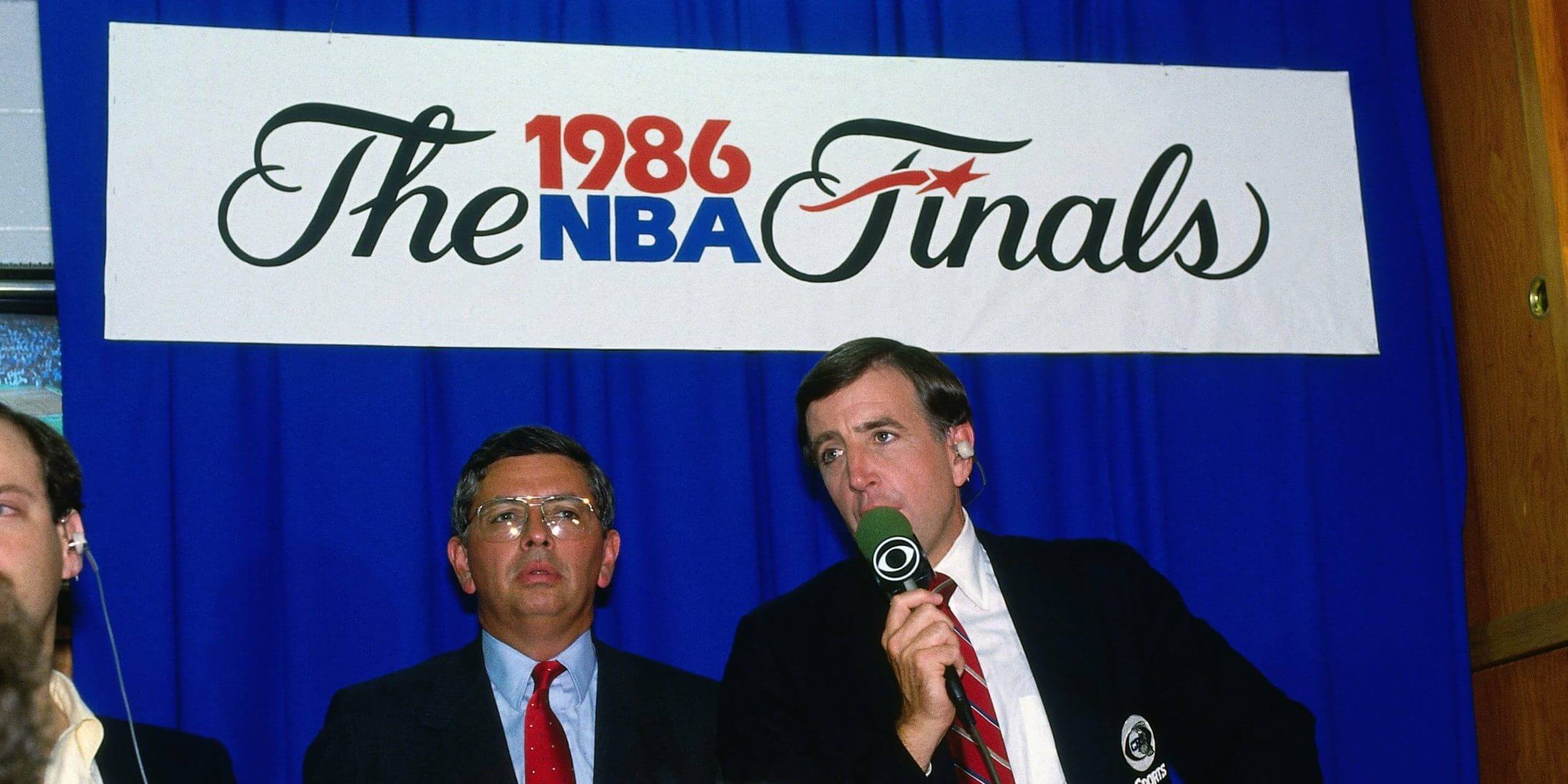
时任NBA总裁大卫·斯特恩与CBS的布伦特·马斯伯格 (Brent Musburger) 站在菲尔·布兰登设计、于1986年首次亮相的Logo前。(Dick Raphael / NBAE 拍摄,由 Getty Images 提供)
是谁?是什么?在什么时候?就是这么简单。就像苹果公司 (Apple)。就像20世纪福克斯 (20th Century Fox)。它足够紧凑,可以印在帽子或T恤上,或者在当时非常重要的一点——印在报纸专栏的排版表格里。
“对任何广告商来说,终极追求就是让人记住,”布兰登说。
而手写体“F”让它脱颖而出。布兰登将其比作你在婚礼请柬上会看到的那种字体。
“在这个阶段,在这个标志的生命周期里,你需要的是绝对的清晰,”他说,“一些极其简单,但又带有一些格调、一些情感的东西——在这种情况下,是两种情感:NBA总决赛的力量感和重要性,它们被分开、以不同的方式表达,但又融合在一起。你该怎么做到这一点?”
“这就是它最初如何演变成那个样子的。唯一真正算得上是花哨点缀的,如果你愿意这么说的话,就是‘Finals’中‘F’的横笔,以及那颗流星。”
在接下来的10年里,除了更改年份外,联盟一直使用布兰登设计的这个简约Logo。这个名字深入人心,成为了伯德、魔术师、伊赛亚·托马斯 (Isiah Thomas) 和乔丹各自多次夺冠的代名词,展现了这项运动所能提供的最高水平。
“这并非一蹴而就,”格拉尼克说,“但人们的反应很积极。在那个时候,纸媒在这些事情上起着至关重要的作用,他们似乎非常乐意将这个Logo作为视觉元素使用。我们当时说,‘这看起来效果相当不错。’随着时间的推移,这不再是有人刻意去说‘这有利于营销’。最终,你希望人们一看到它就会说‘就是它了’。我们要去打‘总决赛’了。”
然后,因为总有人觉得自己有更好的主意,联盟从1996年开始搁置了手写体“F”,转而采用了一个全新的Logo。没有了手写体“F”,取而代之的是旁边放着奥布莱恩杯。该版本一直沿用到2002年。2003年,奥布莱恩杯又被“运球人”/韦斯特Logo所取代。

NBA在1996年总决赛中替换了手写体“F”Logo。(John W. McDonough / 《体育画报》拍摄,由 Getty Images 提供)
2004年,重回理智的NBA重新启用了布兰登设计的手写体“F”。不久后,他们又将奥布莱恩杯和“运球人”都放回了设计中(人们真的需要被提醒他们正在看的是NBA总决赛吗?难道他们会以为自己误入了大陆篮球协会 [CBA] 的总决赛?),但手写体“F”保留了下来。直到2018年,YouTubeTV成为总决赛的“冠名赞助商”。手写体“F”再次淡出,取而代之的是“运球人”,这一用就是四年。
终于——好吧,至少目前是这样——联盟在2022年迎回了手写体“F”。至少这一次,手写体“F”排在了奥布莱恩杯和“运球人”的前面,联盟当时称其为“现代化”的总决赛Logo。布兰登也很高兴看到自己的心血重返舞台中央。
“至少‘总决赛 (The Finals)’这部分(在2022年)找回了它的位置,”布兰登说,“我不是个爱记仇的人,我也不会幸灾乐祸。”
由生成式 AI 翻译,译文内容可能不准确或不完整,以原文为准。
点击查看原文:NBA's 'Script F' Finals logo, 40 years after its debut, still means a team has made it big
NBA’s ‘Script F’ Finals logo, 40 years after its debut, still means a team has made it big
This is a story about the NBA and the Logo.
Almost everyone who follows the NBA knows its iconic league logo – Dribbling Man, the silhouette of Hall of Famer Jerry West, though no one likes to admit that the late Los Angeles Lakers’ legend was the model.
This Logo is the one the NBA uses to announce that the league’s championship series has arrived.
The NBA Finals logo, with the Script F, and the shooting star over the “I” in Finals.
The NBA debuted the Script F in 1986, when the Boston Celtics met the Houston Rockets for the title. Forty years later, a slightly different version of the script logo will adorn the court at Frost Bank Center on Wednesday, when the San Antonio Spurs and the New York Knicks tip off the 2026 finals. The Script F has become as known for the championship series as the Larry O’Brien Trophy — which will return in logo form to center court Wednesday for the first time since 2009, and also be center court at Madison Square Garden when the series moves to New York for Games 3 and 4.
Rather than put a finals decal on the floor, which some players complained about as being slippery — or, good lord, superimposing one on the court for the TV audience, as the NBA did in recent years — the league will paint the Script F logo and the Larry into the wood at Frost Bank and MSG.
Like the Larry, the Script F logo means one thing: They’re playing for the ring. What other reason is there to do this every year? It means you’ve arrived as a team, or as a star player. You can put up all the numbers you want during the regular season, but if you don’t walk out onto a Script F/Larry court, you’re not in the rarest air — where the best of the best played.
“It means a lot, because for my career, I’ve only been able to see that finals logo on TV,” the Knicks’ six-time All-Star Karl-Anthony Towns said Wednesday. “So it means a lot to be the person that sees the logo on their jersey and has this opportunity. The word ‘grateful’ is all I can say.”
Back in the early 1980s, when the NBA was still trying to regain its footing after falling out of favor with large swaths of the American sporting public during the ’70s, the league didn’t have much on which to hang its hat. Magic Johnson and Larry Bird were just at the beginning of their pro careers. Michael Jordan, Hakeem Olajuwon and Patrick Ewing were in college. The NBA’s championship series was still being shown on tape delay — 11:30 p.m. ET, then-Johnny Carson time — to the East Coast of the United States.
And no one knew what to call the series.
CBS, which had the league’s broadcast rights in the early ’80s, called it the “NBA World Championship Series.” That didn’t exactly roll off the tongue like the Super Bowl, the World Series or the Stanley Cup. Even the NCAA had started using a catchy nickname for its championship weekend: the Final Four, in 1978. Each evocative. Each harkening back to memorable plays and moments. And, at any rate, the NBA’s version wasn’t the world championship series, as advocates of FIBA and other international governing bodies for the sport made clear to NBA leadership.
Desperate to create some buzz, someone at NBA HQ in Olympic Tower — mercifully, no one can now remember exactly who, though the late commissioner David Stern’s name came up — pushed the idea to call the 1982 series between the Lakers and the Philadelphia 76ers “Showdown ’82.” It had a logo and everything. And it made the NBA’s championship look like a cheesy, made-up event that would run on ESPN The Ocho. (“Coming up after the Great Eastern Skeet Shooting Championships … it’s Showdown ’82!”)
The Showdown ’82 logo. (Image courtesy of Brian McIntyre)
“Remember how small we were,” said Russ Granik, the NBA’s deputy commissioner at the time. “We didn’t have marketing people, creative people, and if Rick (Welts, the 2018 Naismith Hall of Fame inductee who is now CEO of the Dallas Mavericks) was there, he was selling sponsorships.
“I don’t know where it came from, except maybe David said something. We realized we had a real shortcoming in selling our championship series. People didn’t know what to call it.”
Showdown ’82 had a sequel — Showdown ’83, when the Lakers and Sixers met again in the championship series. It didn’t take, either.
“I actually think it was too closely aligned to the Showtime Lakers, and they were in those finals,” said Brian McIntyre, who was the league’s longtime senior vice president of communications.
Re-enter Granik. At the time, he lived in Westchester County and took the train to work. One of his neighbors worked in advertising.
“Russ and I were friends,” said Phil Brandon, the man who designed the Script F while in the midst of a decades-long career working with companies from Kenner Toys to Mitsubishi cars.
“Our careers kind of intermingled and intermixed, and we spoke about stuff. I was in the advertising world, and Russ was in his world. I like to joke about how I remember when I had a better car than he did. It was just purely, truly, a friendship thing.”
By 1985, after the Lakers and Celtics had played in back-to-back championship series, with Bird and Johnson rekindling the league’s greatest rivalry, the NBA was back on the upswing. It had begun to figure out its economics with its 1983 collective bargaining agreement with its players. At the same time, an incredible amount of Hall of Fame talent was coming into the league to join them, all between 1984 and 1989: Jordan, Olajuwon, Ewing, Clyde Drexler, Scottie Pippen, John Stockton, Karl Malone, Charles Barkley, Reggie Miller and David Robinson.
But the NBA was still searching for what to call the series in which the two best teams played at the end of the season.
“You need to have your ultimate event be identifiable, promotable, and therefore, ownable,” Brandon said. “Russ and I, on the train, would talk about stuff. Or when we were at the playground, pushing swings, we’d talk about stuff. And it just occurred to me as being a marketing problem like any other, really.
“I don’t mean to trivialize it, it’s just that it had the basic needs of a marketing problem — where, in effect, it was like a major new product introduction, at the same time that it was a brand extension … that created, for me, something that was a leap. I thought, they never are going to buy this, but they did. A mark that, literally, spelled it all out.”
Did Granik ask Brandon? Did Brandon volunteer his services to Granik? Neither really remembers.
“I must’ve just said, ‘I’ve got a friend. He does this for a living,'” Granik said. “I think he said ‘Give me a weekend.’
Basically, it happened that fast.
“The year, here — 1986,” Brandon said. “NBA — who is this? And, ‘Finals.'”
Then-NBA commissioner David Stern and CBS’ Brent Musburger stand in front of Phil Brandon’s logo, which debuted in 1986. (Dick Raphael / NBAE via Getty Images)
Who is it? What is it? When is it? It was that simple. Like Apple. Like 20th Century Fox. Something compact enough to fit on a hat or a T-shirt or, in what was important at the time, newspaper column spreadsheets.
“The grail for any advertiser is recall,” Brandon said.
And the Script F made it pop. Brandon likened it to what you’d see on a wedding invitation.
“At this point, in the life of this thing, you needed just absolute clarity,” he said. “Something that’s going to be totally dumb simple, but something that has some style, some emotion to it — in this case, two emotions: the strength and importance of the NBA Finals, expressed separately, differently, but together. How do you do that?
“That’s how this evolved to be what it is, what it was, initially. The only thing that was really a kind of a flourish, if you will, was the crossbar of the ‘F” of ‘Finals,’ and the shooting star.”
For 10 years, other than changing the year, the league used Brandon’s simple logo. The name took, becoming synonymous with Bird and Magic and Isiah Thomas and Jordan each winning multiple titles, displaying the best the sport had to offer.
“It didn’t happen right away,” Granik said. “But people reacted positively to it. Back then, it was the (written) press that was really important in these things, and they seemed perfectly happy to use the logo as a visual. We said, ‘This seems to be doing pretty well.’ And over time, it’s not like somebody said this is good for marketing. Eventually, you want people to just say that’s what that is. We’re going to ‘The Finals.'”
And then, because someone always thinks they have a better idea, the league, starting in 1996, shelved the Script F in favor of a new one. No Script F. And, now, the O’Brien Trophy on the side. A version of that ran through 2002. In 2003, the O’Brien Trophy was replaced by the Dribbling Man/West logo.
The NBA replaced the Script F logo for the 1996 NBA Finals. (John W. McDonough / Sports Illustrated via Getty Images)
In 2004, returning to its senses, the NBA went back to Brandon’s Script F. They soon put both the Larry and Dribbling Man back into the design (Do people need to be reminded it’s the NBA Finals they’re watching? Do they think they’ve stumbled onto the Continental Basketball Association Finals?), but the Script F stayed. Until 2018, when YouTubeTV became the “presenting sponsor” of the finals. Out when Script F, back came Dribbling Man, for four years.
Finally — well, for now, anyway — the league brought the Script F back in 2022. At least, this time, the Script F is back in front of Larry and Dribbling Man, in what the league called at the time a “modernized” logo for the finals. And Brandon is pleased to see his creation back on center stage.
“At least ‘The Finals’ part found its way back (in 2022),” Brandon said. “I’m not the vengeful sort. Nor do I gloat.”
By David Aldridge, via The Athletic