By Zach Kram | ESPN, 2026-03-26 18:45:00
由于全联盟的高管们都将目光投向了天赋异禀的2026届选秀,"摆烂"成为了NBA目前的主流话题。这不无道理:他们可以参考联盟当下的这届新秀,看看一名充满潜力的新星能如何改善球队的长期前景。
2025年选秀大会的前四顺位球员是本赛季表现最出色的新秀。随着常规赛接近尾声,是时候对整个新秀届进行一次全面评估了。
此前我们已在11月和1月两次对本赛季前10名新秀进行了排名。请注意,这是一份关于新秀本赛季表现质量的排名,而非长期潜力预测。
特雷·约翰逊 (Tre Johnson,在上一期排名中位列第八) 在本期跌出了前10名。萨克拉门托国王队的中锋马克西姆·雷诺 (Maxime Raynaud) 自全明星赛后表现神勇,是本次遗憾落选的最后一人。让我们进入更新后的排名:
10. 埃戈尔·德明 (Egor Demin),布鲁克林篮网
1月排名: 第10位
由于足底筋膜炎发作,德明的赛季已于2月27日提前结束。在受伤之前,这位去年选秀的8号秀在一支挣扎的布鲁克林球队中展现出了足够的天赋闪光点,足以保住第10的位置。
德明走出大学时最大的疑问是他的跳投,他在杨百翰大学 (BYU) 的三分命中率仅为27%。但在NBA,德明场均6.2次三分出手,命中率达到了38.5%,这使他成为联盟历史上仅有的八位场均至少出手5次三分且命中率不低于38%的合格新秀之一。其他几位分别是康·克努佩尔 (Kon Knueppel)、基根·穆雷 (Keegan Murray)、泰瑞斯·哈利伯顿 (Tyrese Haliburton)、萨迪克·贝 (Saddiq Bey)、泰勒·希罗 (Tyler Herro)、兰德里·沙梅特 (Landry Shamet) 和鲁迪·费尔南德斯 (Rudy Fernandez)。作为一名新秀,这种级别的投射虽不能保证未来一定成为巨星,但确实是朝着正确方向迈出的一大步。
此外,德明展示了他高阶的传球技巧,且凭借6英尺8英寸的身高,他在防守端不会轻易成为被针对的目标。德明能否在第二个赛季扩展他的进攻手段——他的两分球命中率为39.9%——将决定他如何融入正在完成重建冲刺的篮网队的计划。
9. 瑞安·卡尔克布伦纳 (Ryan Kalkbrenner),夏洛特黄蜂
1月排名: 第7位
卡尔克布伦纳在第一期排名中位列第五,但他未能保持住赛季初那段火热的数据表现。例如,他在前九场比赛中场均能贡献2.6次盖帽,但此后这一数据已降至1.3次。
此外,当穆萨·迪亚巴特 (Moussa Diabate) 坐镇中锋位置,而非体型更大、移动更慢的卡尔克布伦纳时,黄蜂队的表现要好得多。
尽管如此,这位次轮秀的表现依然超出了所有合理的预期,并打出了本届新秀中最好的赛季之一。卡尔克布伦纳依然是一名极其高效的得分手,75%的真实命中率如果达到评选标准将领跑全联盟;即便他不再像赛季初那样封盖一切,他的护筐能力依然是加分项。
8. 乌戈·冈萨雷斯 (Hugo Gonzalez),波士顿凯尔特人
1月排名: 未上榜
冈萨雷斯并不属于这届新秀中技术最细腻的球员,他的基础数据——场均4.0分、3.5个篮板和0.6次助攻——也并无特别之处。
但冈萨雷斯拥有一项极其特别的高阶数据:当他在场时,凯尔特人队的净效率值高达+12.6。这是这支NBA顶级强队中的最佳纪录,在全联盟本赛季出战至少50场比赛的所有球员中排名第四,仅次于维克托·文班亚马 (Victor Wembanyama)、谢伊·吉尔杰斯-亚历山大 (Shai Gilgeous-Alexander) 和切特·霍姆格伦 (Chet Holmgren)。
冈萨雷斯极其出色的净效率值部分归功于波士顿强大的阵容深度和轮换,部分归功于投篮手感带来的运气。但在1,009分钟的登场时间里,冈萨雷斯的在场样本量已经大到足以让他获得相当一部分功劳。凭借他的活力和防守悍将的特质,冈萨雷斯总能做出有助于赢球的贡献。他固然不具备这份名单中其他球员那样的长期上限,但他理应入选最佳新秀阵容。
7. 德里克·奎恩 (Derik Queen),新奥尔良鹈鹕
1月排名: 第4位
奎恩在这一期排名中下滑,是因为他撞上了最严重的新秀墙。全明星赛前,奎恩在26分钟内场均得到12.2分、7.2个篮板和4.1次助攻;全明星赛后,他在20分钟内的数据下降到了8.5分、5.4个篮板和2.5次助攻。
奎恩和同为乐透秀的杰里迈亚·费尔斯 (Jeremiah Fears) 是新奥尔良轮换阵容中在场/不在场效率值最差的球员,这使得鹈鹕队临时主教练詹姆斯·博雷戈 (James Borrego) 越来越倾向于弃用新秀。并非巧合的是,球队本赛季表现最好的一段时期正是老将获得更多出场时间的时候。
然而,这位13号秀在赛季中期的爆发期展示了足够的组织潜力和出色的进攻瞬间,他依然是入选最佳新秀阵容第二阵容的轻松人选。他可能不是扎恩·威廉森 (Zion Williamson) 旁边的长期搭档——据 databallr 数据,当这对组合在场时,新奥尔良的净效率值为-11.7——这让他的短期前景变得复杂。但从长期来看,他依然潜力十足。
6. 柯林·默里-博伊尔斯 (Collin Murray-Boyles),多伦多猛龙
1月排名: 第9位
默里-博伊尔斯刚刚从长达近一个月的拇指伤势中复出,因此他在本期排名中上升几位可能看起来有些奇怪。但这届新秀的前五名之后有一道明显的界线,随后的八名左右新秀几乎可以按任何顺序排列。而默里-博伊尔斯之所以能冲到第二梯队的顶端,是因为他在这一群体中拥有最高的下限。
德明的进攻可能永远无法发展到足以成为真正的先发控卫,冈萨雷斯的上限可能只是第八人,或者奎恩的防守可能会拖累他。但默里-博伊尔斯的身材和防守多样性意味着他至少在未来多年内都会是一名稳健的轮换球员。
这位9号秀需要扩展他的进攻武器库,因为他总共只投进了17个三分球,且只有24个进球是非助攻得分。这一弱点可能会限制他的潜力上限。但默里-博伊尔斯在一支竞争季后赛的球队中做出了贡献,并在一支老将云集的球队中作为一名可行的小球中锋完美融入。对于他在联盟的未来,这是一个非常积极的信号。
5. 塞德里克·考沃德 (Cedric Coward),孟菲斯灰熊
1月排名: 第5位
考沃德已经没有现实机会去竞争年度最佳新秀的前三名,但他依然交出了一个强劲的首秀赛季,在26分钟内场均得到13.4分、6.2个篮板和2.8次助攻。他理应在最佳新秀阵容第一阵容中占有一席之地。
考沃德具备了一名强力3D侧翼的所有特质。他拥有出色防守者的身材(即便基础数据尚未完全体现),而且凭借他优美的投篮姿势,他的三分命中率跌至33.6%坦白说令人意外——不过他85%的罚球命中率预示着他在未来的赛季应该会有所提升。
4. 迪伦·哈珀 (Dylan Harper),圣安东尼奥马刺
1月排名: 第6位
在经历了一段赛季中期的低迷后,哈珀重新冲回了排名的上半部分。这要归功于他在NBA战绩第二好的球队中承担了更多责任,并提升了产出。与这份名单中排在他之后的几位新秀不同,哈珀在全明星赛后的出场时间反而增加了,甚至在上周末获得了职业生涯首次先发,而圣安东尼奥作为西部第二的势头并未放缓。
从长期来看,哈珀最令人鼓舞的数据指标是他的三分命中率已回升至31.4%——这虽然仍不理想,但比1月下旬那23.7%的惨淡数据要好得多。(自1月下旬以来,尽管产量依然不高,但他的三分命中率达到了43.3%。)稳定的跳投将使他与前年度最佳新秀斯蒂芬·卡斯尔 (Stephon Castle) 的后场搭档关系更加稳固。
但即使存在投篮疑问,卡斯尔和哈珀的表现依然出色。根据 databallr 的数据,当这对组合与维克托·文班亚马 (Victor Wembanyama) 同时在场时,球队的净效率值高达惊人的+34.5,尽管这其中包含了一定程度的投篮运气成分且样本量较小。
哈珀在过去一个月的微小飞跃给人留下了深刻印象,以至于他几乎挤进了这份排名的前三,但最终,名单上的下一位球员拥有更完整的全赛季表现记录。
3. VJ·艾奇库姆 (VJ Edgecombe),费城76人
1月排名: 第3位
艾奇库姆在本赛季各方面都有所贡献,但也许他最被低估的成就是熬过了第一个漫长NBA赛季的磨练。艾奇库姆场均出战35分钟——斯科蒂·巴恩斯 (Scottie Barnes) 是过去十年中唯一出场时间比他更多的新秀。在此之前,最近一批场均至少出战35分钟的新秀还是安德鲁·威金斯 (Andrew Wiggins)、达米安·利拉德 (Damian Lillard)、布雷克·格里芬 (Blake Griffin) 和约翰·沃尔 (John Wall)。
艾奇库姆的出场时间足以证明他看起来像是一名未来的全明星。
再加上艾奇库姆好于预期的跳投、组织能力和防守贡献(场均1.4次抢断、0.6次盖帽),完全有理由期待他在未来多年内与泰瑞斯·马克西 (Tyrese Maxey) 组成极具威力的后场搭档。
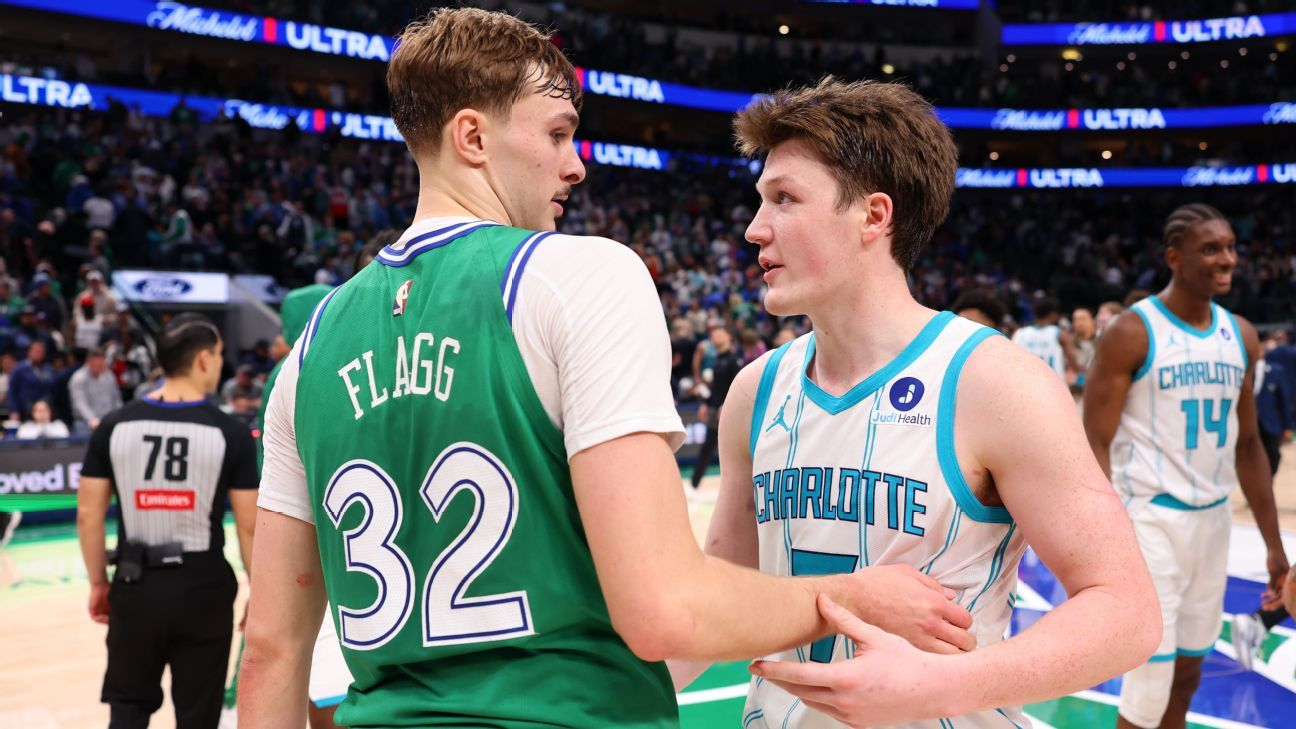
2. 库珀·弗拉格 (Cooper Flagg),达拉斯独行侠
1月排名: 第2位
弗拉格场均得到20.3分、6.6个篮板和4.6次助攻。NBA历史上场均达到20-6-4的新秀只有七位:卢卡·东契奇 (Luka Doncic)、迈克尔·乔丹 (Michael Jordan)、拉里·伯德 (Larry Bird)、西德尼·威克斯 (Sidney Wicks)、卡里姆·阿卜杜勒-贾巴尔 (Kareem Abdul-Jabbar)、奥斯卡·罗伯特森 (Oscar Robertson) 和埃尔金·贝勒 (Elgin Baylor)。
因此,弗拉格的数据表现让他看起来像是一名未来的名人堂核心成员——这还没考虑到他巨大的防守潜力,以及他和东契奇是这份名单中仅有的两名青少年球员这一事实。
弗拉格没能排在榜首或成为年度最佳新秀头号热门的唯一原因,是他的前杜克大学队友本赛季表现得更好。但这并不会抹杀弗拉格在独行侠队一个艰难赛季中所取得的成就。他看起来完全符合状元秀的基石地位,即便在一年后的2025年重选,他依然会是状元。
1. 康·克努佩尔 (Kon Knueppel),夏洛特黄蜂
1月排名: 第1位
根据 ESPN 的净得分指标,克努佩尔本赛季在进攻端贡献了比平均水平高出153分的得分。没有其他新秀超过18分。
即便放眼全联盟,而不仅仅是新秀,克努佩尔的表现也出类拔萃。他的进攻净得分排在全联盟第11位;排在他前面的两位球员是安东尼·爱德华兹 (Anthony Edwards) 和杰伦·布伦森 (Jalen Brunson),排在他后面的两位则是凯德·坎宁安 (Cade Cunningham) 和泰瑞斯·马克西。
简而言之,克努佩尔已是本赛季NBA表现最好的球员之一。他的三分球总命中数领跑全联盟。他在合格的外线球员中真实命中率排名第三,仅次于吉尔杰斯-亚历山大和萨姆·梅里尔 (Sam Merrill)。而且他是一支令人意外的赢球球队的主要贡献者。
克努佩尔理应赢得年度最佳新秀奖,尽管弗拉格表现出色,但这个选择不应该有太大悬念。
由生成式人工智能翻译,译文内容可能不准确或不完整,以原文为准。
点击查看原文:NBA rookie rankings: 10 players to watch ahead of the playoffs
NBA rookie rankings: 10 players to watch ahead of the playoffs
Tanking is the dominant conversation in the NBA as executives across the league set their sights on the ultra-talented 2026 draft class. And for good reason: They can look at the league’s current rookie class to see how one promising young player can improve a team’s long-term outlook.
The first four players picked in the 2025 draft have been the best rookies this season, and as the regular season draws to a close, it’s time to assess the entire class.
We’ve ranked the top 10 rookies this season twice already, once in November and once in January. Note that this is a ranking of the quality of the rookies’ play this season rather than a long-term projection.
Tre Johnson (who ranked eighth in the most recent edition of these rankings) fell out of the top 10 in this edition. Kings center Maxime Raynaud, on a tear since the All-Star break, was the last player cut this time. Let’s get into the updated rankings:
10. Egor Demin, Brooklyn Nets
January ranking: No. 10
Demin’s season ended Feb. 27 due to a bout of plantar fasciitis. Before his injury, the No. 8 pick in last year’s draft showed enough flashes of talent on a struggling Brooklyn team to grab the No. 10 slot.
The biggest question about Demin coming out of college was his jump shot, as he made just 27% of his 3-pointers at BYU. But Demin made 38.5% of his 6.2 long-range attempts per game in the NBA, making him one of eight qualified rookies in league history to convert at least 38% of his 3s on at least five attempts. The others are Kon Knueppel, Keegan Murray, Tyrese Haliburton, Saddiq Bey, Tyler Herro, Landry Shamet and Rudy Fernandez. That level of shooting as a rookie isn’t a guarantee of stardom, but it’s a step in the right direction.
Otherwise, Demin showed off his advanced passing skills, and at 6-foot-8, he has the size to avoid being targeted on the defensive end. Whether Demin can expand his offensive game in his second season – he shot 39.9% from 2 – should dictate how he fits into the Nets’ plans, as they round the corner of their rebuild.
9. Ryan Kalkbrenner, Charlotte Hornets
January ranking: No. 7
Kalkbrenner ranked fifth in the first edition of these rankings, but he hasn’t maintained his scorching statistical start. For instance, he averaged 2.6 blocks through his first nine games, but he is down to 1.3 since.
The Hornets have also played much better with Moussa Diabate manning the center position instead of the bigger, slower Kalkbrenner.
But the rookie second-rounder has still exceeded all reasonable expectations and produced one of the best seasons in his class. Kalkbrenner remains a hyperefficient scorer, with a 75% true shooting mark that would lead the league if he qualified, and his rim protection is still a plus, even if he’s no longer blocking everything in sight.
8. Hugo Gonzalez, Boston Celtics
January ranking: Not ranked
Gonzalez doesn’t rank among the most skilled rookies in this class, and his surface stats – 4.0 points, 3.5 rebounds and 0.6 assists per game – are nothing special.
But Gonzalez has one advanced stat that’s incredibly special: When he’s on the floor, the Celtics have a plus-12.6 net rating. That’s the best mark on one of the NBA’s best teams, and it’s fourth among all players with at least 50 games this season, behind only Victor Wembanyama, Shai Gilgeous-Alexander and Chet Holmgren.
Some of Gonzalez’s superlative net rating is the result of Boston’s strong depth and rotations; some is attributable to shooting luck. But at 1,009 minutes, Gonzalez’s on-floor sample is large enough that he deserves a decent amount of the credit. With his energy and defensive prowess, Gonzalez makes winning plays. He certainly doesn’t possess the highest long-term ceiling of the players on this list, but he should make the All-Rookie team.
7. Derik Queen, New Orleans Pelicans
January ranking: No. 4
Queen falls in this edition of rankings because he’s hit the rookie wall the hardest. Before the All-Star break, Queen averaged 12.2 points, 7.2 rebounds and 4.1 assists in 26 minutes; since the break, he’s down to 8.5 points, 5.4 rebounds and 2.5 assists in 20 minutes.
Queen and fellow lottery pick Jeremiah Fears have the worst on/off ratings among members of New Orleans’ rotation, making Pelicans interim coach James Borrego increasingly lean away from his rookies. It’s no coincidence that the team’s best stretch of the season has come with its veterans receiving more playing time.
And yet, the No. 13 pick displayed enough playmaking upside and standout offensive moments during his midseason hot streak that he’s still an easy choice to nab a spot on the All-Rookie second team. He probably isn’t a long-term fit next to Zion Williamson – New Orleans has a negative-11.7 net rating with that duo on the floor, per databallr – which complicates his short-term future. But over the long term, he still has plenty of potential.
6. Collin Murray-Boyles, Toronto Raptors
January ranking: No. 9
Murray-Boyles just returned from a nearly monthlong absence due to a thumb injury, so it might seem strange that he leapt a few spots from the last edition. But there’s a clear dividing line after the top five rookies in this class, and then a group of eight or so rookies who could be jumbled in almost any order. And Murray-Boyles pushes to the top of that second tier because he has the highest floor among the group.
It’s possible that Demin’s offense might never develop enough to be a true starting point guard, or that Gonzalez tops out as an eighth man, or that Queen’s defense sinks him. But Murray-Boyles’ size and defensive versatility mean he should be, at minimum, a solid rotation player for years to come.
The No. 9 pick could stand to expand his offensive repertoire, as he’s made just 17 total 3-pointers and 24 total unassisted shots. That weakness could place a firm ceiling on his potential. But Murray-Boyles has contributed to a contending team and fit in as a viable small-ball center as a rookie on a veteran-heavy team. That’s a bright green indicator for his future in the league.
5. Cedric Coward, Memphis Grizzlies
January ranking: No. 5
Coward no longer has a realistic chance to contend for a top-three Rookie of the Year finish, but he’s turned in a strong debut season, nonetheless, averaging 13.4 points, 6.2 rebounds and 2.8 assists in 26 minutes. He deserves a spot on the All-Rookie first team.
Coward has all the makings of a strong 3-and-D wing. He has the size (if not the counting stats) of a solid defender, and with his beautiful shooting form, it’s frankly a surprise that he’s fallen to 33.6% on 3-pointers – though his 85% mark from the free throw line suggests he should improve in future seasons.
4. Dylan Harper, San Antonio Spurs
January ranking: No. 6
Following a midseason swoon, Harper has surged back into the top half of these rankings, thanks to his improved production amid increasing responsibilities for the NBA’s second-best team. Unlike several of the rookies below him on this list, Harper has actually played more since the All-Star break, even receiving his first start over the weekend, and San Antonio hasn’t slowed as the No. 2 team in the West.
From a long-term perspective, the most encouraging statistical indicator for Harper is that his 3-point percentage has ticked up to 31.4% – which is still far from ideal, but less worrisome than the 23.7% mark he toted in late January. (He’s made 43.3% of his 3s, albeit on a still low volume, since late January.) A reliable jump shot would make his backcourt partnership with former ROTY Stephon Castle more secure.
But even with shooting questions, Castle and Harper are thriving. Lineups with that duo and Victor Wembanyama playing together have a whopping plus-34.5 net rating, per databallr, albeit with extreme shooting luck in a fairly small sample.
Harper’s mini-leap over the past month has been so impressive that he nearly nudged into the top three in these rankings, but ultimately, the next player on the list has more of a full-season track record.
3. VJ Edgecombe, Philadelphia 76ers
January ranking: No. 3
Edgecombe has contributed across the board throughout this season, but perhaps his most underrated accomplishment is surviving the grind of his first long NBA campaign. Edgecombe is playing 35 minutes per game – Scottie Barnes is the only rookie in the past decade with more playing time. Before that, the most recent rookies to average at least 35 minutes were Andrew Wiggins, Damian Lillard, Blake Griffin and John Wall.
Edgecombe’s playing time is enough to prove he looks like a future All-Star.
Fold in Edgecombe’s better-than-expected jump shot, playmaking and defensive contributions (1.4 steals, 0.6 blocks per game), and there’s every reason to expect he’ll form a potent backcourt partnership with Tyrese Maxey for years to come.
2. Cooper Flagg, Dallas Mavericks
January ranking: No. 2
Flagg is averaging 20.3 points, 6.6 rebounds and 4.6 assists. Only seven rookies in NBA history averaged 20-6-4: Luka Doncic, Michael Jordan, Larry Bird, Sidney Wicks, Kareem Abdul-Jabbar, Oscar Robertson and Elgin Baylor.
So Flagg’s statistical profile makes him look like an inner circle Hall of Famer – and that’s not even accounting for his immense defensive potential, or the fact that he and Doncic are the only teenagers on that list.
The only reason Flagg isn’t No. 1 on this list, or the Rookie of the Year favorite, is that his former Duke teammate has been playing better this season. But that doesn’t diminish what Flagg has accomplished in a difficult campaign for the Mavericks. He looks every bit the franchise cornerstone that befits a No. 1 pick, and he would still be picked first in a 2025 redraft, one year later.
1. Kon Knueppel, Charlotte Hornets
January ranking: No. 1
According to ESPN’s net points metric, Knueppel has contributed 153 points above average on offense this season. No other rookie is above 18.
Knueppel stands out even when compared to the entire league, not just rookies. He’s 11th overall in offensive net points; the two players directly ahead of him are Anthony Edwards and Jalen Brunson, and the two players directly behind him are Cade Cunningham and Tyrese Maxey.
Simply put, Knueppel has been one of the best players in the NBA this season. He’s leading the league in total 3-point makes. He’s third among qualified perimeter players in true shooting percentage, behind only Gilgeous-Alexander and Sam Merrill. And he’s a major contributor to a surprisingly winning team.
Knueppel should win the Rookie of the Year award, and for as well as Flagg has played, the decision shouldn’t be that close.
By Zach Kram | ESPN, via ESPN