By Zach Kram | ESPN, 2026-01-22 19:00:00
NBA赛季的中点为新秀们带来了新的挑战。如果说赛季之初的困难源于更高水平的竞争——对手更强壮、更迅速、技术更精湛,那么当新秀们刚刚开始适应时,41场比赛的节点又增添了新的变数:如今,他们必须经受职业生涯中最漫长篮球赛季的严酷考验。
去年的NCAA全国冠军总共打了40场比赛;勇士队新秀威尔·理查德 (Will Richard),曾是那支佛罗里达大学球队的明星球员,在周二晚间才刚刚在NBA打满第40场比赛,而他还有半个赛季要打。
但这也提供了一个绝佳的机会,通过新一期的榜单来评估这届新秀。请注意:本榜单评估的是新秀们当下的比赛质量,而非长期潜力预测。理查德(在11月的第一版榜单中排名第七)、黄蜂队的锡安·詹姆斯 (Sion James)(第八)和鹈鹕队的杰里迈亚·菲尔斯 (Jeremiah Fears)(第十)在本期榜单中跌出前十,其中菲尔斯是最后被排除的人选。
数据更新至1月21日上午
10. 叶戈尔·杰明 (Egor Demin),布鲁克林篮网
11月排名: 未上榜
杰明是一位特点极其鲜明的球员。他很少冲击篮筐,也极少获得罚球,但他是一位天赋异禀的传球手,身高6英尺8英寸的他,完全符合现代高个主控手的模板。杰明的三分命中率已经攀升至39.8%——考虑到他在大学时仅有27%的命中率,这是一个重大的进步。
如果杰明能够持续稳定地命中远投,那么防守方将被迫在三分线外对他设防,而他也将能更大程度地发挥自己的传球才华。根据databallr的数据,当杰明与小迈克尔·波特 (Michael Porter Jr.) 同时在场时,篮网的净效率值为+3.6,进攻效率值高达120.1,比联盟平均水平高出4个点。
9. 科林·穆雷-博伊尔斯 (Collin Murray-Boyles),多伦多猛龙
11月排名: 第九
根据Cleaning the Glass的数据,尽管注册身高为6英尺7英寸,但穆雷-博伊尔斯有93%的时间都出现在中锋位置上。这种小球打法并不完美,因为穆雷-博伊尔斯在进攻端有诸多局限;他在37场比赛中仅命中15记三分球。但他的换防能力和移动能力使他成为防守端的理想人选:当穆雷-博伊尔斯与斯科蒂·巴恩斯 (Scottie Barnes) 共同在场时,猛龙的防守效率值为106.6,比联盟平均水平要好上10个点。
8. 特雷·约翰逊 (Tre Johnson),华盛顿奇才
11月排名: 未上榜
投射能力可以说是现代NBA球员所能拥有的最重要的单项技能——而约翰逊在这方面天赋异禀。这位19岁的年轻人场均出手5.3次三分,命中率高达39%,并且他在急停跳投(40%)和接球就投(39%)方面的效率同样出色。
自从奇才队交易得到特雷·杨 (Trae Young) 以来,约翰逊也获得了更多的机会。这并非因为杨已经开始为他送出精准传球——这位前老鹰队后卫尚未迎来他的奇才首秀——而是因为在这笔交易中送走CJ·麦科勒姆 (CJ McCollum) 和科里·基斯珀特 (Corey Kispert),意味着华盛顿的年轻球员们将获得更多的上场时间。约翰逊本赛季出场时间最长的四场比赛(一次31分钟,三次30分钟)都发生在交易后的一周内。
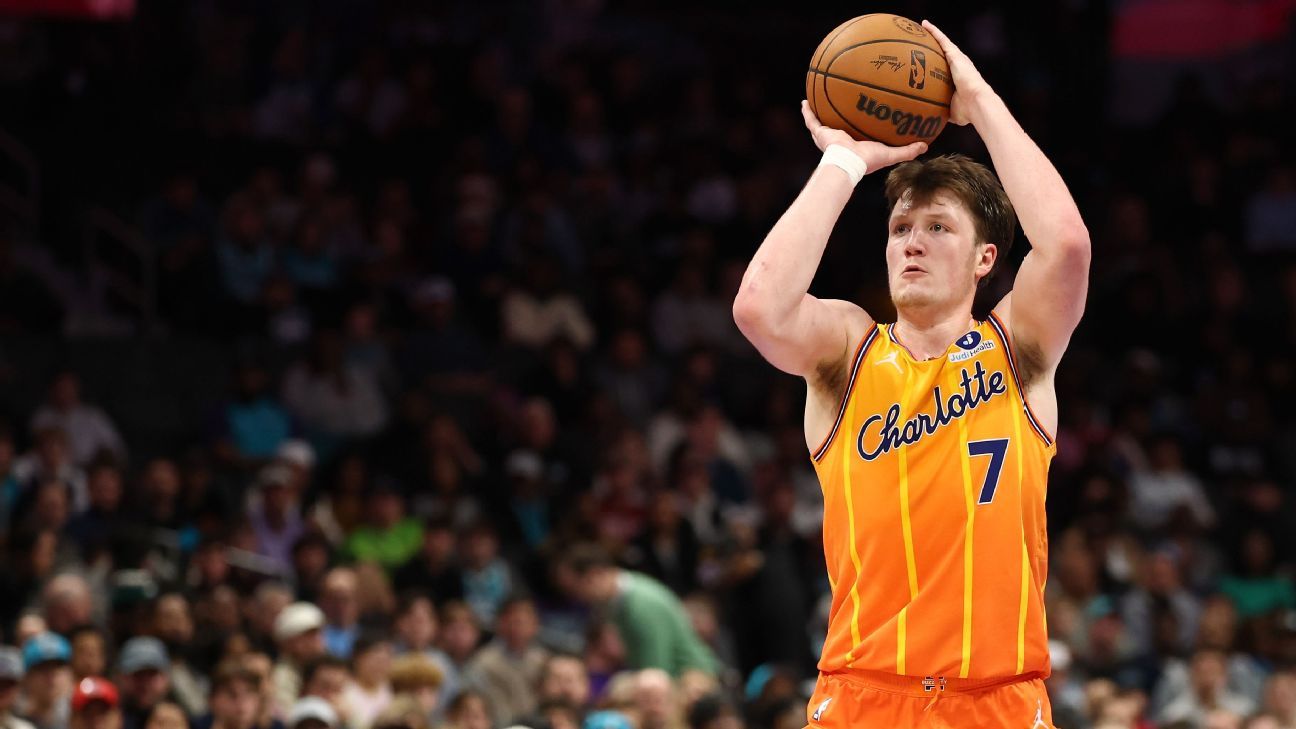
7. 瑞安·卡尔克布伦纳 (Ryan Kalkbrenner),夏洛特黄蜂
11月排名: 第五
卡尔克布伦纳因肘部受伤在新年期间缺席了数周比赛。但这位二轮秀在本榜单中能够排在如此多顺位比他高的球员之前,其原因与第一版榜单时相同。作为一名新秀,卡尔克布伦纳是一位可靠的护筐手,场均贡献1.6次盖帽,且对手在他镇守下的篮下命中率仅为58%,这一数据让他与篮网的尼克·克拉克斯顿 (Nic Claxton)、波特兰开拓者的多诺万·克林根 (Donovan Clingan) 以及费城76人队的乔尔·恩比德 (Joel Embiid) 等人并列于NBA排行榜前列。
尽管卡尔克布伦纳在进攻端并没有什么特别亮眼或革命性的表现,但作为一名投篮命中率高达77%的内线终结者,他依然具备很高的价值。本赛季,明尼苏达森林狼队的鲁迪·戈贝尔 (Rudy Gobert)(72%)是唯一一位场均出手至少4次且命中率达到70%的球员。
6. 迪伦·哈珀 (Dylan Harper),圣安东尼奥马刺
11月排名: 第四
哈珀标志着本榜单的一个层级跃升;排名第六之后的所有球员都从未被真正考虑过获得更高的排名,而接下来的几位球员实力非常接近,在排名过程中位置也曾多次变动。有理由认为哈珀应该再高几个位次,或者像上一版那样保持在第四位。但尽管这位榜眼秀拥有充满爆发力的突破、巧妙的篮下终结能力,并为这支优秀的年轻球队提供了外线防守,一个主要缺陷却让他排名下滑:投篮。
哈珀的罚球命中率仅为74%,三分命中率更是低至24%。在200名符合资格的球员中,他的真实命中率排在第196位。
这不仅仅是一个短期问题,因为圣安东尼奥的目标是争夺2025-26赛季的总冠军;哈珀的投篮困境也可能拉低他的长期潜力上限。根据Stathead的数据,自2010年以来,新秀赛季罚球命中率低于75%且三分命中率低于30%(至少出场1000分钟)的后卫,正如现在的哈珀一样,包括:斯蒂芬·卡斯尔 (Stephon Castle)、以赛亚·科利尔 (Isaiah Collier)、科迪·威廉姆斯 (Cody Williams)、约什·克里斯托弗 (Josh Christopher)、艾萨克·奥科罗 (Isaac Okoro)、贾勒特·卡尔弗 (Jarrett Culver)、约什·奥科吉 (Josh Okogie)、本·西蒙斯 (Ben Simmons)、克里斯·邓恩 (Kris Dunn)、埃尔弗里德·佩顿 (Elfrid Payton)、迈克尔·卡特-威廉姆斯 (Michael Carter-Williams)、菲尔·普雷西 (Phil Pressey)、内特·沃尔特斯 (Nate Wolters)、阿列克谢·施韦德 (Alexey Shved) 和埃里克·布莱索 (Eric Bledsoe)。
这份名单中,很少有球员最终成长为可靠的首发球员,更不用说成为进攻核心了,而西蒙斯是其中唯一一位成为全明星的球员。或许哈珀可以追随队友卡斯尔的脚步,后者尽管同样面临着持续的投篮挑战,但似乎也正走在这条发展轨迹上。但在目前这个节点,这份令人担忧的先例名单足以让哈珀的排名下降几个位次。
5. 塞德里克·考沃德 (Cedric Coward),孟菲斯灰熊
11月排名: 第一
本赛季第一期新秀榜单发布时,恰逢考沃德迎来他赛季初期的巅峰。此后他状态有所下滑,远投命中率降至34%——不过由于他在两分球和罚球方面表现出色,考沃德的整体效率依然很高。在孟菲斯决定是坚持当前路线还是开启更长期的重建时,他仍然是球队明确的建队基石。
但更令人担忧的是考沃德在防守端的积极性不足,尽管他似乎完全符合一名3D侧翼球员的所有标准。数据统计并不能完全反映防守表现,但考沃德场均0.5次抢断和0.3次盖帽的数据实在有些平庸。按分钟计算,考沃德的抢断盖帽率在本赛季出场至少250分钟的34名新秀中仅排在第29位。
4. 德里克·奎恩 (Derik Queen),新奥尔良鹈鹕
11月排名: 第十
总的来说,大多数NBA新秀都是挣扎多于成功。有时,与其关注他们整体的平均数据,不如去寻找那些闪现的潜力瞬间。
我的天,奎恩简直是潜力四溢。如果你在状态好的夜晚看他打球,他看起来就像是这届新秀中最出色的球员:从比赛得分(game score)来看,奎恩在12月对阵马刺时砍下的33分三双,是本赛季新秀中最令人印象深刻的单场表现之一。
但一个需要关注的关键趋势是,当奎恩与蔡恩·威廉姆森 (Zion Williamson) 一同出场时,鹈鹕队的表现非常挣扎。在这些时间里,新奥尔良的净效率值为-14.3,进攻效率值比联盟平均水平低5个点,防守效率值则差了9个点。
考虑到他与威廉姆森的适配性不佳,加上他自身显著的防守短板和缺乏投射射程(三分球42投8中,命中率19%),目前仍然很难想象奎恩未来将如何为一支胜利之师做出贡献。但奎恩兼具的身材和组织能力实在太过诱人,即便是在这届实力强劲的新秀中,他也理应获得如此高的排名。
3. VJ·埃奇科姆 (VJ Edgecombe),费城76人
11月排名: 第二
埃奇科姆在10月份迎来了一个火热的开局,11月份陷入低迷,此后状态回暖,年仅20岁就已成为一名稳健的NBA首发球员。埃奇科姆的整体效率不算很高,但他的三分命中率达到37%,这相比他在贝勒大学时期面对更短大学三分线投出的34%是一个至关重要的进步。他在防守端的积极性非常出色,场均贡献1.5次抢断,并以场均3.5次截断(deflections)排名联盟第14位。
这位年轻后卫仍有巨大的提升空间。例如,在挡拆进攻中,埃奇科姆每回合仅能得到0.76分,在本赛季至少执行过300次挡拆的94名球员中排名垫底。
但对埃奇科姆有利的另一个因素是他的球队环境,他在为一支赢球的队伍效力时,打出了令人印象深刻的整体数据(15.8分、5.3个篮板和4.2次助攻)。在这份榜单的顶尖球员中,只有哈珀能做到这一点,但他只是替补出场,而埃奇科姆在费城场均要打36分钟。
2. 库珀·弗拉格 (Cooper Flagg),达拉斯独行侠
11月排名: 第六
弗拉格绝不会长期停留在本榜单的中游位置。尽管他在生涯初期因出任控球后卫而表现挣扎,并且跳投一直不够稳定(三分命中率28.6%),但他自11月以来取得了令人瞩目的进步。
毫无疑问,弗拉格是这届新秀中技术最全面的球员。他是最佳防守者——而且优势相当明显——他在短短两个月内的进攻进步意义重大。在他的前10场比赛中,弗拉格场均得到13.9分和3.0次助攻,投篮命中率为40%,但此后他场均数据提升至20.4分和4.5次助攻,投篮命中率也达到了50%。和奎恩一样,弗拉格也具备那种“令人惊叹”的特质。
弗拉格上周因脚踝扭伤缺席了一段时间,但在周一于麦迪逊广场花园战胜尼克斯的比赛中,他强势复出,未受任何不良影响。鉴于他目前的发展轨迹,如果他在下一期新秀榜单中占据榜首,也丝毫不会令人意外。
1. 康·克努普尔 (Kon Knueppel),夏洛特黄蜂
11月排名: 第三
根据博彩市场的数据,弗拉格是年度最佳新秀的绝对热门(-750),但他的前杜克大学队友才是本赛季NBA最出色的新秀。无论是由于他效力于被忽视的黄蜂队——他们本赛季的净胜分已悄然提升至持平的0.0——还是因为他是第4顺位而非状元秀,克努普尔在本赛季似乎一直被低估,尽管他打出了前所未有的数据。
围绕克努普尔的主要话题是他对各种新秀三分球纪录的追逐——他场均能以43.5%的命中率投进3.4个三分球。国王队的基根·默里 (Keegan Murray) 保持着新秀单赛季命中三分球总数的纪录(206个),但克努普尔有望达到273个。
讨论较少但可能更令人印象深刻的是克努普尔的整体效率。他64.5%的真实命中率,是在至少1200分钟出场时间内使用率超过20%的NBA历史所有新秀中最高的。
该排行榜上名列前茅的新秀大多是中锋,但非内线球员中最有效率的新秀赛季属于萨鲁纳斯·马修利奥尼斯 (Sarunas Marciulionis)(在作为25岁新秀进入NBA前,他已是欧洲资深职业球员)、“魔术师”约翰逊 (Magic Johnson)、查尔斯·巴克利 (Charles Barkley)、詹姆斯·沃西 (James Worthy)、埃里克·戈登 (Eric Gordon) 和迈克尔·乔丹 (Michael Jordan)。这是一份非凡的参照名单。
自“魔术师”约翰逊和乔丹的新秀赛季以来,联盟整体效率有所提升,克努普尔也从中受益。尽管如此,克努普尔的真实命中率仍比本赛季联盟平均水平高出11%,这与那些顶级名人堂球员在新秀时期的表现相当。
高使用率非中锋球员最高效新秀赛季
| 球员 | 年龄 | 真实命中率 | 真实命中率 vs. 平均值 |
|---|---|---|---|
| 康·克努普尔 | 20 | 64.5% | +11% |
| 萨鲁纳斯·马修利奥尼斯 | 25 | 61.6% | +15% |
| “魔术师”约翰逊 | 20 | 60.2% | +13% |
| 查尔斯·巴克利 | 21 | 59.9% | +10% |
| 詹姆斯·沃西 | 21 | 59.4% | +12% |
| 埃里克·戈登 | 20 | 59.3% | +9% |
| 迈克尔·乔丹 | 21 | 59.2% | +9% |
仅看本赛季,克努普尔的真实命中率高于10位全明星首发中的7位(除了尼古拉·约基奇 (Nikola Jokic)、扬尼斯·阿德托昆博 (Giannis Antetokounmpo) 和谢伊·吉尔杰斯-亚历山大 (Shai Gilgeous-Alexander)),并且在所有高使用率后卫中排名第三,仅次于吉尔杰斯-亚历山大和奥斯汀·里夫斯 (Austin Reaves)。
对于一位成名已久的老将明星来说,这都将是精英级别的表现——而克努普尔作为一名20岁的球员,在他第一个NBA赛季刚过半程时就做到了这一点。正是这一数据点将克努普尔推上了本期榜单的榜首,并帮助他暂时力压弗拉格。
由生成式人工智能翻译,译文内容可能不准确或不完整,以原文为准。
点击查看原文:NBA rookie rankings: Who takes No. 1 spot at midseason mark?
NBA rookie rankings: Who takes No. 1 spot at midseason mark?
The midpoint of the NBA season presents a new challenge for rookies. If the start of the season is difficult because of the higher level of competition, with bigger and faster and more skilled opponents, then the 41-game mark adds a new wrinkle just as rookies are starting to adjust: Now they must endure the grind of the longest basketball season they’ve ever played.
Last year’s NCAA national champion played 40 games; Warriors rookie Will Richard, who starred for that Florida team, reached the 40-game mark in the NBA on Tuesday night and still has half a season to go.
But that also provides a perfect opportunity to assess the rookie class with another ranking. Note: This is a ranking of the quality of the rookies’ play right now, rather than a long-term projection. Richard (who ranked seventh in the first edition of these rankings in November), the Hornets’ Sion James (eighth) and the Pelicans’ Jeremiah Fears (10th) fell out of the top 10 in this edition, with Fears as the last cut.
Stats are updated as of the morning of Jan. 21
Jump straight to the No. 1 player
10. Egor Demin, Brooklyn Nets
November ranking: Not ranked
Demin is a player of extremes. He rarely gets to the rim and rarely draws free throws, but he’s a gifted passer and, at 6-foot-8, fits the modern archetype of a big lead playmaker. Demin’s 3-point accuracy has climbed to 39.8% – a major development given his 27% mark in college.
If Demin can consistently knock down his tries from deep, then defenses will be forced to guard him on the perimeter and he’ll be able to access his passing in a much greater way. When Demin shares the court with Michael Porter Jr., the Nets have a plus-3.6 net rating and a 120.1 offensive rating, per databallr, which is four ticks higher than the league average.
9. Collin Murray-Boyles, Toronto Raptors
November ranking: Ninth
Despite being listed at 6-7, Murray-Boyles has spent 93% of his minutes at center, per Cleaning the Glass. That small-ball approach isn’t perfect, as Murray-Boyles has plenty of offensive limitations; he has made only 15 3-pointers in 37 games. But his switchability and movement make him an ideal fit on the defensive end: The Raptors have a 106.6 defensive rating when Murray-Boyles shares the court with Scottie Barnes, which is 10 points better than the league average.
8. Tre Johnson, Washington Wizards
November ranking: Not ranked
Shooting is arguably the most important single skill a player can possess in the modern NBA – and Johnson has that skill in abundance. The 19-year-old is making 39% of his 5.3 3-point attempts per game, and he has been just as efficient on pull-up attempts (40%) as catch-and-shoot tries (39%).
Johnson has also benefited from greater opportunities since the Wizards traded for Trae Young, not because Young is feeding him pinpoint passes yet – the former Hawks guard hasn’t made his Wizards debut – but because losing CJ McCollum and Corey Kispert in the deal means more playing time for Washington’s youngsters. Johnson’s four highest-minute games of the season (31 minutes once, 30 minutes three times) have all come in the week since the trade.
7. Ryan Kalkbrenner, Charlotte Hornets
November ranking: Fifth
Kalkbrenner sat out a few weeks straddling the new year because of an elbow injury. But the reasons the second-round pick ranks above so many players drafted ahead of him in these rankings are the same as they were in the first edition. Kalkbrenner is a solid rim protector for a rookie, with 1.6 blocks per game and a 58% opposing field goal percentage at the rim that puts him next to the Nets’ Nic Claxton, the Portland Trail Blazers’ Donovan Clingan and the Philadelphia 76ers’ Joel Embiid on the NBA leaderboard.
And though Kalkbrenner isn’t doing anything particularly ambitious or revolutionary on offense, there’s still value in a big finisher who can make 77% of his shots. Rudy Gobert (72%) of the Minnesota Timberwolves is the only other player averaging at least four attempts who’s even at 70% this season.
6. Dylan Harper, San Antonio Spurs
November ranking: Fourth
Harper marks a tier jump in this ranking; nobody ranked below sixth was ever in true consideration to go any higher, while the next few players are all close and moved around at various points in the ranking process. There’s a case Harper deserves to go a couple of spots higher or also remain in fourth place, as he was in the last edition. But despite the No. 2 pick’s electric drives, savvy finishing at the rim and perimeter defense for an excellent young team, one major flaw is knocking him down a peg: shooting.
Harper is making only 74% of his free throws and 24% of his 3-pointers. Among 200 qualified players, he ranks 196th in true shooting percentage.
This isn’t just a short-term problem, as San Antonio aims to contend for the 2025-26 title; Harper’s shooting struggles could also lower his long-term ceiling. According to Stathead, here are the rookie guards since 2010 who shot worse than 75% on free throws and 30% on 3s (minimum 1,000 minutes), as Harper is now: Stephon Castle, Isaiah Collier, Cody Williams, Josh Christopher, Isaac Okoro, Jarrett Culver, Josh Okogie, Ben Simmons, Kris Dunn, Elfrid Payton, Michael Carter-Williams, Phil Pressey, Nate Wolters, Alexey Shved and Eric Bledsoe.
Very few players from that list developed into reliable starters, let alone offensive engines, and Simmons is the only one who became an All-Star. Perhaps Harper can follow in the footsteps of teammate Castle, who appears to be on that trajectory himself, despite his own continued shooting challenges. But that’s a sufficiently worrisome list of precedents that it bumps Harper down a couple of spots at this juncture.
5. Cedric Coward, Memphis Grizzlies
November ranking: First
The season’s first rookie rankings ran at just about the moment that Coward was enjoying his early peak. He has slumped a bit since, falling to 34% from distance – though Coward remains efficient overall because he’s strong on 2-pointers and free throws. He remains a clear building block for Memphis as the franchise decides whether to stay its current course or begin a longer-term rebuild.
But more concerning is Coward’s lack of defensive activity, given that he seemingly checks all the boxes for a 3-and-D wing. The box score isn’t everything on defense, but Coward’s 0.5 steals and 0.3 blocks per game are rather lackluster. On a per-minute basis, Coward’s stock rate ranks 29th among 34 rookies with at least 250 minutes this season.
4. Derik Queen, New Orleans Pelicans
November ranking: 10th
By and large, most NBA rookies struggle more than they succeed. It’s sometimes better to search for glimpses of potential instead of looking at their overall statistical averages.
And my, does Queen ooze potential. Catch him on the right night, and he looks like the best rookie in the whole class: By game score, Queen’s 33-point triple-double against the Spurs in December is tied for the most impressive performance by a rookie this season.
But one key trend to monitor is that the Pelicans have really struggled when Queen plays with Zion Williamson. New Orleans has a minus-14.3 net rating in those minutes, with an offensive rating five points worse than league average and a defensive rating that’s nine points worse.
It’s still hard to envision exactly how Queen will contribute to a winning team in the future, given his poor fit with Williamson and his own considerable defensive shortcomings and lack of shooting range. (He’s 8 for 42, or 19%, on 3-pointers.) But Queen’s combination of size and playmaking ability is so intriguing that, even in a strong rookie class, he deserves a spot this high.
3. VJ Edgecombe, Philadelphia 76ers
November ranking: Second
Edgecombe got off to a scorching start in October, slumped in November and has since rebounded to already be a solid NBA starter at 20 years old. Edgecombe isn’t very efficient overall, but his 37% mark on 3-pointers is a crucial improvement on the 34% he managed on the shorter college line at Baylor. And his defensive activity is stellar, as he’s averaging 1.5 steals and ranks 14th with 3.5 deflections per game.
The young guard still has ample room to improve. On pick-and-rolls, for instance, Edgecombe is averaging just 0.76 points per play, which ranks last among 94 players with at least 300 picks this season.
But the other factor in Edgecombe’s favor is his team context, as he’s putting up impressive overall numbers (15.8 points, 5.3 rebounds and 4.2 assists) while playing for a winner. Harper is the only other rookie near the top of this list who can say the same, and he’s coming off the bench while Edgecombe is playing 36 minutes a game in Philadelphia.
2. Cooper Flagg, Dallas Mavericks
November ranking: Sixth
Flagg was never going to stay in the middle of these rankings for long. Despite a shaky start to his career while he played point guard, and a persistently inconsistent jump shot (28.6% on 3-pointers), he has made an impressive climb since November.
Flagg is unsurprisingly the most complete all-around rookie in this class. He’s the best defender – and it’s not particularly close – and his offensive strides in only two months are meaningful. In his first 10 games, Flagg averaged 13.9 points and 3.0 assists on 40% shooting, but he’s up to 20.4 points and 4.5 assists on 50% shooting since. Like Queen, Flagg checks off the “wow” factor.
Flagg sat out some time last week because of a sprained ankle, but he returned with no ill effects in a win at Madison Square Garden over the Knicks on Monday. Given his current trajectory, it wouldn’t remotely be a surprise to see him claim the top spot in the next set of rookie rankings.
1. Kon Knueppel, Charlotte Hornets
November ranking: Third
Flagg is the heavy Rookie of the Year favorite (-750) according to betting markets, but his former Duke teammate has been the best rookie in the NBA this season. Whether it’s because he plays for the overlooked Hornets – who have quietly improved their point differential to an even 0.0 for the season – or because he was the No. 4 pick instead of the No. 1 selection, Knueppel has seemed underappreciated this season despite unprecedented production.
The main narrative surrounding Knueppel is his pursuit of various rookie 3-point records – he’s making 3.4 3-pointers per game on 43.5% shooting. The Kings’ Keegan Murray has the rookie record for most total made 3s, with 206, but Knueppel is on pace for 273.
Less discussed, but arguably even more impressive, is Knueppel’s overall efficiency. His 64.5% true shooting mark is the highest for any rookie in NBA history with at least a 20% usage rate in 1,200-plus minutes.
Most of the rookies near the top of that leaderboard are centers, but the most efficient rookie seasons from non-bigs belong to Sarunas Marciulionis (a longtime European pro before he came to the NBA as a 25-year-old rookie), Magic Johnson, Charles Barkley, James Worthy, Eric Gordon and Michael Jordan. That’s a remarkable list of comps.
Knueppel has benefited from rising efficiency leaguewide since the likes of Johnson and Jordan were rookies. Still, Knueppel’s true shooting is 11% better than the league average this season, which is comparable to those inner-circle Hall of Famers as rookies.
Most Efficient Rookie Seasons from High-Usage Non-Centers
| Player | Age | True Shooting | TS vs. Average |
|---|---|---|---|
| Kon Knueppel | 20 | 64.5% | +11% |
| Sarunas Marciulionis | 25 | 61.6% | +15% |
| Magic Johnson | 20 | 60.2% | +13% |
| Charles Barkley | 21 | 59.9% | +10% |
| James Worthy | 21 | 59.4% | +12% |
| Eric Gordon | 20 | 59.3% | +9% |
| Michael Jordan | 21 | 59.2% | +9% |
Just looking at this season, Knueppel’s true shooting percentage is higher than seven of the 10 All-Star starters (all except Nikola Jokic, Giannis Antetokounmpo and Shai Gilgeous-Alexander), and it’s third best among all high-usage guards, behind only Gilgeous-Alexander and Austin Reaves.
This would be an elite performance from an established veteran star – and Knueppel is accomplishing it as a 20-year-old halfway into his first NBA season. It’s this data point that vaults Knueppel to the top spot in these rankings and helps him fend off Flagg for now.
By Zach Kram | ESPN, via ESPN