By Jeff McDonald, Staff Writer | San Antonio Express-News (SAEN), 2025-12-01 12:59:03
在周日对阵明尼苏达森林狼及其全明星后卫安东尼·爱德华兹 (Anthony Edwards) 的比赛中,马刺在制定防守计划时面临着两个棘手的选择。
“我们是该放任某个家伙砍下30分,任其予取予求?”马刺后卫迪伦·哈珀 (Dylan Harper) 说道,“还是说,我们应该努力迫使其他球员来击败我们?”
最终,马刺选择了第三个、一个更糟糕的选项:两者皆失。
在标靶中心,爱德华兹砍下32分,帮助明尼苏达以125-112取胜。与此同时,他的队友们在第四节三分线外彻底爆发,一举夺走了马刺在前三节牢牢掌控的比赛。
明尼苏达全场三分球37投17中,末节更是8投7中。
“他们在决胜时刻投进了一些三分球,”马刺前锋凯尔登·约翰逊 (Keldon Johnson) 说,“那正是本场比赛的关键所在。”
凭借这样的表现,森林狼精准打击了马刺本赛季看似稳固的防守体系中的薄弱环节。
在刚刚结束的四连客之旅前,马刺还拥有联盟前十的防守效率,但在丹佛赢球却丢掉136分,加上周日在明尼苏达的失利,他们的防守排名已滑落至第13位。
与此同时,他们的三分防守一直排在联盟末流行列。
在周二于霜冻银行中心迎战孟菲斯之前,马刺的对手三分命中率高达38.9%,全联盟仅夏洛特和布鲁克林比他们更差。
马刺场均被对手投进14.4记三分球,只有五支球队比他们失分更多。
对于马刺本赛季13胜6负的亮眼开局而言,这已成为一大顽疾。
“这是我们必须解决的问题,”凯尔登·约翰逊说道。
维克托·文班亚马 (Victor Wembanyama) 和/或斯蒂芬·卡斯尔 (Stephon Castle) 最终从伤病名单中回归将会有所帮助。但在此期间,马刺显然不希望继续在三分线外扮演联盟“送分童子”的角色。
要想阻止对手下起三分雨,需要考虑多种因素。
单防球员必须防住自己对位的球员。如果防守被突破,队友们必须步调一致地轮转换位来填补空缺。
当一名对手球员(例如像爱德华兹这样的全明星)过于难以一对一防守时,防守方通常会采用包夹战术。
在这种情况下,防守球员之间的沟通就变得至关重要。
而在对阵森林狼的比赛中,所有这些环节都崩溃了。
教练米奇·约翰逊 (Mitch Johnson) 选择将重点放在防守的最后环节——即射手最终起跳投篮时该怎么做。
“我们确实在努力挑战自己,要求自己扑防得更狠一些,”约翰逊说。“这其中涉及到很多细节,比如缺乏沟通或沟通失误。对我们来说,最大的问题在于,我认为我们的扑防有时可以更具侵略性。”
约翰逊承认,NBA的规则使得干扰三分射手如同走钢丝一般充满风险。
一旦离射手的落地区域太近,裁判几乎会立刻吹罚犯规。
尽管如此,米奇·约翰逊表示,如今联盟整体的投射水准已经达到了一个新高度,即使是角色球员也能通过远投改变比赛走向。
“因此,你的扑防和防守存在感必须到位,”他说,“否则任何人都可能投进三、四、五、甚至六个三分球。”
在明尼苏达,马刺队在第四节开场阶段就亲身体会到了这一点。
在此之前,马刺在当晚大部分时间里都处于领先,并带着93-89的优势进入末节。然后,森林狼的“狙击手”们开始开火了。
在该节的前5分半钟内,明尼苏达命中了五记三分球——两记来自纳兹·里德 (Naz Reid),两记来自丹特·迪文琴佐 (Donte DiVincenzo),还有一记来自迈克·康利 (Mike Conley)——一举将比分反超。
全场比赛,迪文琴佐命中四记三分,得到18分。爱德华兹也投进了四记。里德则命中三记。
森林狼仅在第四节就命中了七记三分球,这只比马刺全场的三分命中数少一个。
当明尼苏达火力全开时,马刺在第四节的三分线外却是8投1中,仅在末节的三分球得分上就输了18分。待到尘埃落定,森林狼已经将领先优势扩大到了18分。
米奇·约翰逊在第三节就看到了不祥的预兆,那一节马刺未能迫使对手出现任何一次失误。
“我们防守端的积极性、对抗性和整体性都非常糟糕,”约翰逊说。“无论是有球防守还是无球防守,我们都缺乏应有的存在感。然后他们开始投进球,这时你再想去限制他们就非常困难了。”
马刺的麻烦始于爱德华兹,他全场18投13中,连续第五场比赛砍下30+。
当马刺在第四节最终对他采取包夹时,爱德华兹便将球转移给了其他队友。而那些队友则用一记记远投让马刺付出了代价。
“这就好比你必须选择一杯毒药喝下去,”哈珀说。
而在对阵明尼苏达时,马刺找到了一个完全行不通的选项。
他们把两杯毒药都喝了下去。
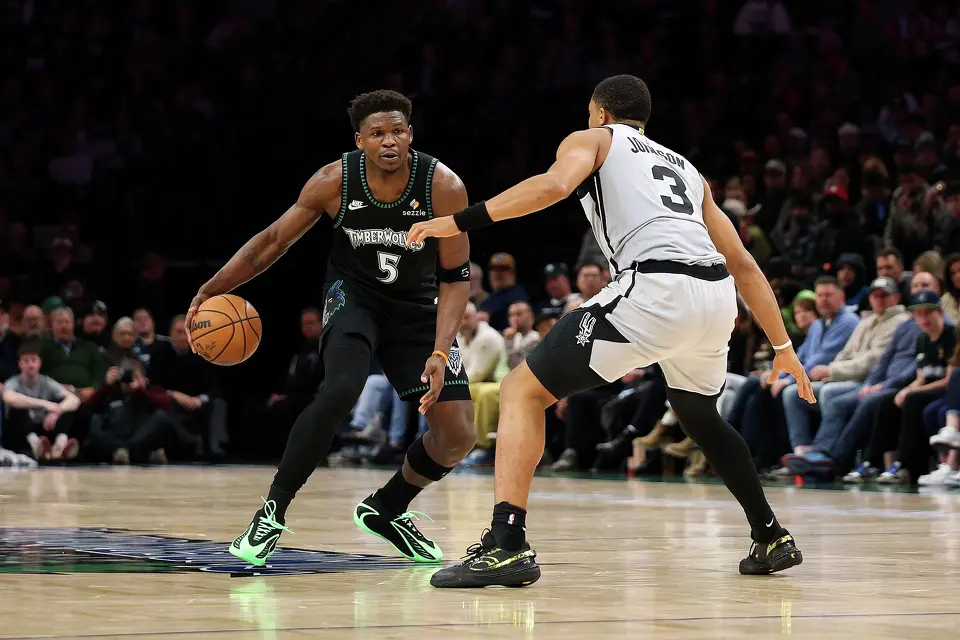
Anthony Edwards (5) of the Minnesota Timberwolves dribbles the ball against Keldon Johnson (3) of the San Antonio Spurs in the third quarter at Target Center on Sunday, Nov. 30, 2025, in Minneapolis. The Timberwolves defeated the Spurs 125-112. (David Berding/Getty Images/TNS)
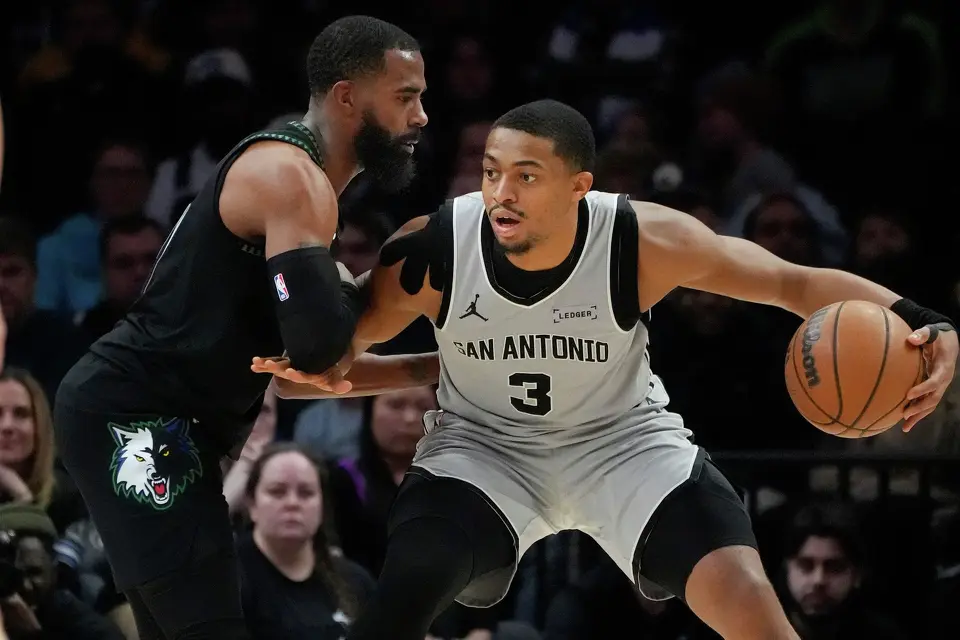
San Antonio Spurs forward Keldon Johnson (3) works around Minnesota Timberwolves guard Mike Conley, left, in the first quarter of an NBA basketball game, Sunday, Nov. 30, 2025, in Minneapolis. (AP Photo/Bruce Kluckhohn)
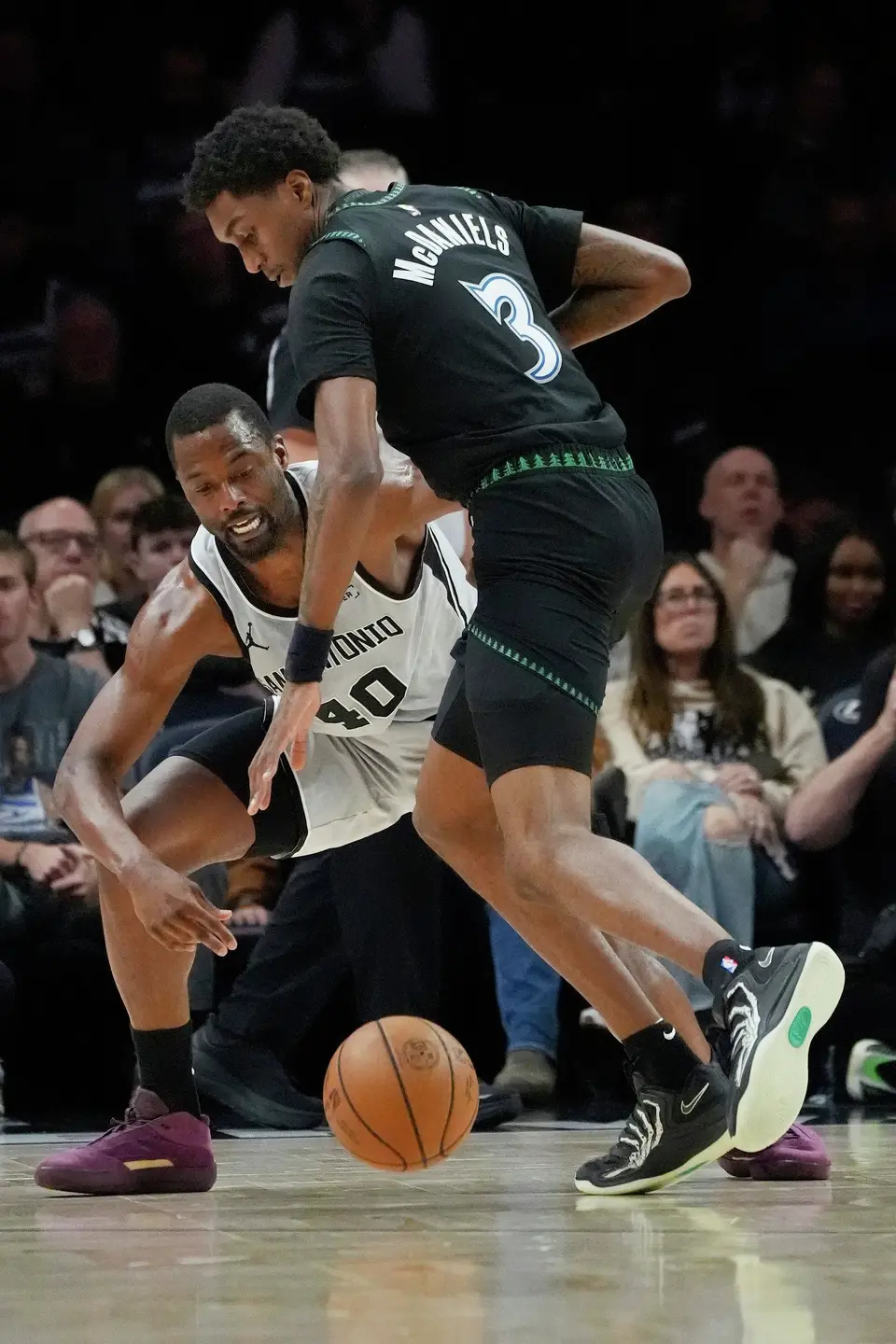
Minnesota Timberwolves forward Jaden McDaniels, right, steals the ball from against San Antonio Spurs forward Harrison Barnes (40) in the first quarter of an NBA basketball game, Sunday, Nov. 30, 2025, in Minneapolis. (AP Photo/Bruce Kluckhohn)
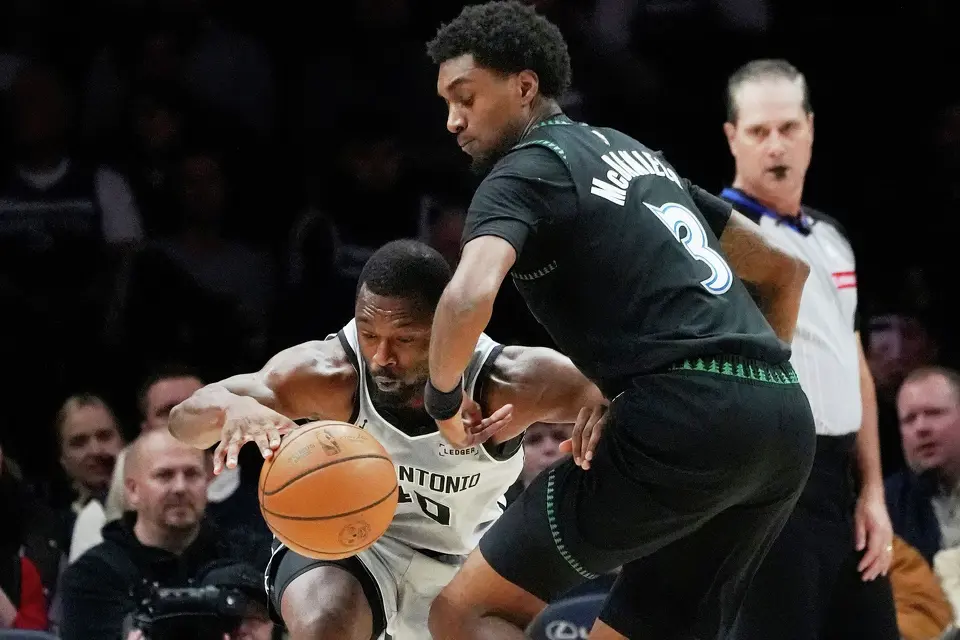
Minnesota Timberwolves forward Jaden McDaniels, right, defends against San Antonio Spurs forward Harrison Barnes (40) in the first quarter of an NBA basketball game Sunday, Nov. 30, 2025, in Minneapolis. (AP Photo/Bruce Kluckhohn)
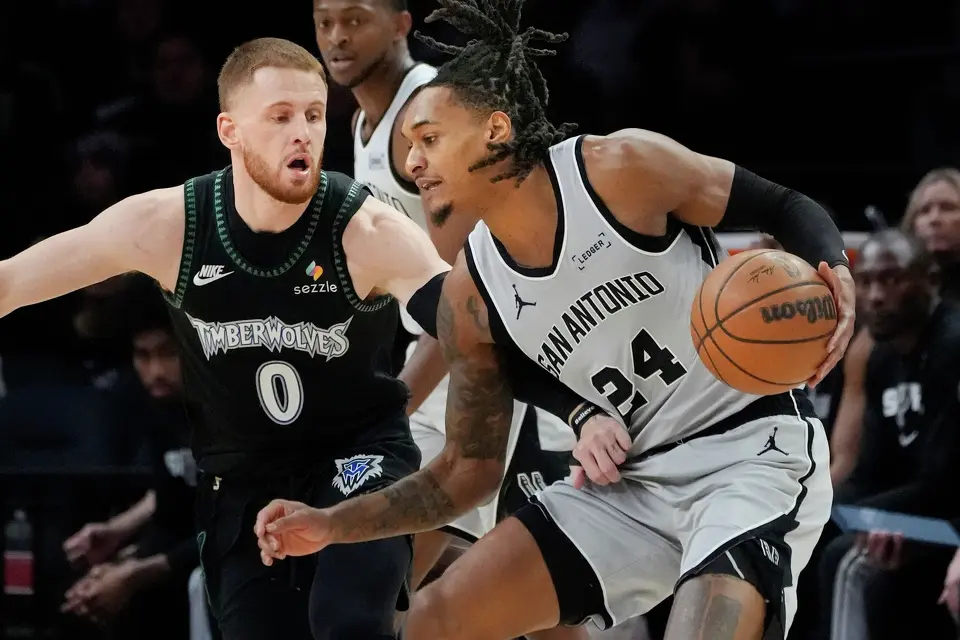
San Antonio Spurs guard Devin Vassell (24) works around Minnesota Timberwolves guard Donte DiVincenzo (0) in the first quarter of an NBA basketball game Sunday, Nov. 30, 2025, in Minneapolis. (AP Photo/Bruce Kluckhohn)
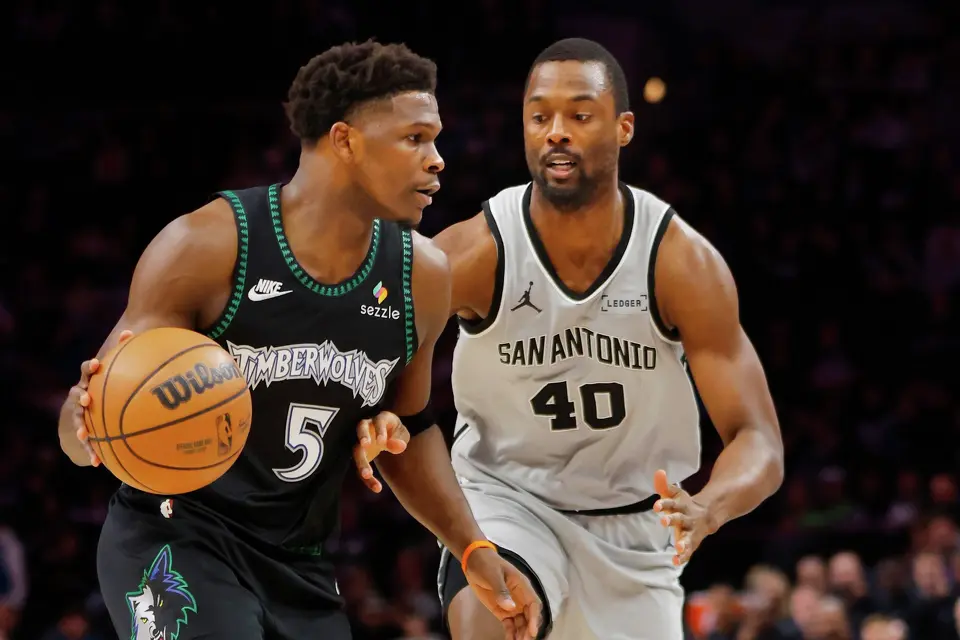
Minnesota Timberwolves guard Anthony Edwards (5) works around San Antonio Spurs forward Harrison Barnes (40) in the first quarter of an NBA basketball game Sunday, Nov. 30, 2025, in Minneapolis. (AP Photo/Bruce Kluckhohn)
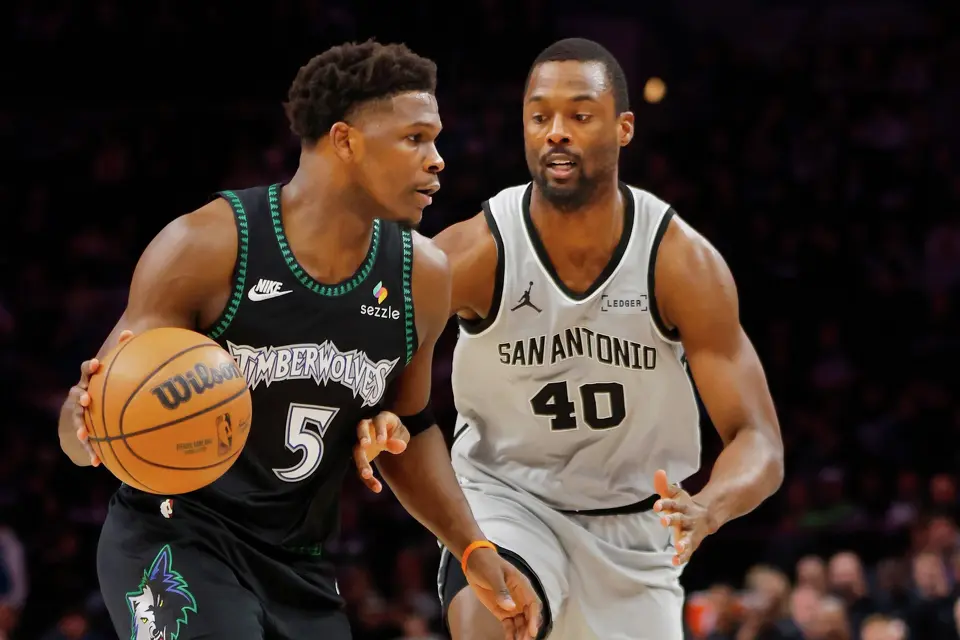
Anthony Edwards (5), escolta de los Timberwolves de Minnesota, se mueve alrededor de Harrison Barnes (40), alero de los Spurs de San Antonio, en el primer cuarto de un juego de baloncesto de la NBA el domingo 30 de noviembre de 2025, en Mineápolis. (AP Photo/Bruce Kluckhohn)
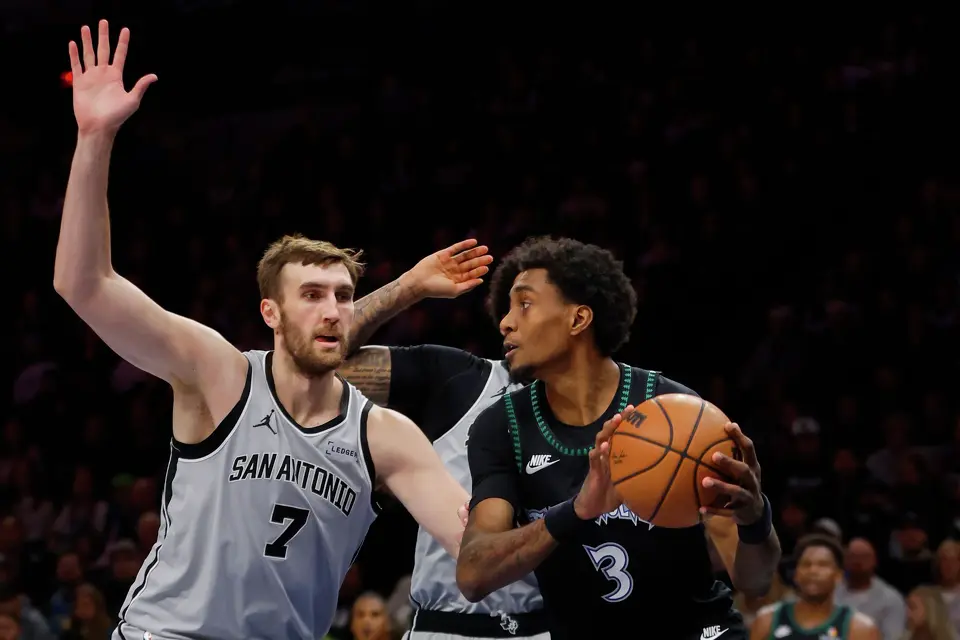
Minnesota Timberwolves forward Jaden McDaniels (3) works around San Antonio Spurs center Luke Kornet (7) in the first quarter of an NBA basketball game Sunday, Nov. 30, 2025, in Minneapolis. (AP Photo/Bruce Kluckhohn)
由生成式 AI 翻译,译文内容可能不准确或不完整,以原文为准。
点击查看原文:Spurs' 3-point defense collapses in fourth vs. Timberwolves
Spurs’ 3-point defense collapses in fourth vs. Timberwolves
When it came to a game plan for defending the Minnesota Timberwolves and All-Star guard Anthony Edwards on Sunday, the Spurs faced a pair of unsavory options.
“Are we going to let someone go for 30 and have their way?” Spurs guard Dylan Harper said. “Or are we going to try to make other guys beat us?”
Ultimately, the Spurs chose a third, even less savory option: Neither.
Edwards scored 32 points in Minnesota’s 125-112 victory at the Target Center. His teammates, meanwhile, went ballistic from 3-point range in the fourth quarter to seize a game the Spurs had controlled through three quarters.
Minnesota made 17 of 37 3-pointers overall, going 7 of 8 in the final frame.
“They hit some threes coming down the stretch,” Spurs forward Keldon Johnson said. “That was the name of the game.”
In doing so, the Timberwolves exploited a weak spot in what has otherwise been a solid Spurs’ defense this season.
The Spurs entered their just-completed four-game road trip boasting a top-10 defense, but slipped to 13th after allowing 136 points in a win at Denver coupled with Sunday’s loss in Minnesota.
Their 3-point defense, meanwhile, has consistently ranked among the worst in the league.
Heading into Tuesday’s game against Memphis at the Frost Bank Center, the Spurs are allowing opponents to shoot 38.9% from beyond the arc. Only Charlotte and Brooklyn are giving up a higher percentage.
The Spurs are surrendering 14.4 made 3-pointers per game. Only five teams allow more.
It has been the scourge of the Spurs’ otherwise impressive 13-6 start to the season.
“It’s something we’ve got to clean up,” Keldon Johnson said.
The eventual return of Victor Wembanyama and/or Stephon Castle from the injured list will help. The Spurs would prefer not to be the NBA’s gift that keeps on giving from the 3-point stripe in the meantime.
When it comes to preventing an opposing team’s 3-point free-for-all, a range of factors come into play.
Individual defenders have to keep their man in front of them. In the event that does not happen, teammates have to rotate in lockstep to fill the breach.
When an opposing player proves too difficult to defend one-on-one – an All-Star like Edwards, for example – defenses often bring a double-team.
In that instance, communication becomes critical between individual defenders.
All of that broke down against the Timberwolves.
Coach Mitch Johnson chooses to focus on the final part of the equation – what happens when a shooter at last rises for a shot.
“We really try to challenge ourselves at closing out a little harder,” Johnson said. “There’s a lot of little stuff that goes into it, in terms of lack of communication or miscommunication. The biggest thing for us is I think our closeouts at times can be more aggressive.”
Johnson acknowledges NBA rules can make contesting a 3-point shooter as dicey as a tightrope walk.
Get too close to a shooter’s landing zone, and a foul call is almost automatic.
Still, the quality of shot-making across the league has gotten to the point that even role players can turn a game from deep, Mitch Johnson said.
“So your closeouts and your presence on the basketball defensively has to be there,” he said. “Or anybody can go make three, four, five, six 3s.”
The Spurs learned that firsthand in the opening moments of the fourth quarter in Minnesota.
To that point, the Spurs had led the game much of the night, and carried a 93-89 edge into the final frame. Then the Timberwolves’ snipers went sniping.
Minnesota made five 3-pointers in first 5 ½ minutes of the frame – two by Naz Reid, two by Donte DiVincenzo and one by Mike Conley – to shoot its way into the lead.
In all, DiVincenzo made four 3-pointers on his way to 18 points. Edwards knocked down four of his own. Reid made three.
The Wolves’ seven 3-pointers in the fourth quarter were one fewer than the Spurs made the entire game.
As Minnesota went nuclear, the Spurs went 1-of-8 from beyond the arc in the fourth, giving up an 18-point deficit from the 3-point line in the final frame. By the time the smoke cleared, the Timberwolves had pushed ahead by 18 points.
Mitch Johnson saw the warning signs blinking in the third quarter, when the Spurs’ forced zero turnovers.
“The activity, resistance and togetherness defensively was really poor,” Johnson said. “We just didn’t have that level of presence on or off the basketball. Then they start making shots, and it’s going to be tough to try and slow them down.”
The Spurs’ troubles started with Edwards, who made 13 of 18 attempts en route to his fifth consecutive 30-point game.
When the Spurs brought finally double teams in the fourth quarter, Edwards moved the ball to other teammates. Those teammates made the Spurs pay from deep.
“It’s like you’ve got to pick your poison,” Harper said.
Against Minnesota, the Spurs found an option that really didn’t work.
They chose both poisons.
By Jeff McDonald, Staff Writer, via San Antonio Express-News