By Madison Iszler, Staff Writer | San Antonio Express-News (SAEN), 2024-11-21 10:30:13
由生成式 AI 翻译,译文内容可能不准确或不完整,以原文为准。
围绕一个大型体育娱乐区的数十亿美元改造市中心计划,经过一年多的闭门讨论后即将公开。
在本周上午与市议会举行会议,概述该计划的要点之前,官员们与《圣安东尼奥快报新闻》讨论了该项目。尽管许多关键问题仍然存在,但他们表示,这项工作将是“变革性的”——并将确保圣安东尼奥马刺队(the Spurs)的未来。
官员们设想为这支NBA球队建造一座新的市中心球馆,一个更大的亨利·B·冈萨雷斯会议中心,一个翻新的阿拉莫巨蛋体育场,另一家会议中心酒店,以及将前约翰·H·伍德二世联邦法院改造成一个活动场所。这些设施周围可能环绕着公寓、餐厅、商店和公园,以及新的街道,并且可能还会有一座跨越37号州际公路的陆桥,将东区与该区域连接起来。
马刺队球馆——以及阻止这支NBA球队前往更赚钱的城市,并带走一代天才维克托·文班亚马(Victor Wembanyama)——是这项庞大计划的关键,该计划将在市中心东南角展开。
“我要把悄悄话大声说出来。如果有人认为2032年之后马刺队还会在弗罗斯特银行中心打球,我认为他们错了,”市长罗恩·尼伦伯格谈到球队目前的主场时说道。“他们的市场价值翻了三倍。他们拥有地球上最重要的NBA球员。全国每个城市都希望拥有马刺队。我们正在努力做的,我相信也是马刺队想要的,那就是留在圣安东尼奥,并拥有一个长期的愿景。”
市政府官员一直在与马刺体育娱乐公司的管理人员、顾问、建筑师、开发商、银行家和律师讨论这些项目的可行性。他们要求许多人签署保密协议,以讨论“奇迹计划”——这是他们对该地区的代号。
“这是一个改善我们市中心的机会,实现更广阔的愿景,我对圣安东尼奥的变革性愿景,我相信这将改变我们城市的格局,”尼伦伯格说。
预算多少?
市政府官员表示,成本和资金来源尚不清楚,但支付方式可能包括一般责任债券、酒店入住税、税收增量再投资区增加的财产税收入、税收抵免、私人开发以及与州政府从酒店获得的收入份额相关的融资区,市经理埃里克·沃尔什说道。该市已经使用296万美元的联邦拨款来启动将东区与市中心连接起来的项目。
沃尔什表示,纳税人也可能需要支付基础设施的费用。
在《圣安东尼奥快报新闻》通过公共记录请求获得的2023年6月的电子邮件中,助理市经理洛里·休斯顿写道,该地区可能耗资30亿至40亿美元。本周,她淡化了这个价格标签的准确性,称该市尚未确定具体数字。
“我不是工程师,”休斯顿说。“我不知道我到底在说什么。它可能低于或高于40亿美元——我们不知道。我们仍在研究成本估算。”
在早期讨论中,马刺体育娱乐公司的高管们估计仅球馆一项就可能耗资12亿美元,但沃尔什表示,他们正在修改这个价格标签。马刺队官员拒绝在周四的市议会会议之前发表评论。
场地规划显示,市属设施周围约有61.9英亩的土地可用于混合用途开发,包括计划中的马刺队球馆附近的现德克萨斯文化研究所所在地,以及环绕阿拉莫巨蛋体育场的大片停车场。市政府或马刺体育娱乐公司可能会就球馆周围地块的开发发出招标书。
这些项目可能需要5到15年的时间才能完成,并且将分阶段进行。沃尔什表示,将会议中心扩建至多17.5万平方英尺是目前进展最快的部分。
“这与我们的经济直接相关。我们有记录表明我们已经错失了一些业务,也有记录表明我们可以获得一些业务,”他说。“奥斯汀和达拉斯将在未来几年处于亏损状态,我们需要尽可能多地争取(业务)。”
在市中心另一端为圣安东尼奥传教士队建造一个新棒球场并围绕其进行私人开发的计划与“奇迹计划”无关。消息人士去年表示,沃尔什劝阻这支小联盟球队的老板不要将德克萨斯文化研究所的所在地作为球场的选址。相反,它将建在圣佩德罗溪文化公园附近。
分享秘密
今天上午,市政府工作人员将就“奇迹计划”项目征求市议会的意见,并着手与马刺体育娱乐公司以及拥有弗罗斯特银行中心的贝克萨尔县就球馆的谅解备忘录开展工作。
他们还将开始征求居民的意见,这有助于衡量选民对资助球馆或其他项目的意愿,如果市政府或马刺队最终将提案提交投票表决的话。
一些消息人士推测,官员们可能着眼于2025年5月的投票,但目前尚不清楚这是否可行。
本周,沃尔什暗示这可能为时过早。他说,他与堪萨斯城的同行进行了交谈,在那里,选民在4月份以压倒性多数否决了一项销售税措施,该措施原本可以帮助支付箭头体育场和市中心棒球场的翻新费用。
“失败的原因有很多,但其中一个原因是球队、市政府,以及在本例中还有县政府,无法解释其影响是什么,社区利益是什么,”沃尔什说。“这无疑将是市长和市议员们要问的问题,我们将不得不经历这个过程。”
市政府官员表示,体育娱乐中心的计划源于几个因素。
项目的起源
奥斯汀和达拉斯的会议中心正在进行长达数年的改造,圣安东尼奥的旅游业领导者正试图从原本会在那里举行的会议中抢夺业务。
沃尔什表示,如果圣安东尼奥市想要继续吸引大型活动,其会议中心也必须保持竞争力。近年来,由于会议中心规模不够大,该市已经错失了超过5.25亿美元的收入,据圣安东尼奥旅游局(一个向会议策划者和旅行者推销该市的公私组织)称。
还有建成已有30年的阿拉莫巨蛋体育场,以体育娱乐行业的标准来看,它已经老旧了。
它的技术和照明已经过时,并且缺乏一些音乐会观众和体育迷们期望的超现代化设施。市政府官员表示,由于考虑到该设施的不足,美国全国大学生体育协会放弃了在圣安东尼奥举办2031年男子篮球四强赛,而选择了更新的场馆。
“我们必须为巨蛋体育场打扮一番。每次我们举办四强赛时,我们都会在建筑物上投入5000万美元并更新套房,”沃尔什说。
然后是振兴半球公园的总体规划,半球公园是1968年世界博览会的举办地,沃尔什表示,它的“发展速度极其缓慢”。
圣安东尼奥德克萨斯大学也在扩大其在市中心的占地面积,大学领导人与市政府接洽,商讨如何处理位于德克萨斯馆的德克萨斯文化研究所,他说。它所占用的土地是预计建造马刺队球馆的地方。
“如果我们要在半球公园做些什么,我们想要那个街角的地,”沃尔什说。“那是宝贵的财产。那是通往会议中心后方、美洲之塔的入口。”
2022年,该市通过与联邦政府的土地交换,获得了半球公园的圆形前法院和弧形的阿德里安·A·斯皮尔斯司法培训中心。它还试图从联邦政府手中获得法院旁边的一栋办公楼和东塞萨尔·E·查韦斯大道对面的一块停车场。
效果图描绘了一座新的会议中心酒店,它将建在东市场街和东商业街之间的地块上,该地块部分被圣安东尼奥供水系统冷却厂占据。它可以建在该市从海特公司收购的拥有1003间客房的君悦酒店对面,包括1000间客房、5万平方英尺的宴会厅和会议空间、2.6万平方英尺的餐厅和商店、1040个停车位和2万平方英尺的圣安东尼奥德克萨斯大学酒店管理学院。
沃尔什表示,休闲旅客正在君悦酒店预订更多房间,而举办会议的协会越来越难以预订支持会议业务所需的大量房间。
弗罗斯特银行中心的未来
弗罗斯特银行中心位于会议中心以东约三英里,马刺队从县政府租用了该中心,租期至2032年。
这是球队效力的第三个球馆。马刺队从1973年到1993年在半球公园球馆比赛,该设施最终被拆除,并在1993年搬到了阿拉莫巨蛋体育场。该巨蛋是为了吸引NFL球队而建造的,对于NBA比赛来说太大了,这促使马刺队在2002年离开,搬到了现在的弗罗斯特银行中心。
居民和企业主希望该球馆能带动周边社区的繁荣,但这从未实现。房价飙升,越来越多的投资者正在翻新和转售房产,但几乎没有新的开发项目出现。参加马刺队比赛和其他活动的人通常开车进去,停车,然后在终场哨响后离开。
目前尚不清楚,如果其主要租户离开,弗罗斯特银行中心会发生什么——而且该设施与阿拉莫巨蛋体育场在活动方面的竞争可能会加剧。
“这是一个真正的问题,”沃尔什说。
县法官彼得·萨凯表示,除非弗罗斯特银行中心的未来以及如何重新开发其周边地区成为讨论的一部分,否则他不会签署与市政府和马刺队的谅解备忘录。
“我们必须弄清楚弗罗斯特中心在娱乐业中扮演什么角色,如果有的话,”他说。“我想向公众明确表示,如果圣安东尼奥市和圣安东尼奥马刺队计划为马刺队建造一个新的场馆,我们确实需要弄清楚他们的战略计划是什么。”
萨凯表示,他还没有收到市政府官员关于“奇迹计划”的简报,但他知道关于马刺队可能搬到市中心的讨论一直在进行。现在提供有关弗罗斯特银行中心的潜在用途以及附近可能建造什么的具体信息还为时过早,包括在毗邻该设施的市属柳泉高尔夫球场,萨凯说。
尼伦伯格表示,马刺队的高管告诉他,除非新球馆是更大体育娱乐中心的一部分,否则他们对搬到市中心的新球馆不感兴趣。
他还表示,市政府官员并没有将球馆宣传为就业引擎。
“我们不认为球馆是一种经济发展引擎,”尼伦伯格说。
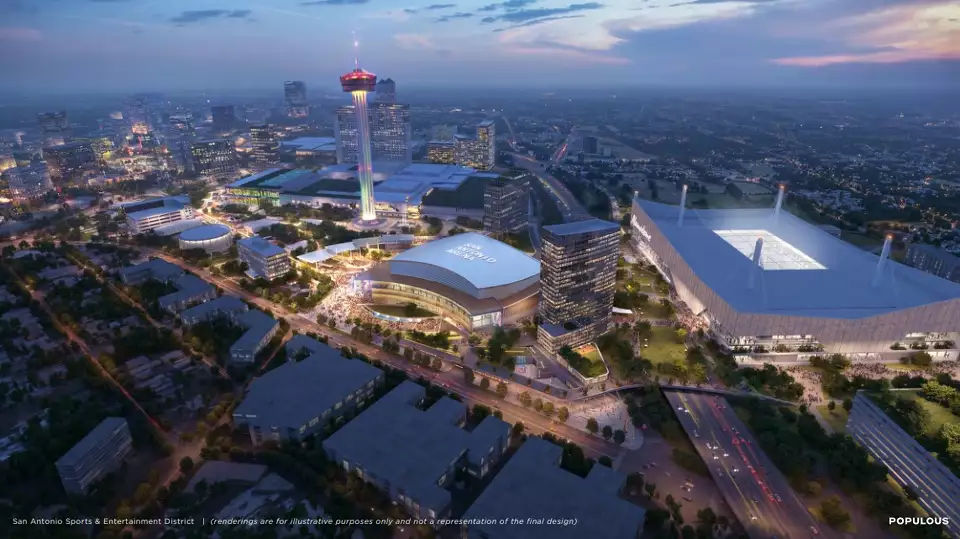
A rendering gives a first look at what a downtown sports and entertainment district could look like. It could involve a new arena for the Spurs, renovated Alamodome, an expanded Henry B. González Convention Center, another Convention Center hotel with a hospitality school for the University of Texas at San Antonio and the John H. Wood Jr. Federal Courthouse refashioned as an event venue as well as mixed-use development and parks between the facilities.
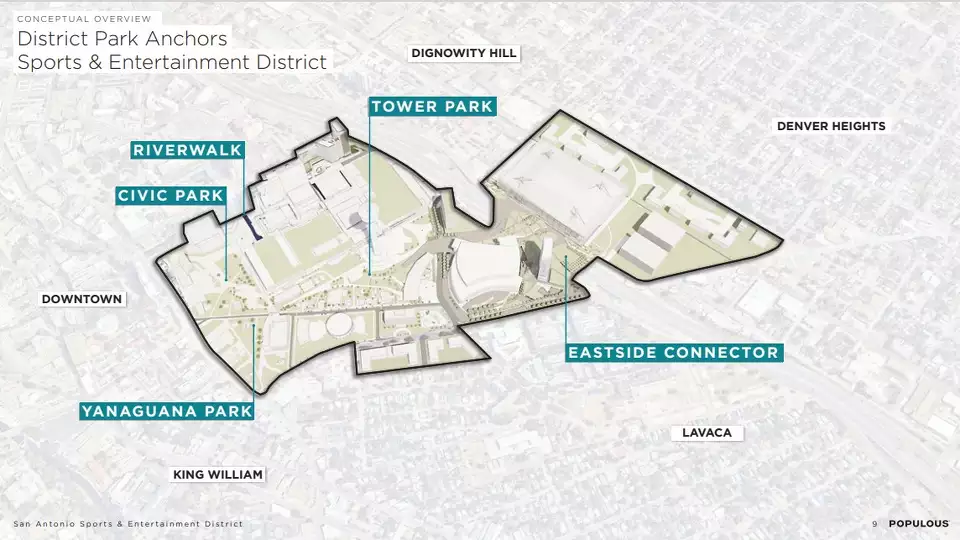
A map shows parks at Hemisfair, including the yet-to-be-built Tower Park, and a land bridge connecting the East Side to the area.
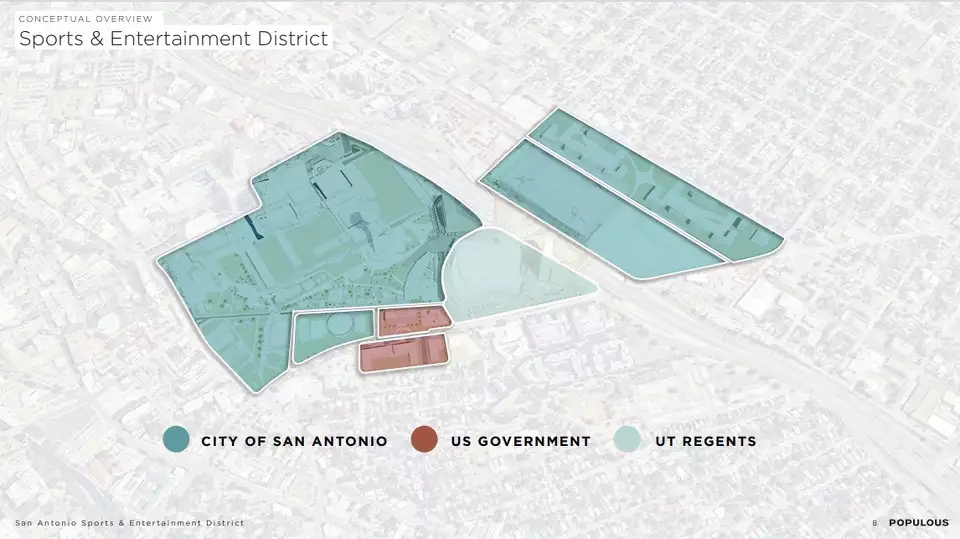
A map shows land owned by the city of San Antonio and land it is seeking to acquire from the federal government. The map also shows the Institute of Texan Cultures site, which the city has the option to lease or buy from the University of Texas at San Antonio.
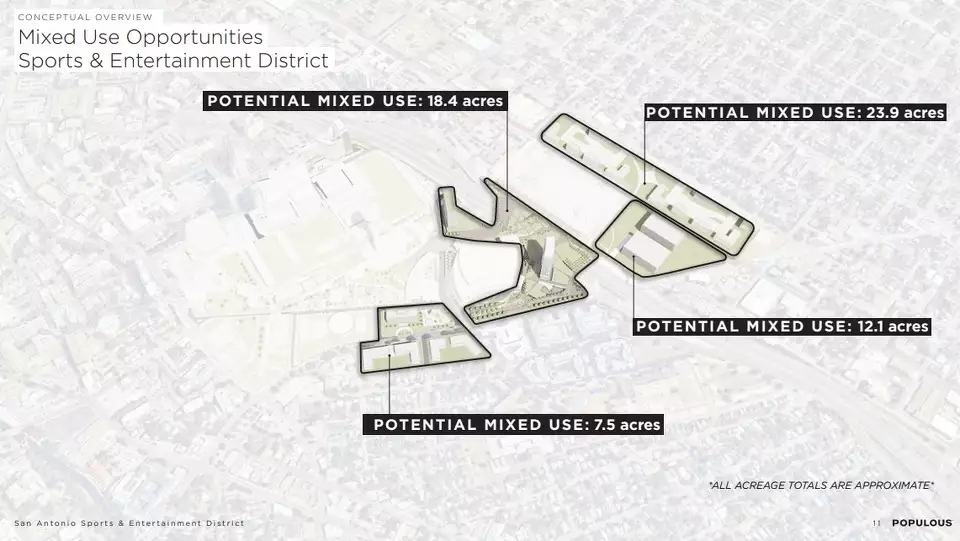
A map shows property that could be used for mixed-use development such as apartments, stores and restaurants.
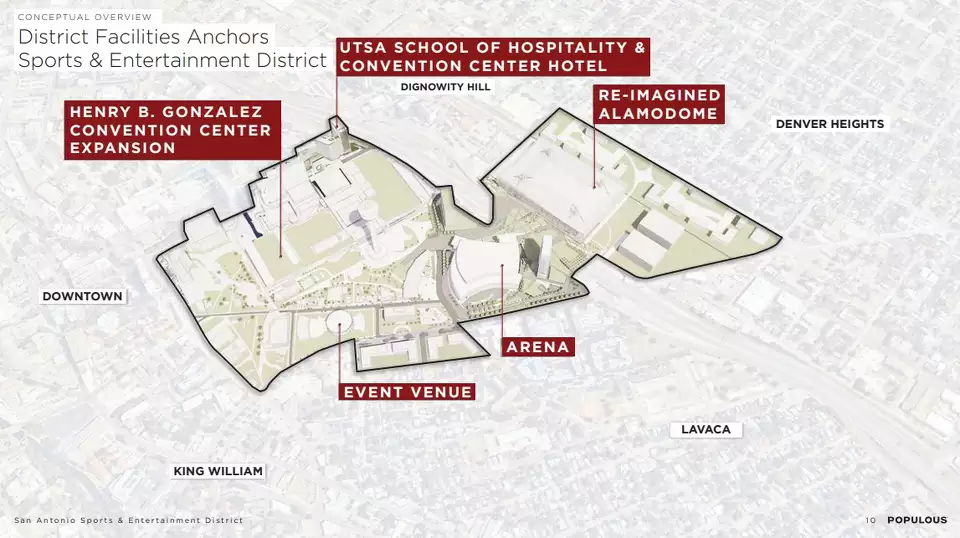
A map shows various components of the sports and entertainment district that city officials envision downtown, including a Spurs arena, a renovated Alamodome, an expanded Henry B. González Convention Center, another Convention Center hotel with a hospitality school for the University of Texas at San Antonio and the John H. Wood Jr. Federal Courthouse refashioned as an event venue.
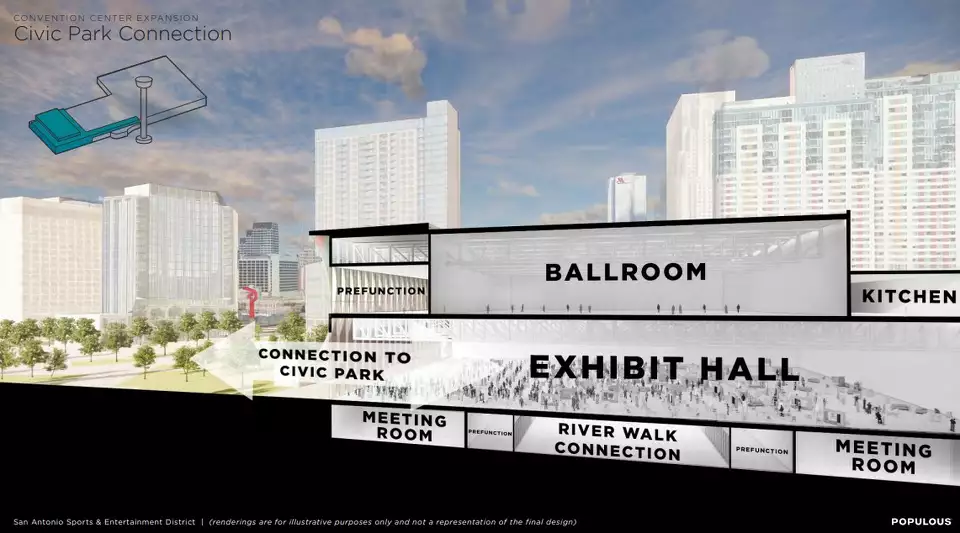
A rendering shows an expanded Henry B. González Convention Center connected to Civic Park at Hemisfair.
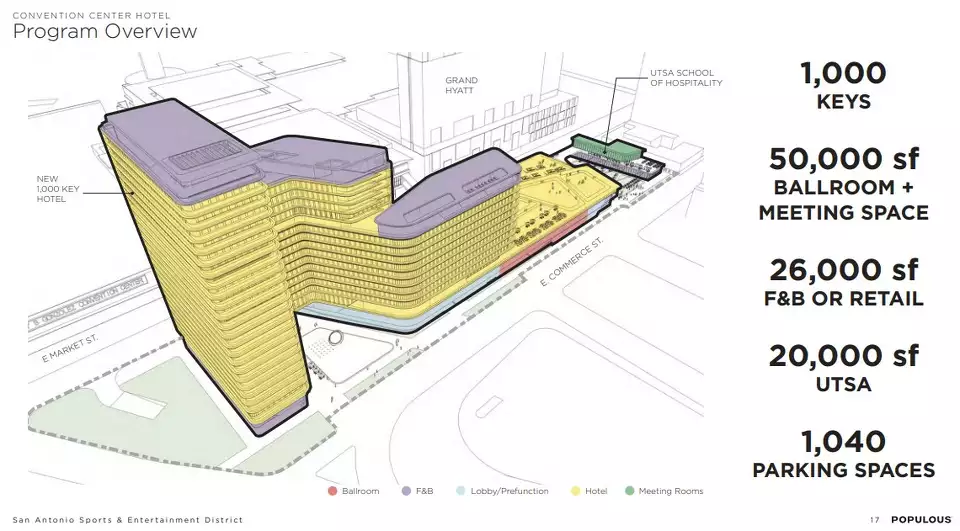
A rendering shows a second hotel for conferences at the Henry B. González Convention Center. The Grand Hyatt is attached to the Convention Center.
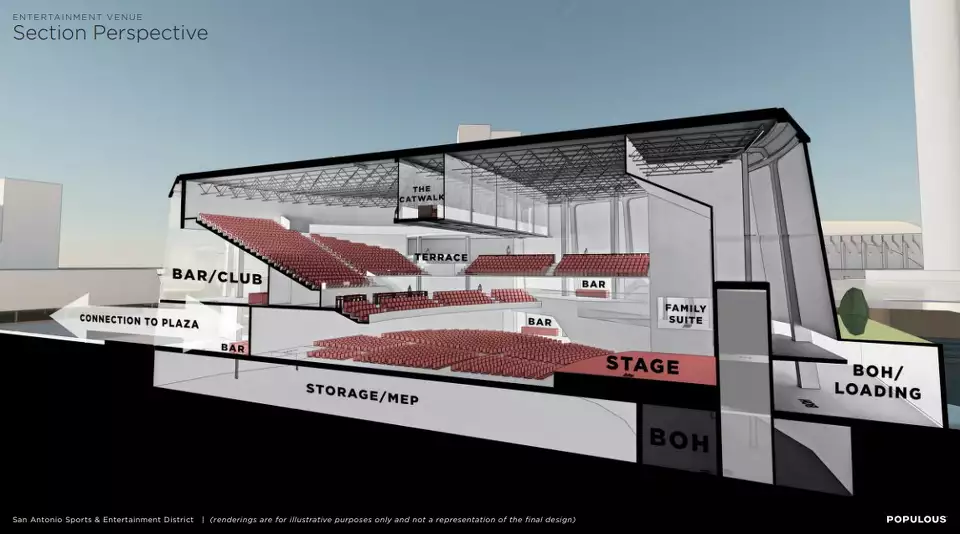
A rendering shows the John H. Wood Jr. Federal Courthouse refashioned as an event venue.
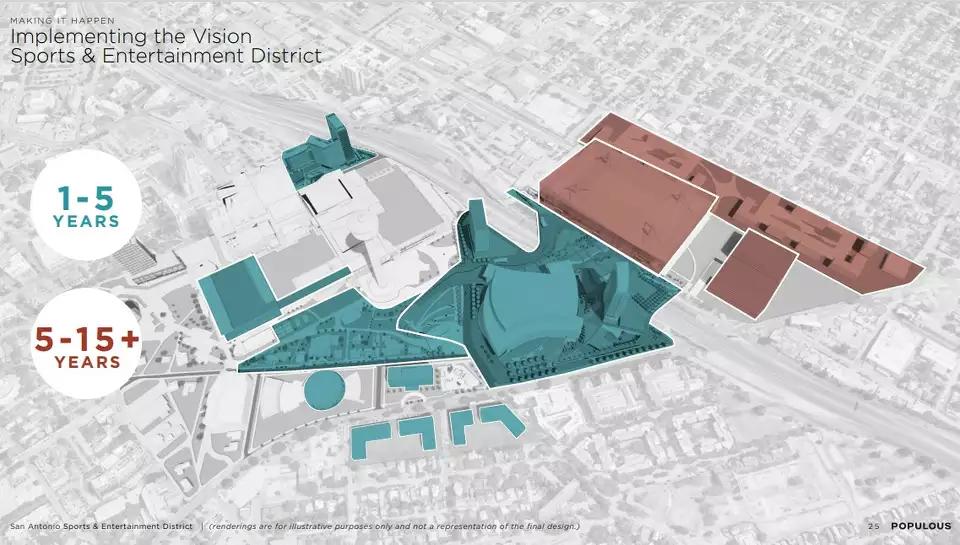
Completing all of the projects that would be part of the sports and entertainment district is expected to take five to 15 years.
点击查看原文:Details of Spurs-anchored San Antonio sports, entertainment hub
Details of Spurs-anchored San Antonio sports, entertainment hub
A multi-billion dollar plan to reshape downtown around a massive sports and entertainment district is about to become public after more than a year of closed-door discussions.
Ahead of laying out the broad strokes this morning in a meeting with City Council, officials this week discussed the project with the San Antonio Express-News. Though many key questions remain, they said the effort would be “transformative” — and secure a San Antonio future for the Spurs.
Officials envision a new downtown arena for the NBA team, a bigger Henry B. González Convention Center, a renovated Alamodome, another Convention Center hotel and the former John H. Wood Jr. Federal Courthouse being refashioned as an event venue. The facilities could be surrounded by apartments, restaurants, stores and parks as well as new streets and, potentially, a land bridge over Interstate 37 connecting the East Side to the area.
The Spurs arena — and heading off the specter of the NBA team leaving for more lucrative pastures and taking along generational talent Victor Wembanyama — is the linchpin of the sprawling undertaking that would unfold in the southeast corner of downtown.
“I’ll say the quiet part out loud. If anybody thinks post 2032 that the Spurs will be playing in the Frost Bank Center, I think they’re mistaken,” Mayor Ron Nirenberg said of the team’s current home. “Their market value’s tripled. They have the most important NBA franchise player in the planet on their roster. Every city in the country would love to have the Spurs. What we’re trying to do is what I believe the Spurs want also, which is to stay in San Antonio and have a long-term vision.”
City officials have been talking to executives at Spurs Sports & Entertainment, consultants, architects, developers, bankers and lawyers about the feasibility of the projects. They’ve required many of them to sign non-disclosure agreements to discuss “Project Marvel,” their code name for the district.
“This is an opportunity to improve our downtown, to realize a broader vision, that transformative vision for San Antonio that I believe will be a game changer for our city,” Nirenberg said.
How much?
Costs and financing sources are unknown, city officials said, though options to pay for it could include general obligation bonds, hotel occupancy taxes, increases in property tax revenue from a tax increment reinvestment zone, tax credits, private development and a financing zone tied to the state’s share of revenue from hotels, City Manager Erik Walsh said. The city already is using a $2.96 million federal grant to kick-start an effort to connect the East Side to downtown.
Taxpayers will also likely foot the bill for the infrastructure, Walsh said.
In June 2023 emails the San Antonio Express-News obtained through a public records request, Assistant City Manager Lori Houston wrote that the district could cost from $3 billion to $4 billion. She downplayed the accuracy of that price tag this week, saying the city has yet to determine figures.
“I’m not an engineer,” Houston said. “I don’t know what the hell I’m talking about. It could be less or more than $4 billion — we don’t know. We’re still looking at the cost estimates.”
In early discussions, Spurs Sports & Entertainment executives estimated an arena alone could cost $1.2 billion, but Walsh said they’re revising that price tag. Spurs officials declined to comment before Thursday’s City Council meeting.
Site plans show about 61.9 acres of land around the city-owned facilities that could be devoted to mixed-use development, including swaths near the planned Spurs arena at the site of the current Institute of Texan Cultures and the sea of parking lots ensconcing the Alamodome. The city or Spurs Sports & Entertainment could put out a request for proposals for development on the parcels around the arena.
The projects would likely take from five to 15 years to complete and be built in stages. Expanding the Convention Center by as much as 175,000 square feet is the component that’s furthest along, Walsh said.
“That’s tied directly to our economy. We’ve got documented business that we’ve lost out on and we’ve got documented business that we could get,” he said. “Austin and Dallas are going to be in the hole for years and we need to scoop up as much (business) as possible.”
Plans for a new ballpark for the Missions surrounded by private development at the other end of downtown are separate from Project Marvel. Sources said last year that Walsh discouraged the minor league team’s owners from pursuing the Institute of Texan Cultures site as a location for the stadium. Instead, it is to be built near San Pedro Creek Culture Park.
Sharing secrets
This morning, city staff will ask City Council for its input on the Project Marvel projects and the go-ahead to work on a memorandum of understanding for an arena with Spurs Sports & Entertainment and Bexar County, which owns the Frost Bank Center.
They’ll also begin asking residents to weigh in, which could help gauge voters’ appetite for helping fund the arena or other projects if the city or the Spurs eventually put a proposal on the ballot.
Some sources have speculated officials could be eyeing the May 2025 ballot but it’s unclear whether that’s in the cards.
This week, Walsh suggested that could be too soon. He said he’s talked to his counterpart in Kansas City, where voters in April resoundingly rejected a sales tax measure that would have helped pay for renovations at Arrowhead Stadium as well as a downtown ballpark.
“There was a number of reasons (why it failed), but one of the reasons was that the teams and the city, and in this case, the county, couldn’t explain what the impact was, what the community benefit was,” Walsh said. “That will undoubtedly be a question that the mayor and council members are going to ask, and we’re going to have to go through that process.”
City officials said the plan for a sports and entertainment hub stemmed from several factors.
Project’s origins
Convention centers in Austin and Dallas are undergoing years-long overhauls and San Antonio’s tourism leaders are trying to snap up business from meetings that would otherwise have been held there.
San Antonio’s Convention Center also must remain competitive if the city wants to continue attracting big events, Walsh said. In recent years, the city has missed out on more than $525 million in revenue from major conferences because the Convention Center isn’t big enough, according to Visit San Antonio, the public-private organization that markets the city to convention planners and travelers.
There’s also the 30-year-old Alamodome, which is old by the standards of the sports and entertainment industry.
Its technology and lighting are outdated and it lacks some of the ultra-modern amenities concertgoers and sports fans have come to expect. In a decision reflecting the facility’s shortcomings, the National Collegiate Athletic Association passed over San Antonio to host the 2031 Men’s Final Four college basketball tournament in favor of newer arenas, city officials said.
“We have to put lipstick on the dome. Every time we get the Final Four, we go drop $50 million in the building and update suites,” Walsh said.
Then there’s the master plan for revitalizing Hemisfair, the site of the 1968 World’s Fair, which has been “developing at a snail’s pace,” Walsh said.
The University of Texas at San Antonio is also expanding its footprint downtown, and university leaders approached the city about figuring out what to do with the Institute of Texan Cultures, which occupies the Texas Pavilion building, he said. The land it occupies is where the Spurs arena is expected to be built.
“If we’re going to look at doing something in Hemisfair, we want that corner lot,” Walsh said. “That’s valuable property. That’s an entryway into the back end of the Convention Center, the Tower (of the Americas).”
In February, the University of Texas board of regents conditionally approved a proposal for UTSA to lease or sell the land to the city. University leaders plan to demolish the Texas Pavilion building and build a new home for the Institute of Texan Cultures either near the Alamo or other downtown property.
The city acquired the round former courthouse and curved Adrian A. Spears Judicial Training Center at Hemisfair in 2022 in a land swap with the federal government. It is seeking to get an office building next to the courthouse and a parking lot across East César E. Chávez Boulevard from the feds as well.
Renderings depict a new Convention Center hotel rising between East Market and East Commerce streets on property partially occupied by a San Antonio Water System cooling plant. It could be built across from the 1,003-room Grand Hyatt the city is acquiring from Hyatt Corp., and encompass 1,000 rooms, 50,000 square feet of ballroom and meeting space, 26,000 square feet of restaurants and stores, 1,040 parking spaces and 20,000 square feet for a school of hospitality for UTSA.
Walsh said leisure travelers are taking more rooms at the Grand Hyatt and it’s become harder for associations holding conferences to book large blocks of rooms needed to support convention business.
Frost Bank Center future
About three miles east of the Convention Center sits the Frost Bank Center, which the Spurs are leasing from the county through 2032.
It’s the third arena the team has played in. The Spurs played at HemisFair Arena from 1973 to 1993, a facility that was eventually razed, and moved to the Alamodome in 1993. The dome was built to attract an NFL team and was too big for NBA games, prompting the Spurs to leave in 2002 for what’s now the Frost Bank Center.
Residents and business owners hoped the arena would spark a boom in the neighborhoods around it, but that never materialized. Home prices have soared and more investors are renovating and reselling properties but little new development has risen. People attending Spurs games and other events typically drive in, park, and leave after the final buzzer.
It’s unclear what would happen to the Frost Bank Center if its main tenant leaves — and competition between the facility and the Alamodome for events is likely to intensify.
“That’s a real issue,” Walsh said.
County Judge Peter Sakai said he wouldn’t sign off on the memorandum with the city and the Spurs unless the future of the Frost Bank Center and how the area around it could be redeveloped is part of the discussion.
“We have to figure out what niche, if any, the Frost center will play into the entertainment business,” he said. “I want to make it clear to the public that we really do need to figure out what the city of San Antonio and the San Antonio Spurs are going to do from their strategic plan if they plan to build a new venue for the Spurs.”
Sakai said he hadn’t been briefed on Project Marvel by city officials, but knows conversations about the Spurs potentially moving downtown have been ongoing. It’s too early to provide specifics about potential uses for the Frost Bank Center and what could be built near it, including at the city-owned Willow Springs Golf Course adjacent to the facility, Sakai said.
Nirenberg said Spurs executives have told him they’re not interested in moving to a new arena in the middle of downtown unless it’s part of a larger sports and entertainment hub.
He also said city officials aren’t pitching the arena as an engine for jobs.
“We’re not looking at the possibility of an arena as some sort of economic development generator,” Nirenberg said.
A rendering gives a first look at what a downtown sports and entertainment district could look like. It could involve a new arena for the Spurs, renovated Alamodome, an expanded Henry B. González Convention Center, another Convention Center hotel with a hospitality school for the University of Texas at San Antonio and the John H. Wood Jr. Federal Courthouse refashioned as an event venue as well as mixed-use development and parks between the facilities.
A map shows parks at Hemisfair, including the yet-to-be-built Tower Park, and a land bridge connecting the East Side to the area.
A map shows land owned by the city of San Antonio and land it is seeking to acquire from the federal government. The map also shows the Institute of Texan Cultures site, which the city has the option to lease or buy from the University of Texas at San Antonio.
A map shows property that could be used for mixed-use development such as apartments, stores and restaurants.
A map shows various components of the sports and entertainment district that city officials envision downtown, including a Spurs arena, a renovated Alamodome, an expanded Henry B. González Convention Center, another Convention Center hotel with a hospitality school for the University of Texas at San Antonio and the John H. Wood Jr. Federal Courthouse refashioned as an event venue.
A rendering shows an expanded Henry B. González Convention Center connected to Civic Park at Hemisfair.
A rendering shows a second hotel for conferences at the Henry B. González Convention Center. The Grand Hyatt is attached to the Convention Center.
A rendering shows the John H. Wood Jr. Federal Courthouse refashioned as an event venue.
Completing all of the projects that would be part of the sports and entertainment district is expected to take five to 15 years.
By Madison Iszler, Staff Writer, via San Antonio Express-News