By Tom Orsborn, Staff Writer | San Antonio Express-News (SAEN), 2025-09-15 13:03:51
由生成式 AI 翻译,译文内容可能不准确或不完整,以原文为准。
1957年,维克托·罗德里格斯 (Victor Rodriguez) 面临着一个艰难的抉择。
作为北德州大学历史上首位西班牙裔奖学金运动员及首位获得校队荣誉的西班牙裔成员,罗德里格斯在田径和越野赛场上大放异彩。刚刚结束两年兵役的他,发现自己正面临两份工作邀约,需要权衡利弊。
宝洁公司(Procter & Gamble)对他出色的双语能力印象深刻,希望聘请他到墨西哥城分公司从事公共关系工作,并开出了5500美元的年薪,外加福利和全额费用报销。然而,在他的大姐的敦促下,罗德里格斯也考虑了另一份来自圣安东尼奥独立学区(San Antonio Independent School District)的邀约——一份年薪3000美元的教职,在库珀初中(Cooper Junior High)教导四十多名英语能力有限甚至完全不会英语的拉丁裔六年级学生。
从经济角度看,宝洁公司似乎是理所当然的选择。但罗德里格斯转念一想,作为一名教育工作者,他能为年轻的西班牙裔孩子们的生命带来多么大的改变。
罗德里格斯回忆起自己在埃德纳镇(Edna)一所被当地人称为“墨西哥裔美国人学校”的种族隔离单间校舍里求学的日子,想起了那位无私奉献的小学老师露西尔·林德伯格 (Lucille Lindberg),最终接受了圣安东尼奥独立学区(SAISD)的邀约。
现年93岁的罗德里格斯说道:“我当时就在想,‘如果当初没有她,我今天会身在何方?’”
罗德里格斯决定不忘自己平凡的出身,并以此回报林德伯格,这一选择开启了他在SAISD长达36年的职业生涯。这期间,他于20世纪60年代在拉尼尔(Lanier)高中和高地(Highlands)高中担任越野及田径教练,留下了难忘的执教经历;最终,他从1982年起担任学区总监,开启了历史性的12年任期,直至1994年退休。
本周六,作为2025届入选者之一,罗德里格斯将在亨利·B·冈萨雷斯会议中心(Henry B. Gonzalez Convention Center)正式入驻圣安东尼奥体育名人堂。同期入选的还有查理·博格斯 (Charlie Boggess)、蒂姆·德克 (Tim Derk)、莎伦·诺伊格鲍尔-谢泼德 (Sharon Neugebauer-Shepard) 以及马刺队1999年NBA总冠军阵容。此前,他已分别被北德州大学和SAISD载入史册。
崭露头角,踏上征程
罗德里格斯出生于美国大萧条时期,在德州南部伊内兹(Inez)的一个小型农牧社区长大。他的父亲是一位不识字的佃农,靠着一头骡子拉犁耕种田地;在他年仅4岁时父亲便不幸离世,母亲则靠做家政工人维持生计。罗德里格斯克服了贫困和种族歧视,最终成为德州最受尊敬的教育家之一。
在罗德里格斯于1981年获得德克萨斯大学博士学位并开始执掌SAISD后,该学区的辍学率从50%骤降至不足10%,其教师和其他员工也享受到贝克萨尔县(Bexar County)最优厚的薪资福利待遇。他还努力确保到1986年,学区内的每一所学校都安装了空调。
拉丁裔体育史学家马里奥·朗格利亚 (Mario Longoria) 在评价这位SAISD首位西班牙裔总监、同时也是德州12个最大学区中的首位拉丁裔总监时说:“他是一位极具前瞻性的思想家,谈吐优雅,富有个人魅力。”
“人们对他的尊敬跨越了任何种族界限和人口特征。如果他当年决定竞选市长,他肯定会当选。”
罗德里格斯的破局之路始于休斯顿以西一百英里的埃德纳镇。在那里,他和他的四个姐妹成为了这个小镇上首批从“墨西哥裔美国人学校”四年级升入盎格鲁人学校,并最终进入高中的孩子。
这段不可思议的旅程,始于林德伯格亲自为他挑选了一项重要却又劳累的工作。
这位年轻的老师坚信公民责任感的重要性,她将罗德里格斯推向了通往伟大的道路——委派他每天早上去圣艾格尼丝天主教堂(St. Agnes Catholic Church)敲钟。这项任务要求这个小男孩在凌晨5点赤脚跑上两英里,途中还要躲避狂吠的野狗,只为唤醒埃德纳镇的其他人。
“敲钟人的责任会教会你许多东西,让你终生受益。”林德伯格曾这样告诉罗德里格斯。
这并非她教给他的唯一一堂重要课程。
罗德里格斯说:“林德伯格老师每天都提醒我们,我们生活在世界上最伟大的国家,只要你努力工作,敢于竞争,你就能成为任何你想成为的人。”
在埃德纳高中(Edna High)打过橄榄球、跑过田径后,罗德里格斯帮助维多利亚初级学院(Victoria Junior College)赢得了1952年全国田径锦标赛冠军。他是维多利亚学院第一位签订奖学金的西班牙裔学生,也是第一位获得校队荣誉证书的成员,期间他还赢得了初级学院全国半英里赛的冠军。
1953年,罗德里格斯在全国声名鹊起。在爱荷华州得梅因市(Des Moines)久负盛名的德雷克接力赛(Drake Relays)上,他在40华氏度(约4.4摄氏度)的雨天中,代表北德州大学短跑混合接力队跑第一棒四分之一英里,并赢得了大学组比赛的冠军。1954年,他又作为学校两英里接力队的一员,在劳伦斯(Lawrence)赢得了堪萨斯接力赛(Kansas Relays)的冠军。
“飞翔的L”标志
在北德州大学就读期间——当时全校仅有五名西班牙裔学生——罗德里格斯学习了传奇的“吝啬绿”队(Mean Green)田径教练温顿·“老爹”·诺阿 (Winton “Pop” Noah) 的执教之道。
“我学会了如何控制情绪,如何只管尽力而为,不过分担心结果,”罗德里格斯说,“他也是一位严格的纪律执行者。他不允许抽烟、喝酒或晚归,任何违反规定的人都会受到纪律处分。”
1962年,当罗德里格斯成为拉尼尔高中田径队主教练和校二队橄榄球教练时,已获得北德州大学硕士学位的他,运用了许多诺阿的执教方法。
根据罗德里格斯的自传《敲钟人》(The Bell Ringer)记载,这所位于西区(West Side)的高中曾在传奇教练内莫·埃雷拉 (Nemo Herrera) 的带领下,于1943年和1945年赢得州男子篮球冠军,但此后便鲜有体育方面的建树,甚至被“朋友和对手一致”戏称为“La Garra”(意为“破布”)。
尽管如此,Voks队(拉尼尔高中的昵称)还是培养出了一些优秀的田径运动员,包括1958年州半英里赛冠军理查德·门查卡 (Richard Menchaca)。但即便如此,罗德里格斯仍面临着艰巨的任务。
“当时围绕拉尼尔高中的氛围非常消极,”他说,“我的想法是,我必须先改变他们的思维方式。”
罗德里格斯从要求他的运动员定期理发并“保持整洁的仪容”开始着手改造。
“在那之前,他们都留着鸭尾式发型,”罗德里格斯说,“我告诉他们,‘如果你想成为冠军,你就必须看起来像个冠军。’”
罗德里格斯以身作则,他的弟子们很快就注意到了这一点。
“他看起来就像个运动员,”前拉尼尔高中长跑运动员、现年77岁的理查德·索利斯 (Richard Solis) 说,“我们很佩服他的体格,他的肌肉线条非常分明。”
罗德里格斯还废弃了印有“Lanier”字样的T恤,改用印有“Voks”字样的新队服,队服上还有一个大大的“L”,两侧各有一只翅膀。这个由同时还教授艺术课程的罗德里格斯设计的标志,后来被称为“拉尼尔飞翔的L”(Lanier Flying L)。
在新教练的带领下,Voks队员们的自尊心大增。
“他很早就向我们介绍了积极思考的力量,”曾在21世纪初担任拉尼尔高中校长的索利斯说道。
在罗德里格斯的激励下,Voks越野队在1963年与冠军失之交臂后,于1964年至1966年连续三年赢得城市冠军。1967年,罗德里格斯转至高地高中执教,带领该校猫头鹰队(Owls)在州田径比赛中获得亚军,仅次于休斯顿斯普林布兰奇队(Houston Spring Branch)。
彰显体育精神
无论在哪里执教或教学,罗德里格斯都以林德伯格为榜样,鼓励他的学生追求远超他人期望的教育。他对同为圣安东尼奥名人堂成员的两位后辈产生了深远影响——他鼓励福克斯技术高中(Fox Tech)的田径新星里卡多·罗莫 (Ricardo Romo) 和高地高中的橄榄球与田径明星朱利叶斯·惠蒂尔 (Julius Whittier) 去争取顶尖大学的体育奖学金。
罗莫和惠蒂尔最终都进入了德克萨斯大学。前者成为该校首位在4分钟内跑完一英里的长角牛队(Longhorn)队员,并赢得了1964年NCAA越野赛冠军;后者则成为德州大学历史上第一位获得校队荣誉的黑人橄榄球运动员,并作为成员帮助球队在1970至1972年间连续三次赢得西南联盟(Southwest Conference)冠军。
“他深知上大学的价值,而这在我们的高中里是很少听到的,”曾于1999年至2017年担任德州大学圣安东尼奥分校(UTSA)校长的罗莫说道,“在福克斯技术高中、拉尼尔高中、埃奇伍德(Edgewood)高中,老师们不会鼓励你去考虑上大学,他们鼓励你想想学一门好手艺。”
“但在这方面他很特别。他认为大学教育非常重要,每个人都应该去追求。他热爱教学,热爱与年轻人共事。”
作为学区总监,罗德里格斯以正直、重视问责、诚实和透明而著称,并希望学区内的每一个人都能如此。这些品质在1993年得到了充分体现。当时,爱迪生(Edison)高中和杰斐逊(Jefferson)高中的球员之间发生斗殴,导致比赛在还剩约两分钟时被裁判叫停。事后,罗德里格斯做出了一个极具争议的决定——取消两所学校的橄榄球季后赛资格。
罗德里格斯的决定是在27-5A区执行委员会(由其八所成员学校的校长组成)建议对爱迪生和杰斐逊高中处以一年察看期(从1994-95学年开始)之后做出的。委员会的建议本可以让金熊队(Golden Bears)和野马队(Mustangs)参加1993年的季后赛。
罗德里格斯的裁决登上了全国新闻头条,并标志着管理德州公立学校课外活动的大学校际联盟(University Interscholastic League)历史上,首次有学区总监推翻了自己下属执行委员会的决定。
“作为教练,我学到了一点,你必须教导你的年轻人体育精神和对对手的尊重,”罗德里格斯说,“我们总是说,‘无论输赢,你都要和你的对手握手致意。’”
两所学校的家长和学生都嘲讽他的决定,但罗德里格斯立场坚定,对这场舆论风暴置之不理。而在媒体报道了取消资格的消息后,来自全国各地的电话和信件如潮水般涌入SAISD总部,对这一决定表示赞赏。
罗德里格斯做出了正确的抉择——正如他在1957年选择投身教育事业时一样。
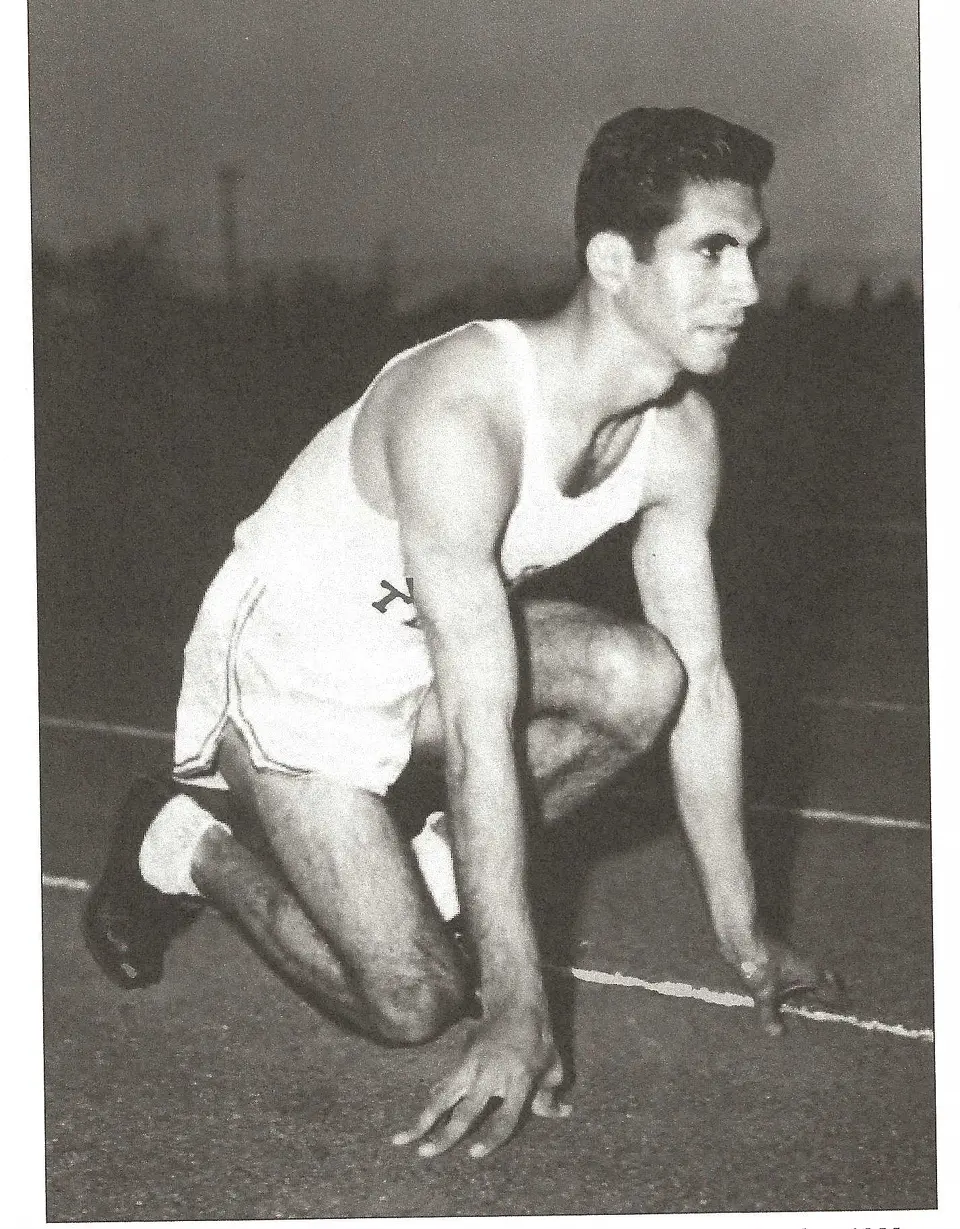
Victor Rodriguez starred at North Texas while running track and cross country from 1952-55 as the school’s first Hispanic scholarship athlete and first Latino letterman.
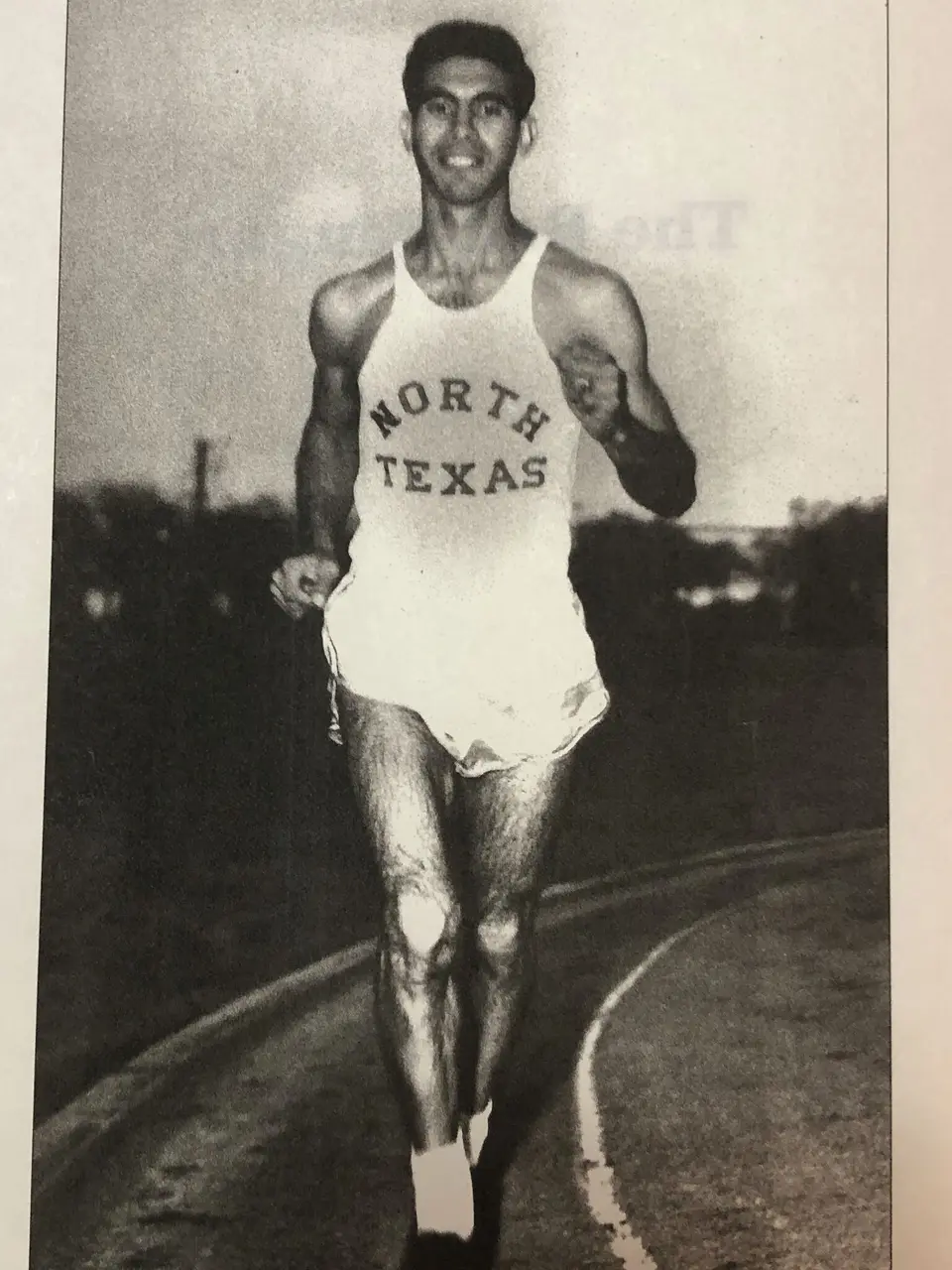
Victor Rodriguez starred at North Texas while running track and cross country from 1952-55 as the school’s first Hispanic scholarship athlete and first Hispanic letterman.
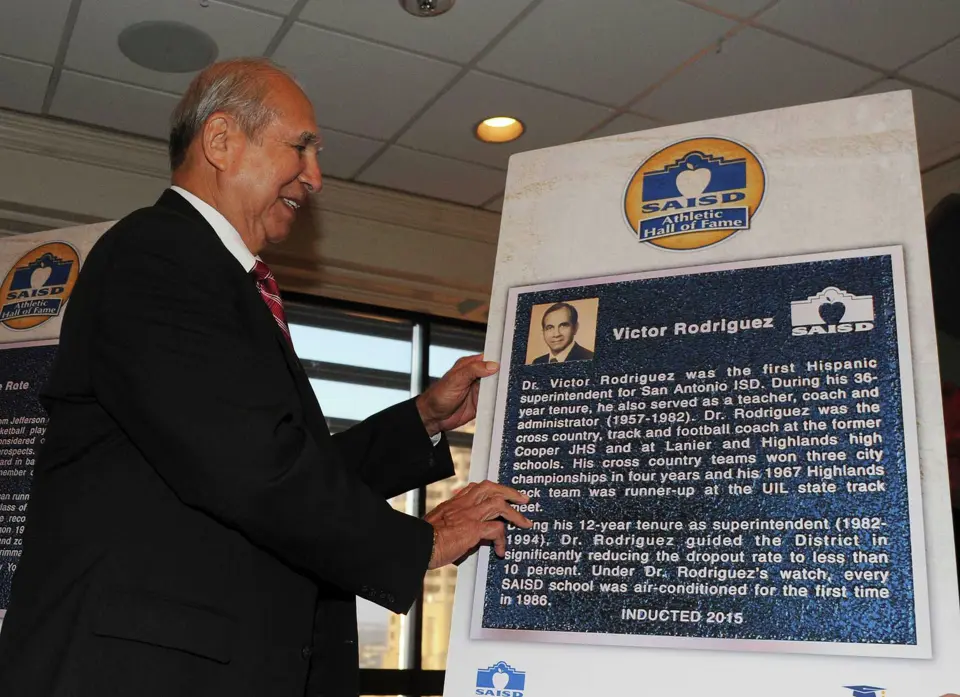
Dr. Victor Rodriguez admires a copy of a plaque that will be placed in his honor at Alamo Stadium during the first SAISD Athletic Hall of Fame Inaugural Ceremony on Saturday, Feb. 21, 2015. He coached at Lanier and Highlands high schools.
点击查看原文:Victor Rodriguez overcame poverty, prejudice to shine as track star, c
Victor Rodriguez overcame poverty, prejudice to shine as track star, c
Victor Rodriguez faced a difficult decision in 1957.
Fresh off serving two years in the Army after starring in track and cross country at North Texas as the school’s first Hispanic scholarship athlete and first Hispanic letterman, Rodriguez found himself weighing two job offers.
Impressed by his skills as a bilingual speaker, Procter & Gamble wanted him to do public relations at its Mexico City office for an annual salary of $5,500 plus benefits and all expenses paid. But prodded by his oldest sister to become a teacher in San Antonio, Rodriguez was also considering an offer of $3,000 from the San Antonio Independent School District to teach 40-plus Latino sixth graders at Cooper Junior High with either limited English-speaking ability or none at all.
From a money standpoint, Procter & Gamble seemed the way to go. But then Rodriguez thought of the difference he could make in the lives of young Hispanics as an educator.
Recalling his days as a student of a selfless elementary school teacher named Lucille Lindberg in a segregated one-room schoolhouse in Edna dubbed the “Mexican-American school” by locals, Rodriguez accepted SAISD’s offer.
“I got to thinking, ‘Where would I be today if it had not been for her?’” Rodriguez, 93, said.
Rodriguez’s decision to honor his humble roots and pay back Lindberg spawned a 36-year career with SAISD that included a memorable stint coaching cross country and track at Lanier and Highlands in the 1960s and ended with a historic 12-year run as superintendent from 1982 until he retired in 1994.
On Saturday, Rodriguez will be inducted into the San Antonio Sports Hall of Fame at the Henry B. Gonzalez Convention Center as part of a 2025 class that includes Charlie Boggess, Tim Derk, Sharon Neugebauer-Shepard and the Spurs’ 1999 NBA championship team. He has already been immortalized by North Texas and SAISD.
Off and running
Born during the Great Depression in the small South Texas ranching and farming community of Inez to an illiterate father who worked as a sharecropper sowing fields with a mule-drawn plow and a mother who toiled as a domestic worker after her husband died when her son was just 4, Rodriguez overcame poverty and racial discrimination to become one of the most respected educators in the state.
With Rodriguez heading SAISD after earning a doctorate from Texas in 1981, the district’s dropout rate plummeted from 50% to less than 10% and its teachers and other employees enjoyed the best salary and benefits package in Bexar County. He also worked to ensure each of its schools had air conditioning by 1986.
“He was a very forward thinker with a very nice style of presentation, very charismatic,” Latino sports historian Mario Longoria said of SAISD’s first Hispanic superintendent and the first Latino superintendent among the state’s 12 largest school districts.
“The respect for him cut across any racial lines, any demographics. If he had ever decided to run for mayor, he would have been elected.”
Rodriguez began breaking barriers in Edna a hundred miles west of Houston, where he and his four sisters were among the first children in the small town to advance from the fourth grade of the Mexican-American school to the Anglo school and then on to high school.
That improbable journey began with Lindberg hand-picking him for an important but taxing job.
A strong believer in civic responsibility, the young teacher placed Rodriguez on his path to greatness by tasking him with ringing the bell at St. Agnes Catholic Church each morning, a chore that required the youngster to run barefoot two miles while dodging barking dogs to wake up the rest of Edna at 5 a.m.
“Being a bell ringer is a responsibility that will teach you many things that will benefit you for the rest of your life,” Lindberg told Rodriguez.
It wasn’t the only important lesson she taught him.
“Miss Lindberg reminded us every day we lived in the greatest country in the world and if you worked hard and were willing to compete, you can be anything you want to be,” Rodriguez said.
After playing football and running track at Edna High, Rodriguez helped Victoria Junior College win the 1952 national track and field title. He was the first Hispanic to sign a scholarship at Victoria and the first to letter at the school, where he also won the junior college national championship in the half mile.
Rodriguez gained national prominence in 1953 when he ran the opening quarter mile on a North Texas sprint medley relay team that won the college section event at the prestigious Drake Relays in Des Moines, Iowa, in 40-degree rain. In 1954, he was a member of the school’s two-mile relay team that won the Kansas Relays in Lawrence.
Flying the L
While at North Texas, where he was one of only five Hispanic students, Rodriguez studied the ways of legendary Mean Green track coach Winton “Pop” Noah.
“I learned how to control your emotions, how to just do your best and not worry too much about the outcome,” Rodriguez said. “And he was a strict disciplinarian. He didn’t allow smoking or drinking or staying out late and would discipline anybody violating the rules.”
Rodriguez, who by that time had earned a master’s degree from North Texas, used many of Noah’s methods after becoming head track coach and coach of the junior varsity football team at Lanier in 1962.
The West Side high school had won boys state basketball championships in 1943 and 1945 under legendary coach Nemo Herrera but had enjoyed little athletic success since then and was nicknamed “La Garra” (the rag) “by friends and foes alike,” according to Rodriguez’s autobiography “The Bell Ringer.”
But the Voks had produced some quality track athletes, including Richard Menchaca, a state champion in the half mile in 1958. Still, Rodriguez had his work cut out for him.
“There was such a negative attitude about Lanier,” he said. “I started with the idea I needed to change their thinking.”
Rodriguez began his makeover by requiring his athletes to get regular haircuts and “look neat in appearance.”
“Before then, they had duck tails,” Rodriguez said. "I told them, ‘If you want to be a champion, you’ve got to look like a champion.’ "
And Rodriguez practiced what he preached, something his charges noticed immediately.
“He looked like an athlete,” former Lanier runner Richard Solis, 77, said. “We admired his cast. He was well-toned.”
Rodriguez also scrapped T-shirts emblazoned with “Lanier” in favor of ones sporting “Voks” with a large “L” with wings on each side. The symbol, designed by Rodriguez, who also taught art, became known as the “Lanier Flying L”.
Under their new coach, the Voks’ self-esteem soared.
“He introduced us real early to the power of positive thinking,” said Solis, who had a stint as Lanier’s principal in the 2000s.
Motivated by Rodriguez, the Voks’ cross country team won three consecutive city championships from 1964-66 after narrowly missing out on the title in 1963. In 1967, Rodriguez moved to Highlands, where he coached the Owls to second place at the state track meet behind Houston Spring Branch.
Showing Sportsmanship
Wherever Rodriguez coached or taught, he followed Lindberg’s example by encouraging his students to pursue their education well beyond what others may have expected of them. He had an impact on two of his fellow San Antonio Hall of Fame members, encouraging Fox Tech track standout Ricardo Romo and Highlands football and track star Julius Whittier to pursue athletic scholarships at major schools.
Romo and Whittier wound up at Texas, where the former became the first Longhorn to run the mile in under 4 minutes and was winner of the 1964 NCAA cross-country title and the latter became the first Black football letterman in UT history and a member of three straight Southwest Conference championship teams from 1970-72.
“He knew the value of going to college, and that’s something we had not heard much about at our high schools,” said Romo, who served as UTSA’s president from 1999-2017. "At Fox Tech, Lanier, Edgewood, your teachers didn’t encourage you to think about college. They encouraged you to be thinking about a good trade to learn.
“But he was special in that way. He thought college was important and that everybody should pursue it. He loved teaching, loved working with young people.”
As superintendent, Rodriguez gained a reputation as a man of integrity who valued accountability, honesty and transparency and wanted everyone in the district to do the same. Those traits came into play in 1993 when he made the controversial decision to disqualify Edison and Jefferson from the football playoffs after a brawl between the high schools’ players forced officials to call off their game with about two minutes left.
Rodriguez’s decision came after the District 27-5A executive committee, comprised of principals from its eight-member schools, had recommended placing Edison and Jefferson on probation for one year beginning at the start of the 1994-95 school year, which would have allowed the Golden Bears and the Mustangs to participate in the 1993 playoffs.
Rodriguez’s ruling made national headlines and marked the first time in the history of the University Interscholastic League, the organization that governs extracurricular activities at Texas public schools, that a superintendent had overruled his own executive committee.
“I learned as a coach you had to teach your youngsters sportsmanship and respect for your opponents,” Rodriguez said. “We always said, 'Win or lose, you shake hands with your competitors.”
Parents and students from both schools derided his decision, but Rodriguez stood firm and ignored the firestorm. But after the media reported the disqualification, phone calls and letters from around the nation applauding the decision flooded SAISD headquarters.
Rodriguez had made the right call - just as he did in 1957 when he chose a career in education.
By Tom Orsborn, Staff Writer, via San Antonio Express-News